
What is BGP Local Preference Attribute and How to Set It?
What is BGP Local Preference Attribute? BGP Local Preference Attribute is an optional non-transitive BGP attribute that is…
The stability and optimal performance of networks running BGP (Border Gateway Protocol) rely heavily on preventing routing loops. Loops can lead to suboptimal routing, congestion, and instability.
Understanding techniques to avoid loops is critical for effective BGP operations. Preventing loops should be a top priority for network administrators operating BGP networks.
Routing loops can cause a variety of major issues including traffic blackholes, congestion, and routing table inflation. This significantly degrades network performance and availability.
BGP loops can seriously impact user experience and disrupt business operations. Therefore, implementing mechanisms to prevent loops is essential for optimal BGP routing.
This post will provide an overview of BGP loops, examine their causes, discuss their effects, and explore key techniques like split horizon, route reflection, and route dampening to prevent loops.
The goal is to give network engineers a comprehensive guide to avoiding BGP loops.
A BGP loop occurs when routers continuously pass traffic between each other looking for the destination network. This creates a problematic circular path that packets traverse endlessly, never reaching the intended destination. BGP loops lead to wasted bandwidth and poor network connectivity.
Several common factors can lead to the formation of BGP loops:
BGP loops degrade network performance and health severely:
Split horizon prevents problematic route feedback. When a router learns a route from a neighbor, it avoids advertising that route back to the same neighbor. This simple yet effective mechanism avoids potential loops.
Split horizon is quite effective at preventing simple BGP loops between two adjacent routers. If router R1 learns a route from R2, R1 will not advertise the route back to R2, breaking the loop. This simple coordination eliminates basic loops.
Route reflection allows routers to propagate routes learned from their clients to other clients avoiding full mesh iBGP sessions. Route reflectors reflect learned routes selectively following certain rules to prevent loops. This enables scaling while preventing loops.
Route reflection prevents complex iBGP looping scenarios by carefully controlling route propagation among clients via the route reflection rules:
This ensures efficient iBGP scaling without routing loops occurring.
Route dampening minimizes instability by temporarily suppressing problematic fluctuating routes through an exponential penalization system before readvertising them. This calms oscillations.
Route dampening helps avoid vicious loops caused by route flapping. By penalizing and suppressing unstable routes, route dampening breaks loops caused by pathological route fluctuation.
BGP loop prevention is critical for optimal network operations. Techniques like split horizon, route reflection, and dampening are invaluable for avoiding both simple and complex loops.
Network engineers must actively utilize the comprehensive loop prevention techniques and guidelines covered here to optimize BGP stability, reachability, and performance. Prioritizing loop prevention should be a key focus area.
Hand-picked articles you might also find useful.
 BGP
BGP What is BGP Local Preference Attribute? BGP Local Preference Attribute is an optional non-transitive BGP attribute that is…
 BGP
BGP BGP flapping is a session or prefix repeatedly going up and down. Here are the real causes, the…
 BGP
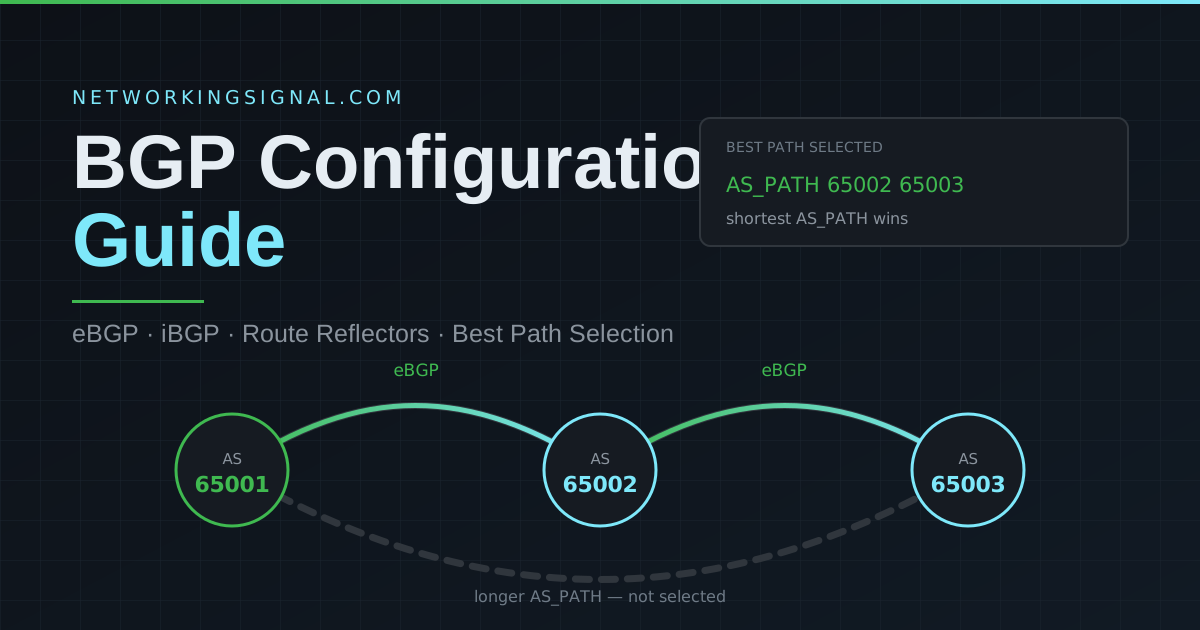
BGP A complete BGP configuration guide with real Cisco IOS commands — configure eBGP and iBGP peering, fix next-hop…