
What is BGP Authentication? Detail Explained
What is BGP Authentication? BGP authentication is the process of verifying the authenticity of BGP routing information. This…
BGP Route Reflector is a feature in the Border Gateway Protocol (BGP) that allows BGP routers to exchange routing information without having to establish peer-to-peer sessions. This reduces the number of BGP sessions that need to be established, which can save on CPU and memory resources.
BGP Route Reflector is especially useful in large BGP networks, where there may be hundreds or even thousands of BGP routers. By using the BGP Route Reflector, the number of BGP sessions can be reduced to a manageable level.
If you are running a large BGP network, or if you are considering implementing BGP Route Reflector, there are a few things you should keep in mind.
Here are some of the benefits of using BGP Route Reflector:
The best way to check if BGP Route Reflector is working as expected is to use a tool like BGPMon. BGPMon is a free, open-source tool that allows you to monitor BGP routes in real-time.
If you see unexpected changes in your BGP routing table, or if you see routes disappearing or appearing, you can use BGPMon to investigate the cause.
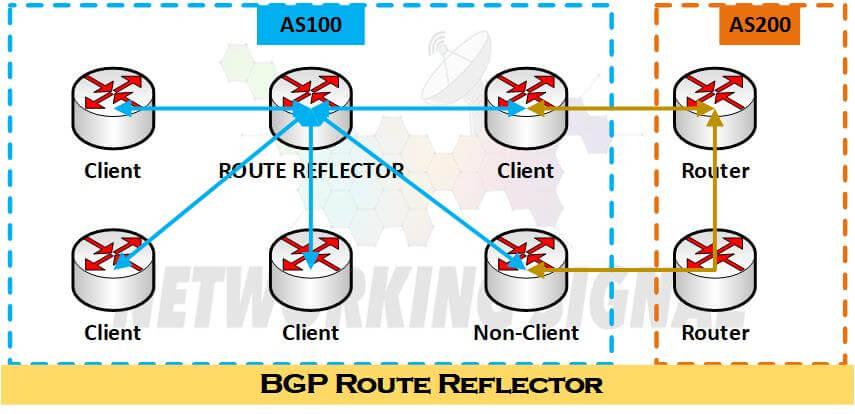
Here are the steps to configure BGP Route Reflector:
Example:
RouterA(config)# bgp cluster-id 100
RouterA(config)# bgp client-to-client reflection
RouterB(config)# bgp cluster-id 100
RouterB(config)# bgp client-to-client reflection
RouterC(config)# bgp cluster-id 100
RouterC(config)# bgp client-to-client reflection
In the example above, we have configured three BGP routers RouterA, RouterB, and RouterC to use BGP Route Reflector. We have also assigned a unique cluster ID of 100 to all three routers.
Now, when a route reflector client says RouterA sends its routes to the route reflector RouterB those routes will be reflected back to all the other clients, including RouterA.
Here are some use cases of BGP route reflectors that can be helpful for your understanding.
BGP route reflectors are commonly used in service provider networks. By using a route reflector, service providers can confine the IBGP full mesh requirement to a small set of route reflector clients and servers. This results in a significant reduction in the IBGP meshing requirements and the number of TCP sessions that must be maintained.
BGP route reflectors can also be used in enterprise networks.
BGP route reflectors can also be used in small networks where it is not practical to configure a full IBGP mesh. In this case, the route reflector can be used to confine the IBGP full mesh requirement to a single router.
Hand-picked articles you might also find useful.
 BGP
BGP What is BGP Authentication? BGP authentication is the process of verifying the authenticity of BGP routing information. This…
 BGP
BGP BGP explained — what the Border Gateway Protocol does, its path attributes, the neighbour state machine, and how…
 BGP
BGP When it comes to routing between autonomous systems, the discussion instantly turns to Internet Border Gateway Protocol (IBGP)…