
Where are MPLS labels placed within a frame?
Where are MPLS labels placed within a frame? MPLS labels placed within a frame between the layer 2…

Multi-Protocol Label Switching (MPLS) is a type of data-carrying technique for high-performance telecommunications networks that direct data from one network node to the next based on short path labels rather than long network addresses, avoiding complex lookups in a routing table.
The labels identify virtual links (paths) between distant nodes rather than endpoints. MPLS can be used to create a virtual private network (VPN) by dynamically routing packets across the Internet.
MPLS is implemented in software, firmware, or hardware and can be used in conjunction with other networking technologies, such as routers, switches, optical transport systems, security devices, and servers. MPLS works best in networks that have been designed using traffic engineering principles.
See Also: How MPLS Works and How do Labels Forwarding in MPLS?
MPLS was first proposed in the late 1990s by a team of network engineers at Cisco Systems. The goal was to create a layer 2 switching technology that could be used to improve the performance of IP networks. MPLS was standardized by the Internet Engineering Task Force (IETF) in 2004 and has since been adopted by major networking equipment vendors.
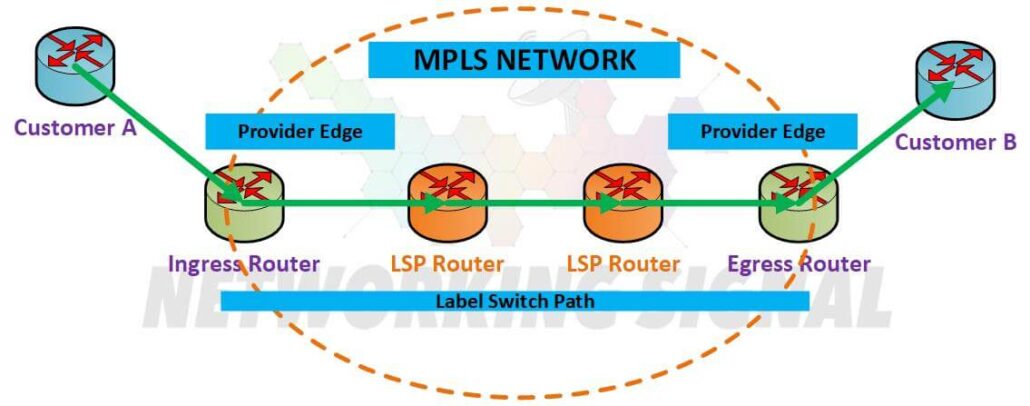
MPLS networks consist of the following components:
Label Edge Routers (LERs): LERs are routers that are located at the edge of an MPLS network. They are responsible for forwarding packets into and out of the MPLS network.
Label Switching Routers (LSRs): LSRs are routers that are located in the core of an MPLS network. They are responsible for forwarding packets between LERs.
Label Switched Paths (LSPs): LSPs are logical paths that are created by LSRs to forward packets between LERs. LSPs can be created statically (by network administrators) or dynamically (by the LSRs themselves).
Labels: Labels are short, fixed-length identifiers that are used by LSRs to forward packets along an LSP. The size of a label (in bits) is determined by the particular MPLS implementation. A label is 4 bytes long in MPLS.
MPLS provides many benefits over traditional data-carrying techniques, such as:
Increased bandwidth: MPLS can increase the bandwidth of a network by using short path labels instead of long network addresses. This allows for more efficient use of bandwidth and can result in increased throughput and higher speeds.
Reduced latency: MPLS can reduce latency by using shorter path labels. This allows data to be routed more quickly and can result in lower latency and improved performance.
Improved security: MPLS can improve security by using encryption and other security measures to protect data as it is routed across the network.
Improved reliability: MPLS can improve reliability by using redundancy and other methods to ensure that data is routed correctly even if some part of the network fails.
Improved scalability: MPLS can improve scalability by allowing for more efficient use of bandwidth and by supporting a larger number of virtual private networks (VPNs).
Here are the points of the relationship between MPLS and SDWAN:
MPLS is important in ISP networks for the following reasons:
Hand-picked articles you might also find useful.
 MPLS
MPLS Where are MPLS labels placed within a frame? MPLS labels placed within a frame between the layer 2…
 MPLS
MPLS MPLS is a protocol for speeding up the forwarding of packets through a network. It does this by…
 MPLS
MPLS The Cisco MPLS Multi VRF Lab is a dynamic and cutting-edge network technology environment designed to explore the…