
SOAP vs REST: Comparison of Web Services APIs
What is API? API stands for Application Programming Interface. It is a set of routines, protocols, and tools…
In computing, network traffic is the amount of data sent and received by a computer over a network. It can be measured in terms of bitrate or bandwidth. Network traffic is often classified into different categories, such as web traffic, email traffic, file transfer traffic, and so on.
Some common causes of high network traffic include downloading large files, streaming video or audio, and visiting websites with lots of images. Traffic can also be caused by malicious software, such as viruses and worms, that propagate themselves by sending copies to other computers on the network.
There are two main types of network traffic: unicast and multicast.
Unicast traffic is sent from one computer to another specific computer. This is the most common type of traffic on the Internet and includes things like web browsing, email, and file transfers.
Multicast traffic is sent from one computer to a group of computers. This is often used for streaming media, such as audio or video, and can be inefficient if there are a lot of members in the group who are not interested in the data being sent.
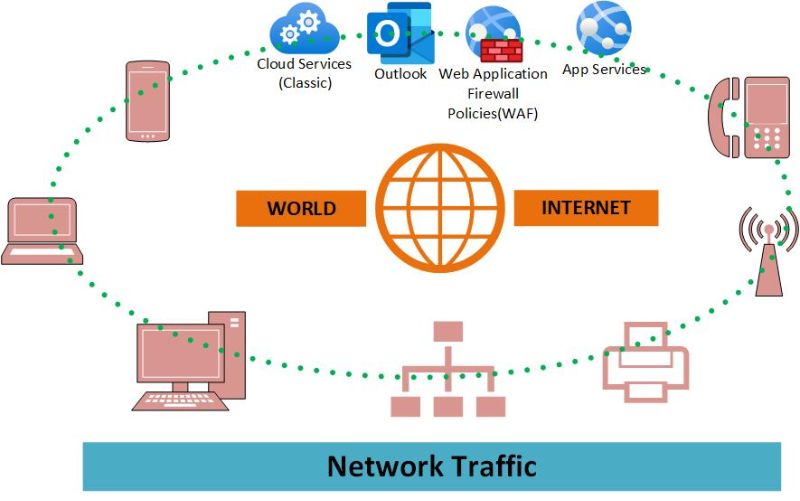
Network traffic typically flows in one of two directions: ingress or egress.
Ingress traffic is data that is coming into a network from the outside.
Egress traffic is data that is flowing out of a network to the outside.
Some types of traffic can flow in both directions at the same time. For example, when you are browsing the web, you are both downloading data (ingress traffic) and sending data (egress traffic).
Network traffic can be measured in a number of ways, but the two most common methods are bitrate and bandwidth.
Bitrate is a measure of the number of bits (pieces of data) that are being transferred per second. It is typically measured in kilobits per second (kbps) or megabits per second (Mbps).
Bandwidth is a measure of the amount of data that can be transferred in a given period of time. It is typically measured in bits per second (bps) or bytes per second (Bps).
Network traffic is important because it can have a big impact on the performance of a computer network. If there is too much traffic, it can cause the network to become congested and slow down. In extreme cases, it can even cause the network to crash.
That’s why it’s important to monitor network traffic and be aware of what is causing high traffic levels. By doing this, you can avoid or fix problems that can lead to poor network performance.
Monitoring network traffic can help identify problems, such as bottlenecks, and can be used for troubleshooting.
For example
Network traffic can be monitored using various tools, such as packet sniffers and traffic analyzers. These tools can be used to view traffic in real time or can be used to analyze logging data.
Network traffic analysis and monitoring are important for a number of reasons:
Monitoring network traffic can be a complex task, but it is important for the smooth operation of networks. By understanding what network traffic is and how it can be monitored, you can make sure that your network runs smoothly and efficiently.
Hand-picked articles you might also find useful.
 Routing & Switching
 What is API? API stands for Application Programming Interface. It is a set of routines, protocols, and tools…
 Routing & Switching
 Running config lives in RAM and is lost on reboot; startup config lives in NVRAM and survives. How…
 Routing & Switching
 Built-in ways to see network usage on Windows — Task Manager, Resource Monitor, Settings data usage and PowerShell…
One response to “What is Network Traffic, its Types, and How is it Measured?”
[…] and software to perform their tasks. They are typically designed to work with a specific type of network traffic, such as Ethernet or […]