
Ethernet Splitter vs Switch: Which is the Good?
An Ethernet Splitter and an Ethernet Switch are two different devices that can offer a variety of capabilities…
There is one right order for most people, and it depends on a single question: do you already have an IT job?
No job yet. Take CompTIA Network+ first. It is vendor neutral, it teaches the fundamentals every other certification assumes, and it satisfies the US Department of Defense 8140 requirements, which opens government and contractor roles.
Already working in IT. Skip straight to Cisco CCNA. It is the credential hiring managers actually recognise for network roles, and it goes deeper than Network+ on the things you will be doing.
Two to three years in. Add a cloud networking credential such as AWS Advanced Networking. This is where the salary difference is in 2026, because most companies now run hybrid networks and few engineers understand both sides.
CCNP when you want to move into senior or design roles. CCIE only if you are certain you want to be a deep specialist.
| Certification | Level | Vendor | Exam cost | Valid | Take it when |
|---|---|---|---|---|---|
| CompTIA Network+Start here | Entry | Neutral | Around $369 | 3 years | No IT job yet |
| Cisco CCNABest value | Associate | Cisco | Around $300 | 3 years | First network role |
| AWS Advanced NetworkingBest for salary | Specialty | AWS | Around $300 | 3 years | 2 to 3 years in |
| Cisco CCNP EnterpriseSenior roles | Professional | Cisco | Around $800 total | 3 years | Design and lead work |
| Juniper JNCIA-JunosCheapest | Associate | Juniper | Around $200 | 3 years | Service provider work |
Exam prices and codes change. Confirm current figures on the vendor’s own site before booking.
The most common mistake is collecting certifications rather than following a path. Three or four unrelated badges look worse to an interviewer than one credential plus real depth, because they suggest someone chasing exams rather than building skill.
Both are entry level and they are not equivalent.
Network+ is broad and vendor neutral. It covers the OSI model, cabling, addressing, routing and switching concepts, wireless, security fundamentals and troubleshooting method, without teaching any manufacturer’s command line. That is genuinely valuable groundwork, and it is why it appears on so many job listings.
Its other advantage is bureaucratic and real. Network+ satisfies the US Department of Defense workforce requirements, so government and defence contractor roles frequently list it as mandatory. If those jobs are on your list, this is not optional.
CCNA is narrower and deeper. It covers similar ground plus Cisco IOS configuration, and it expects you to actually configure things rather than describe them. It has more weight with hiring managers for network specific roles, simply because Cisco equipment is everywhere.
The honest rule: if you already work in IT, CCNA on its own is enough and Network+ adds little. If you are switching careers with no IT job, Network+ first gives you the vocabulary that makes CCNA study far less painful, and it is easier to pass, which matters for momentum.
This is the part worth understanding before spending a year studying.
Traditional routing and switching is still the foundation and it is no longer a differentiator. Plenty of people hold a CCNA. What separates candidates is being able to configure and troubleshoot rather than recite, which is what a CCNA home lab is for.
What is scarce is engineers who understand both traditional networking and cloud networking. Nearly every company now runs a hybrid network: some equipment on premises, some workloads in AWS or Azure, connected by VPN or a dedicated circuit.
The people who can design and troubleshoot across that boundary are genuinely hard to hire, and that is reflected in what they are paid.
So the sequence that pays is CCNA, then two years of real work, then a cloud networking specialty. Not CCNA then CCNP then CCIE, unless you specifically want to be a deep Cisco specialist, which is a legitimate and well paid path but a narrower one.
Configuring devices one at a time by hand is becoming the exception in larger networks. Python, Ansible and network APIs are now expected in mid level and senior roles. A config backup script is the easiest way in, and our Netmiko tutorial walks through a working one.
You do not necessarily need a certification for this. A public repository of scripts that solve real problems demonstrates it more convincingly than an exam does. But knowing enough Python to parse configuration output and push changes across fifty devices is now a baseline senior skill rather than a bonus.
Almost every certification here expires after three years.
Cisco renews through continuing education credits or by passing another exam. CompTIA renews through its continuing education programme, which carries an annual fee, or by passing a higher certification, which also renews the lower ones.
That means a certification is not a one time cost. Budget for renewal, and prefer stacking upward, since passing CCNP renews CCNA and passing a higher CompTIA exam renews Network+.

The right first certification for anyone without an IT job, and largely redundant for anyone who already has one.
It covers networking fundamentals without any vendor’s syntax: the OSI model, addressing and subnetting, routing and switching concepts, wireless, cloud networking basics, security fundamentals and a structured troubleshooting method.
Being vendor neutral is the point. You learn how networks work rather than how one manufacturer’s command line works, and that transfers to Cisco, Juniper, Aruba, Fortinet or any cloud platform.
The DoD 8140 approval is the practical advantage. Roles with the US government or its contractors frequently require an approved certification, and Network+ is one. If that sector interests you, this is a hard requirement rather than a preference.
It is also easier than CCNA. That matters more than pride: passing something builds momentum, and failing an expensive exam early puts people off entirely.
The Sybex study guide covers the N10-009 objectives with practice questions, and is the standard preparation text alongside video courses.
Be honest about its limits. It teaches concepts, not configuration. You will finish able to explain how OSPF works and unable to configure it on anything. That is why CCNA follows it rather than replacing it.
Renewal is through CompTIA’s continuing education programme with an annual fee, or automatically by passing a higher CompTIA certification.
Take this if you have no IT job yet or want government and defence roles.

The single most useful certification in networking, and the one most job adverts for network roles actually name.
It covers network fundamentals, access, IP connectivity, IP services, security fundamentals, and automation and programmability, and it expects configuration rather than description. You will be asked what a command does and what to type to achieve something.
That practical bias is why it carries weight. A hiring manager reading CCNA on a CV assumes you have logged into a switch and made it do something, which they cannot assume from a purely conceptual certification.
The automation and programmability section is the modern addition worth noting. Cisco added it because the industry moved, and it signals where the field is going even at associate level.
How to prepare. The Official Cert Guide library is two volumes and is the standard text. Reading it is not enough. You need hands on practice, and there are three ways: Cisco Packet Tracer, which is free and adequate for CCNA; GNS3 or EVE-NG with real IOS images, which is closer to reality; or second hand physical switches, which teach cabling and console access properly.
Budget three to six months of consistent study. People who pass in six weeks usually had relevant experience already.
The Sybex kit at $35.26 is a cheaper alternative with practice tests, and many people use both.
Renewal is by continuing education credits or by passing another Cisco exam, and passing CCNP renews it automatically.
Take this for your first or second network role. It is the highest return per hour studied.

This is where the salary difference is, and it is the certification most network engineers put off for too long.
It covers VPC design, hybrid connectivity through Direct Connect and VPN, Transit Gateway architectures, DNS at scale with Route 53, load balancing, and network security and monitoring in the cloud.
The scarcity is the point. Plenty of people understand traditional networking. Plenty understand cloud. Few understand the boundary between them, and that boundary is where hybrid networks break.
When on premises routing does not reach a cloud subnet, or DNS resolves differently on each side, or a Direct Connect fails over badly, the person who can diagnose it across both worlds is rare and valued accordingly.
Do not take this early. It assumes solid networking fundamentals and real AWS experience. Attempting it without both means memorising service names rather than understanding architecture, which the exam is designed to catch.
Two to three years into a network role, with CCNA behind you and some real exposure to cloud infrastructure, is the right moment.
The Sybex ANS-C01 guide is the current standard text. The older official study guide at $8.85 covers an earlier exam version, so it is useful background reading but should not be your primary preparation.
Azure has an equivalent path, and if your employer runs Azure, take that instead. The skill transfers; the exam does not.
Take this two to three years in, once CCNA and real cloud exposure are behind you.

The step from doing the work to designing it. Take it when you want senior, lead or design responsibility.
The structure is two exams: the ENCOR core exam covering enterprise infrastructure, virtualisation, security, automation and assurance, plus one concentration exam in an area you choose such as advanced routing, SD-WAN, wireless or automation.
That structure is genuinely good, because it lets you specialise while proving broad competence. Choose the concentration that matches where you want to work rather than the one that looks easiest.
The core exam is shared with CCIE Enterprise, so passing ENCOR is also the written requirement toward CCIE if you go that far.
Passing CCNP renews CCNA automatically, which is worth factoring into the cost. Two exams at roughly $400 each is not cheap, and removing a separate CCNA renewal takes some of the sting out.
Study time is significant. Six to twelve months for most people working full time, and the ENCOR exam has a reputation for breadth: it asks about many topics at moderate depth rather than a few in detail.
The Official Cert Guide is the standard text. The Fast Track guide at $29.99 is a useful supplement with decision tables and troubleshooting cues, but it is not sufficient on its own for an exam this broad.
Consider whether you want this. It deepens Cisco expertise, which pays well and is narrower than adding cloud skills. If you want to be a Cisco specialist, take it. If you want to be broadly employable, take the cloud path first.
Take this when you want design and lead work and have chosen the Cisco specialist path.

The cheapest way into a vendor certification, and genuinely valuable in one specific part of the industry.
Juniper equipment is heavily used by internet service providers, telecommunications carriers and large data centres. In those environments, Junos knowledge is worth more than Cisco IOS knowledge, and far fewer engineers have it.
JNCIA-Junos covers networking fundamentals, the Junos operating system, user interfaces, configuration basics, operational monitoring and routing fundamentals.
Junos is a genuinely different operating system, not a variation on IOS. It uses a hierarchical configuration with commit and rollback, which means you stage changes and apply them atomically, and you can roll back to a previous configuration with one command. Anyone who has broken a network with a half applied change will appreciate why that matters.
Learning it also makes you a better engineer generally, because seeing a second approach separates the concepts from one vendor’s implementation of them.
Juniper periodically runs free or heavily discounted voucher promotions through its learning portal, so check before paying full price.
The limitation is demand. Outside service providers and large data centres, most enterprise job adverts name Cisco. If you are aiming at ordinary corporate network roles, CCNA is the better first vendor certification and this is a strong second.
Preparation material is thinner than Cisco’s, though Juniper’s own documentation is excellent and free, and vSRX and vMX images allow lab practice.
Take this if you are aiming at service providers or large data centres, or as a strong second vendor.
If you already work in IT, go straight to CCNA, because Network+ adds little you will not learn anyway. If you are changing careers with no IT job, take Network+ first for the vocabulary and the easier pass, and because it satisfies US Department of Defense requirements that some employers treat as mandatory.
Cloud networking specialties such as AWS Advanced Networking, because engineers who understand both traditional and cloud networking are scarce and hybrid networks are now the norm. CCIE pays well too, but it is a much longer path with narrower application.
Yes, almost all of them after three years. Cisco renews through continuing education credits or another exam, CompTIA through a continuing education programme with an annual fee. Passing a higher certification usually renews the lower ones automatically, so stacking upward saves money.
It gets interviews, not offers. A certification proves you studied; employers hire for demonstrated ability. Build a home lab, document what you built, and be able to explain a problem you diagnosed. That combination converts far better than a certification alone.
Increasingly, yes. Configuring devices one at a time is becoming the exception in larger networks, and Python, Ansible and network APIs are expected in mid level and senior roles. You do not need a certification for it, and a public repository of working scripts demonstrates it more convincingly.
Only if you want to be a deep specialist. It is expensive, requires a demanding practical lab exam, and takes years. It commands high salaries in specific consulting and large enterprise roles. For most engineers, CCNP plus cloud skills opens more doors for far less effort.
Follow the path rather than collecting badges. No IT job: Network+ first, then CCNA. Already in IT: CCNA directly, and skip Network+ unless a specific employer requires it.
Then work for two or three years and add a cloud networking specialty. That combination, real networking depth plus cloud, is where the shortage is and where the salary difference shows.
Take CCNP when you want design and lead responsibility and have decided the Cisco specialist path suits you. Take JNCIA-Junos if you are heading for service providers or want a genuinely different second platform.
And remember what a certification actually does: it gets you the interview. What gets you the job is being able to explain something you built and something you fixed. For a fuller side by side breakdown, see our networking certifications compared guide.
Disclosure: Networking Signal is a participant in the Amazon Services LLC Associates Program. We earn a commission on qualifying purchases of study materials linked on this page, at no additional cost to you. Book prices were accurate at the time of writing and may change. Exam fees, exam codes and renewal policies are set by each certification body and change regularly, so confirm current details on the vendor’s own site before booking. We are not affiliated with Cisco, CompTIA, Amazon Web Services or Juniper Networks.
Hand-picked articles you might also find useful.
 Routing & Switching
 An Ethernet Splitter and an Ethernet Switch are two different devices that can offer a variety of capabilities…
 Routing & Switching
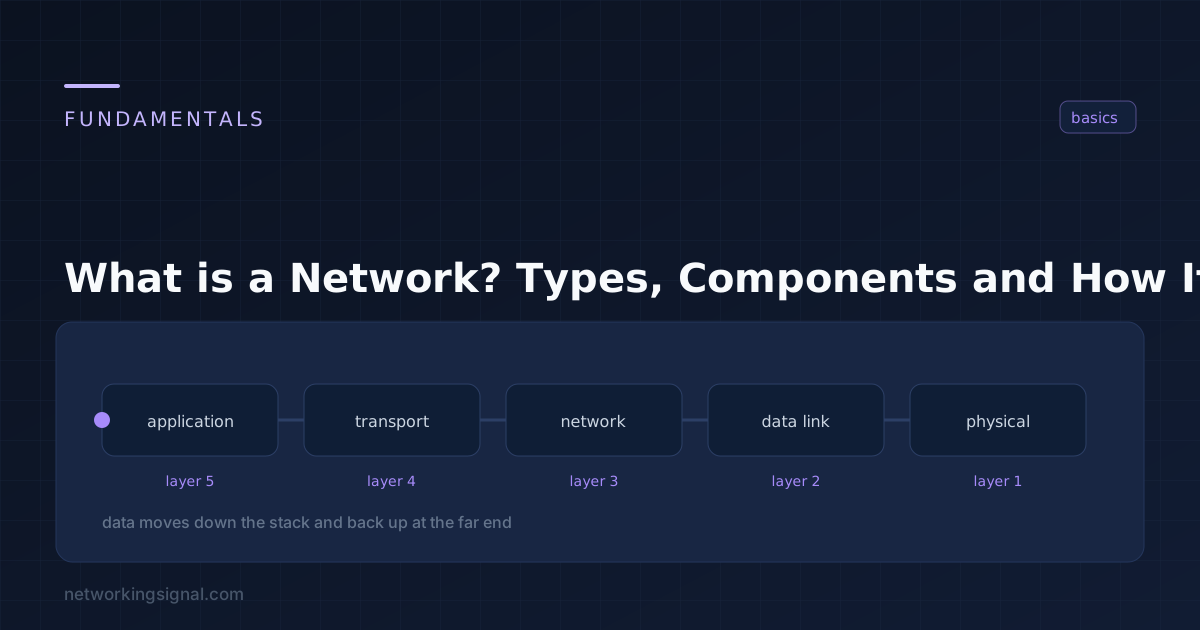
 A network is two or more devices linked so they can exchange data. Here are the network types…
 Routing & Switching
 Mesh topology explained — the difference between full and partial mesh, why the link count grows so fast,…