
Understanding Asymmetric Routing in Computer Networks
In the vast landscape of computer networks, various complex phenomena influence the efficiency and reliability of data transmission.…
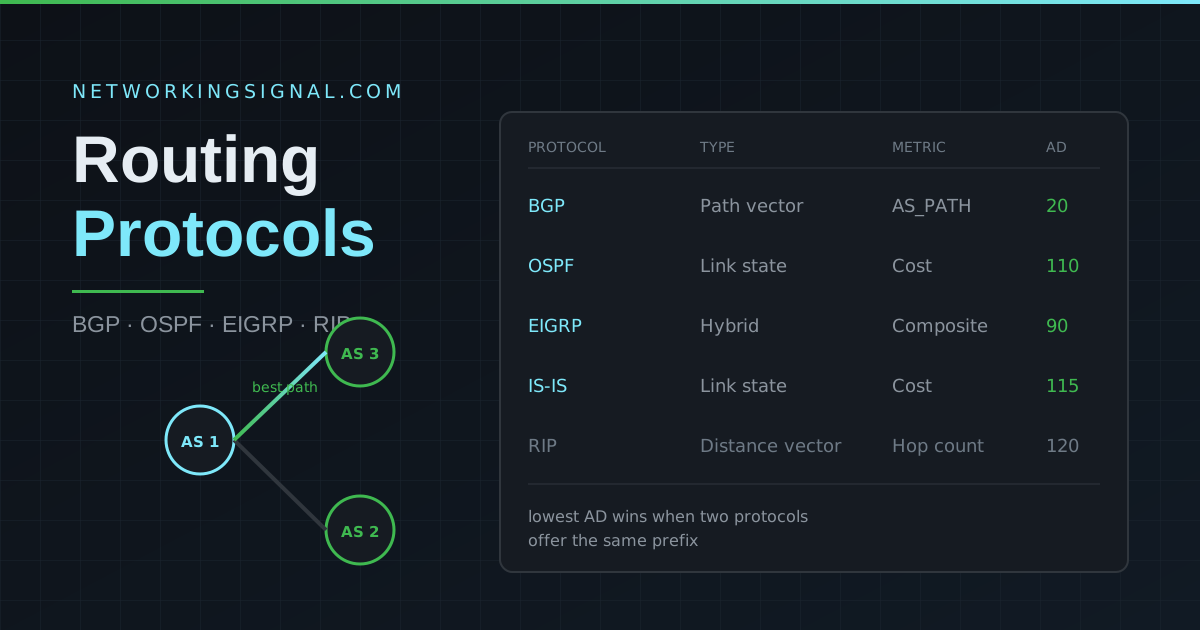
Routing protocols are algorithms that determine the best path for data to travel across a network. The two main categories are Interior Gateway Protocols (IGPs) like OSPF and EIGRP used inside a single AS, and Exterior Gateway Protocols (EGPs) like BGP used between different Autonomous Systems on the internet.
A routing protocol is a set of rules that routers use to discover network paths, share routing information with each other, and determine the best path to forward packets. Without routing protocols, routers would only know about directly connected networks, they would have no idea how to reach distant destinations.
Every routing protocol must solve the same fundamental problem: given a destination IP address, what is the best next hop to forward this packet toward its destination?
Before diving into specific protocols, understand the fundamental choice:
| Feature | Distance Vector | Link-State |
|---|---|---|
| Algorithm | Bellman-Ford | Dijkstra (SPF) |
| View | Knows direction + distance | Complete network map |
| Examples | RIP, EIGRP | OSPF, IS-IS |
| Convergence | Slower | Faster |
| CPU/Memory | Lower | Higher |
| Updates | Periodic full table | Event-driven LSA flooding |
| Feature | IGP (Interior) | EGP (Exterior) |
|---|---|---|
| Scope | Within one AS | Between different ASes |
| Examples | OSPF, EIGRP, RIP, IS-IS | BGP |
| Metric | Cost, bandwidth, delay | Policy-based attributes |
| Scale | Thousands of routes | 900,000+ internet routes |
BGP is the routing protocol of the internet, it connects Autonomous Systems (ASes) across the globe. Every major ISP, cloud provider, and large enterprise runs BGP.
Key facts:
BGP Cluster on this site:
OSPF is the most widely deployed IGP for enterprise networks. It is an open standard (RFC 2328) link-state protocol that uses Dijkstra’s SPF algorithm to calculate the shortest path to every destination.
Key facts:
OSPF Cluster on this site:
EIGRP is Cisco’s advanced distance-vector protocol using the DUAL (Diffusing Update Algorithm). It was Cisco-proprietary until 2013 when it was partially opened as an informational RFC.
Key facts:
RIP is the simplest dynamic routing protocol and one of the oldest. It uses hop count as its only metric (max 15 hops, 16 = unreachable).
RIP is rarely used in production today, OSPF and EIGRP converge faster and scale far better. It is still tested on CCNA exams as a foundational concept.
IS-IS is a link-state protocol similar to OSPF. It runs directly over Layer 2 (not IP), making it extremely scalable. It is the preferred IGP for large ISP backbone networks and is widely used by Tier 1 providers.
| Protocol | Type | Algorithm | Transport | AD | Best For |
|---|---|---|---|---|---|
| BGP | EGP | Path-vector | TCP 179 | 20 (eBGP) / 200 (iBGP) | Internet, multi-homing |
| OSPF | IGP | Link-state (Dijkstra) | IP 89 | 110 | Enterprise networks |
| EIGRP | IGP | Advanced distance-vector (DUAL) | IP 88 | 90 (internal) | Cisco networks, fast convergence |
| RIP | IGP | Distance-vector (Bellman-Ford) | UDP 520 | 120 | Small labs, legacy |
| IS-IS | IGP | Link-state (Dijkstra) | Layer 2 | 115 | ISP backbones |
| Static | — | Manual | — | 1 | Small nets, default routes |
Administrative Distance (AD) determines which routing protocol’s routes are preferred when multiple protocols advertise the same prefix. Lower AD wins.
When multiple routing protocols run in the same network, route redistribution imports routes from one protocol into another. Always set appropriate metrics when redistributing to avoid routing loops and suboptimal paths.
CEF is Cisco’s high-performance packet switching mechanism, enabled by default on all modern Cisco platforms. It uses the FIB (Forwarding Information Base) and Adjacency Table to forward packets in hardware without CPU involvement.
Asymmetric routing occurs when forward and return traffic take different paths. This breaks stateful firewalls and NAT, always design for symmetric routing in enterprise networks.
OSPF is the industry standard choice for most enterprise networks, it is vendor-neutral, scales well, and converges quickly. Use EIGRP if your network is 100% Cisco and you need faster convergence with simpler configuration. Use BGP when connecting to multiple ISPs or cloud providers.
eBGP (External BGP) runs between routers in different Autonomous Systems, typically between your network and your ISP. iBGP (Internal BGP) runs between routers within the same AS to distribute external routes internally. iBGP requires a full mesh or route reflectors.
OSPF Area 0, also called the backbone area, is mandatory in any multi-area OSPF network. All other OSPF areas must connect directly to Area 0 via an Area Border Router (ABR). Inter-area traffic must always transit Area 0.
Yes. You can run multiple routing protocols simultaneously and use route redistribution to share routes between them. This is common in networks transitioning between protocols or using different protocols in different parts of the network.
Hand-picked articles you might also find useful.
 Routing
 In the vast landscape of computer networks, various complex phenomena influence the efficiency and reliability of data transmission.…
 Routing
 What is Default Routing in Networking? Default routing, also known as static routing , is an IP routing…
 Routing
 What is SDWAN? SDWAN is a software-defined networking technology that allows for the creation of virtualized network overlays.…