
Stateful vs Stateless Firewall — Differences, Uses and Which to Deploy
A stateless firewall checks each packet against static rules; a stateful firewall tracks connections and permits return traffic…
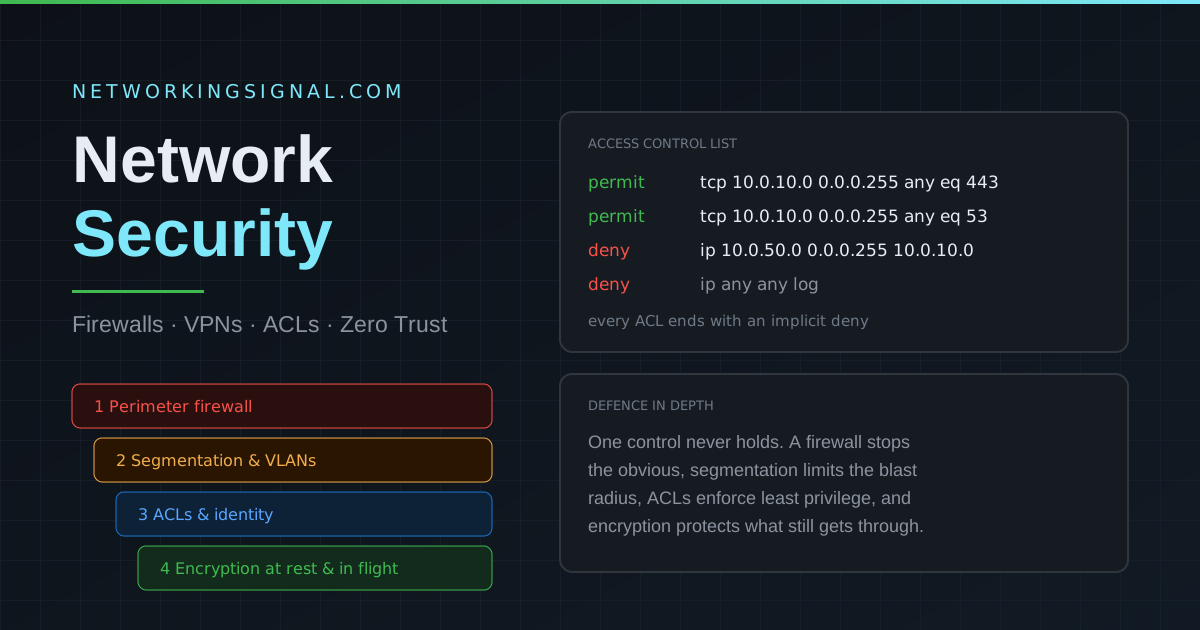
Network security protects the integrity, confidentiality, and availability of a network and its data. It encompasses firewalls, VPNs, access control, intrusion detection, encryption, and architectural principles like Zero Trust, all working together to defend against unauthorized access, attacks, and data breaches.
Every security decision maps back to three core principles:
| Threat Category | Examples | Layer |
|---|---|---|
| Reconnaissance | Port scanning, network sniffing | Multiple |
| DoS/DDoS | SYN flood, UDP flood, ICMP flood | L3/L4 |
| Man-in-the-Middle | ARP spoofing, DNS spoofing, SSL stripping | L2/L3/L7 |
| Layer 2 Attacks | MAC flooding, VLAN hopping, DHCP exhaustion | L2 |
| Social Engineering | Phishing, pretexting, vishing | Human |
| Malware | Ransomware, trojans, worms | Host/App |
| Password Attacks | Brute force, dictionary, credential stuffing | Application |
A firewall controls traffic entering and leaving a network segment based on rules. Two fundamental types:
ACLs are ordered permit/deny rules applied to router interfaces to filter traffic:
Key rules: Processed top-down (first match wins). Implicit deny all at the end. Always keep at least one permit statement.
VPNs create encrypted tunnels over public networks, allowing secure communication between remote locations or users.
Authentication Header (AH), Protocol 51. Provides integrity and authentication but NO encryption. Incompatible with NAT.
ESP (Encapsulating Security Payload), Protocol 50. Provides encryption, integrity, and authentication. Most commonly used in practice.
IPSec modes: Transport mode (host-to-host, only payload encrypted) | Tunnel mode (gateway-to-gateway, entire original packet encapsulated and encrypted).
Zero Trust is a security model based on the principle: “Never trust, always verify.” No user or device is trusted by default, even inside the corporate network. Every access request must be authenticated, authorized, and continuously validated.
Zero Trust pillars:
IDS (Intrusion Detection System) monitors network traffic for suspicious patterns and alerts administrators. It is passive, does not block traffic.
IPS (Intrusion Prevention System) sits inline and actively blocks malicious traffic in real time. NGFW appliances combine firewall + IPS in a single device.
Network segmentation divides a network into isolated zones, limiting an attacker’s movement if they breach one segment.
DMZ (Demilitarized Zone): A network segment between the internet and the internal network. Public-facing servers (web, email, DNS) live in the DMZ, separate from internal resources. If a DMZ server is compromised, the internal network is not directly accessible.
Segmentation methods: VLANs, physical separation, firewalls between zones, microsegmentation (software-defined).
| Protocol | Port | Purpose |
|---|---|---|
| SSH | 22 | Encrypted remote device management (replaces Telnet) |
| HTTPS / TLS | 443 | Encrypted web traffic |
| IPSec/IKEv2 | 500, 4500 | VPN tunneling and encryption |
| RADIUS | 1812, 1813 | Centralized AAA for network access (802.1X) |
| TACACS+ | 49 | Cisco AAA for device management access |
| SNMP v3 | 161, 162 | Encrypted network monitoring |
| Syslog | 514 | Centralized logging for security events |
IDS (Intrusion Detection System) is passive, it monitors and alerts but does not block traffic. IPS (Intrusion Prevention System) is inline and active, it detects and blocks malicious traffic in real time. Modern NGFWs include integrated IPS functionality.
AAA stands for Authentication (who are you?), Authorization (what are you allowed to do?), and Accounting (what did you do?). RADIUS handles AAA for network access (WiFi, VPN, 802.1X). TACACS+ handles AAA for device management access (SSH into routers and switches).
Traditional perimeter security trusts everything inside the corporate network by default, once you breach the firewall, you have broad access. Zero Trust eliminates the concept of a trusted inside network, every access request is verified regardless of origin, treating internal and external traffic as equally untrusted.
Microsegmentation divides the network into small, isolated security zones at the workload or application level, not just at the network perimeter. It limits lateral movement by attackers. Even if a server is compromised, the attacker cannot move freely to adjacent systems. Implemented via software-defined networking (SDN) or host-based firewalls.
Hand-picked articles you might also find useful.
 Security
 A stateless firewall checks each packet against static rules; a stateful firewall tracks connections and permits return traffic…
 Security
 Denial-of-service (DoS) attacks are a significant threat to any organization with an online presence. These attacks attempt to…
 Security
 A managed firewall service outsources configuration, monitoring and rule changes to a provider. What is actually included, realistic…