
Cyber Security Goals and Three Pillar of Cyber Security
What is the Goal of Cyber Security? The goal of cyber security is to protect electronic information and…
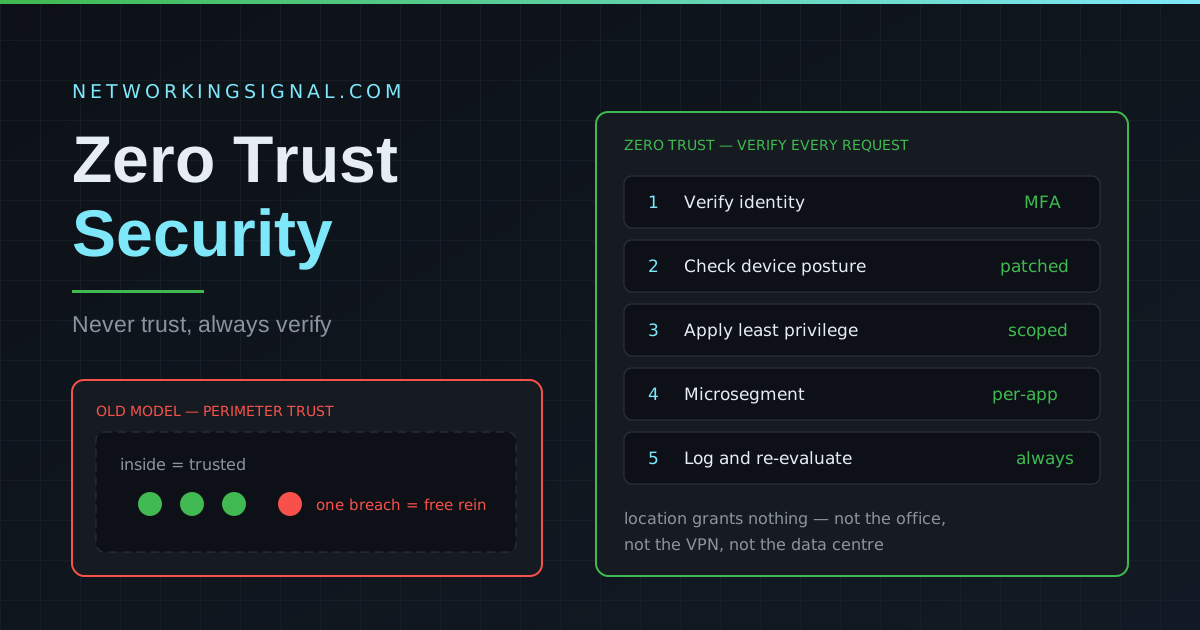
Zero Trust is a security model and philosophy based on the principle: “Never trust, always verify.” Unlike traditional perimeter-based security models that trust everything inside the corporate network, Zero Trust assumes that threats exist both inside and outside the network. Every user, device, and application must be continuously authenticated and authorized, regardless of location.
The concept was coined by Forrester Research analyst John Kindervag in 2010, and it has become the dominant enterprise security framework as remote work and cloud adoption have eliminated traditional network perimeters.
The traditional “castle-and-moat” security model assumed:
This model breaks down because: modern employees work remotely, applications live in the cloud (not inside the data center), and attackers who breach the perimeter move laterally with little resistance. The 2020 SolarWinds attack demonstrated how trusted network access can be exploited across thousands of organizations simultaneously.
Always authenticate and authorize based on all available data points: identity, location, device health, service or workload, data classification, and anomalies. Never grant access based on network location alone.
Limit user access with just-in-time (JIT) and just-enough-access (JEA). Users get only the permissions they need, only when they need them. This limits blast radius if credentials are compromised.
Design security as if attackers are already inside the network. Minimize blast radius, segment access, encrypt all traffic end-to-end, use analytics to detect anomalies, and improve response time.
| Component | Function | Examples |
|---|---|---|
| Identity Provider (IdP) | Authentication and SSO | Azure AD, Okta, Google Workspace |
| Multi-Factor Authentication | Verify user identity beyond password | Microsoft Authenticator, Duo, YubiKey |
| Device Health Verification | Ensure devices meet security policy | Microsoft Intune, CrowdStrike, Jamf |
| ZTNA / SDP | Replace VPN with identity-aware access | Zscaler, Cloudflare Access, Netskope |
| Microsegmentation | Isolate workloads to limit lateral movement | VMware NSX, Illumio, Akamai Guardicore |
| SIEM / SOAR | Monitor, detect, and respond to threats | Microsoft Sentinel, Splunk, IBM QRadar |
| PAM | Manage privileged accounts | CyberArk, BeyondTrust, Delinea |
Traditional VPNs grant network-level access, once connected, users can typically reach many internal resources. Zero Trust Network Access (ZTNA) grants application-level access only, based on verified identity and device posture.
| Feature | Traditional VPN | ZTNA (Zero Trust) |
|---|---|---|
| Access Scope | Full network access | Per-application access only |
| Trust Model | Trust on connection | Continuous verification |
| Lateral Movement | High risk | Prevented by microsegmentation |
| User Experience | Slow, complex | Seamless, app-like |
| Cloud App Support | Limited | Native |
| Device Posture | Minimal | Continuous assessment |
| Remote Work | Good for occasional remote | Designed for everywhere work |
| Aspect | Perimeter Security | Zero Trust |
|---|---|---|
| Trust assumption | Inside = trusted | No implicit trust anywhere |
| Security boundary | Network edge (firewall) | Identity and device |
| Lateral movement | Uncontrolled | Controlled via microsegmentation |
| Remote access | VPN-based | Identity-aware application access |
| Cloud apps | Poor fit | Native support |
| Verification | Once at login | Continuous |
As a network engineer, Zero Trust means rethinking how you design and segment networks:
Zero Trust is a security strategy and architecture philosophy, not a specific product. Many vendors sell “Zero Trust” products, but true Zero Trust requires a holistic approach across identity, devices, applications, data, and network.
No. Firewalls remain important in a Zero Trust architecture, but their role shifts. Instead of being the primary trust boundary, they become one of many enforcement points in a defense-in-depth strategy.
Zero Trust implementation is a journey, not a project. Most organizations take 2 to 5 years to fully mature their Zero Trust architecture. Start with identity and MFA, these provide the biggest security improvement in the shortest time.
Related: VPN Complete Guide | Firewall Guide | IDS/IPS Guide | How to Improve Network Security
Hand-picked articles you might also find useful.
 Security
 What is the Goal of Cyber Security? The goal of cyber security is to protect electronic information and…
 Security
 What is a Tunnel in Networking? A tunnel is a connection between two computer networks, in which data…
 Security
 Unlike symmetric encryption which uses a single key, asymmetric encryption ensures that secret messages can be securely transmitted…