
What is VRRP and How to Configure It in Cisco Switch?
What is VRRP? Virtual Router Redundancy Protocol (VRRP) is a routing protocol designed to increase the availability and…
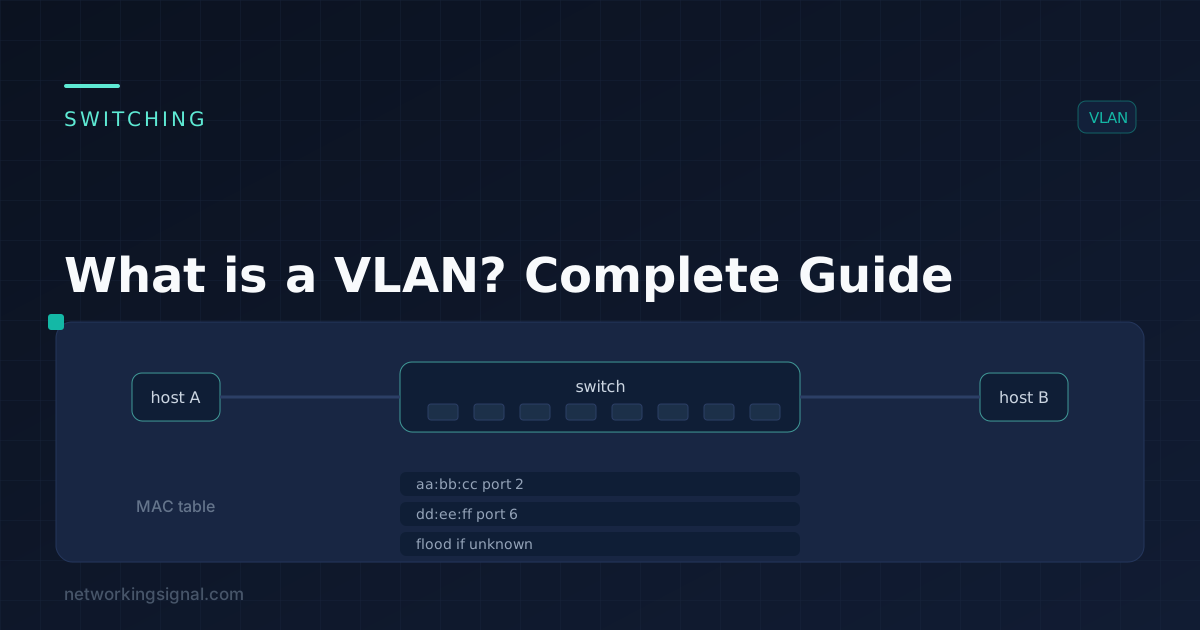
A VLAN is a virtual LAN. VLANs keep different network traffic isolated from each other even if they are on the same physical network. This allows for better security and performance because traffic only flows between the devices that are on the same VLAN. It also makes it easier to manage the network because you can segment it into different logical networks.
VLANs are identified by a VLAN ID, which is a 12-bit number ranging from 1 to 4094. The first VLAN, VLAN 1, is the default VLAN and is usually unused because it has no isolation properties.

Here are some common uses for VLANs:
Here are some of the benefits that VLANs can provide:
Improved security: By implementing VLANs, you can segregate different parts of your network so that only authorized users and devices can access specific resources. With VLANs, traffic is segregated on a logical basis rather than a physical one, making it much more secure than traditional networks.
Increased flexibility: You can create multiple VLANs for each department, team, or user group in your network to give them separate access to the same resources without needing additional switches or physical wiring. This makes it easier to manage security and allows users to share files, applications, and services across departments with ease.
Increased scalability: VLANs can help networks to scale quickly and easily. By segmenting the network, more users can be added without having to reconfigure the entire system.
Cost savings: since VLANs require fewer physical connections than traditional networks, there is less overhead involved in maintaining them and they can save businesses money on networking equipment.
Improved performance: by isolating traffic into separate VLANs, you can ensure that sensitive data is not slowed down due to heavy traffic from other parts of the network. This helps optimize performance and reliability for users across all parts of your network.
There are some potential disadvantages to using VLANs, such as:
Increased complexity: Using VLANs introduces additional layers of complexity within the network. This can make it more difficult to troubleshoot and debug issues when they arise.
Cost: VLANs typically involve investing in additional hardware and software, which can be costly.
Security issues: VLANs can create blind spots in the network, which can make it easier for malicious actors to attack.
Network performance: VLANs may also negatively affect overall network performance by increasing overhead and latency.
Scalability: VLANs may not be the best solution for larger networks, as they can become difficult to manage at scale.
Normal VLAN: A regular VLAN that is used to segment a network into smaller, more manageable pieces.
Native VLAN: The default VLAN on a network. Devices on the native VLAN can communicate with all other devices on the network.
Private VLAN: A special VLAN used to segment a network into smaller, more manageable pieces. Private VLANs are typically used in conjunction with normal VLANs to improve security and performance.
The IEEE 802.1Q standard determines how virtual local area networks (VLANs) operate on a network. This standard defines the frame tagging and associated protocols used to identify VLAN traffic on Ethernet frames, allowing multiple LAN segments to exist within one physical segment while still separating broadcast domains.
It also provides guidelines for trunking across switches, which allows a single link to carry traffic from multiple VLANs. This makes it possible to create separate broadcast domains and increase network performance, scalability, security, and flexibility.
The 802.1Q standard is widely used in corporate networks as well as on home networks. It is also the basis for many other networking protocols such as Spanning Tree Protocol (STP) and Link Aggregation Protocol (LACP).
Hand-picked articles you might also find useful.
 Switching
 What is VRRP? Virtual Router Redundancy Protocol (VRRP) is a routing protocol designed to increase the availability and…
 Networking Gears
 The best managed switches for a home lab in 2026. The NETGEAR MS308E at $150 is the reliable…
 Routing & Switching
 RSTP vs STP — complete comparison of Rapid Spanning Tree Protocol vs Spanning Tree Protocol. Convergence time, port…