
What is a MAC Address and How Does Work in Data Link Layer?
A MAC address is a unique identifier for a network adapter. MAC addresses are used in the media…
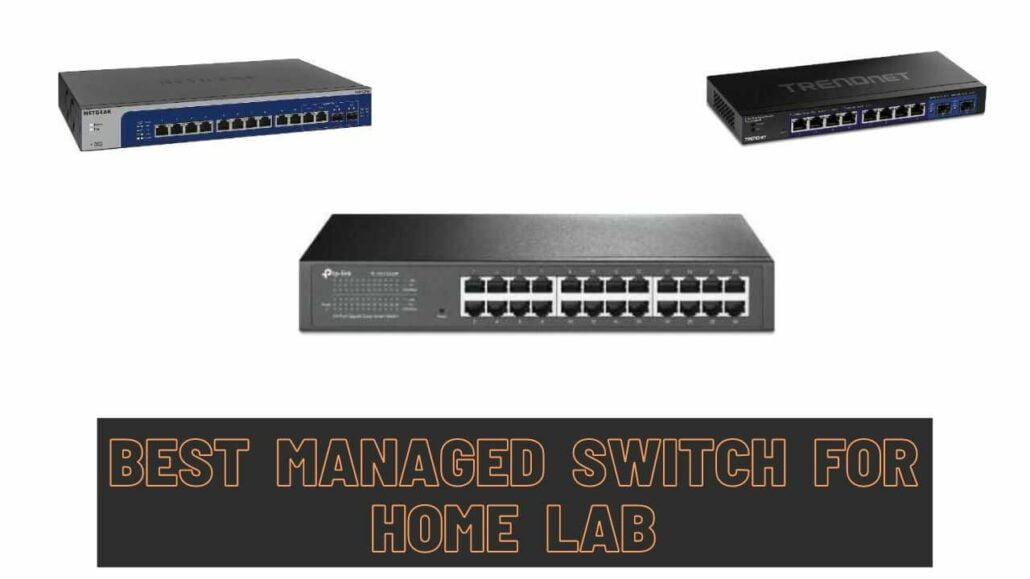
The NETGEAR MS308E ($149.99) is the safest home lab switch, eight 2.5G ports, VLANs, QoS, port monitoring, fanless and silent, from a vendor that ships firmware updates for years.
But the value here is remarkable. A GoodTop 9-port 2.5G managed switch with a 10G SFP+ uplink costs $49.99. That is VLAN support, link aggregation, spanning tree and a 10-gigabit uplink for the price of an unmanaged gigabit switch two years ago.
One thing to get right: in a home, choose SFP+ over 10GBASE-T where you can. A 10G copper port draws 4 to 6 W and runs hot; an SFP+ port with a DAC cable draws under 1 W and stays cool, which is what lets these switches be fanless, and silence matters when the lab lives in a spare room.
| Product | Switch | Ports | Uplink | Management | Price |
|---|---|---|---|---|---|
 | NETGEAR MS308EBest overall | 8 × 2.5G | None | Smart managed | $149.99 |
 | GoodTop 9-Port 2.5GbBudget pick | 8 × 2.5G | 1 × 10G SFP+ | Web managed | $49.99 |
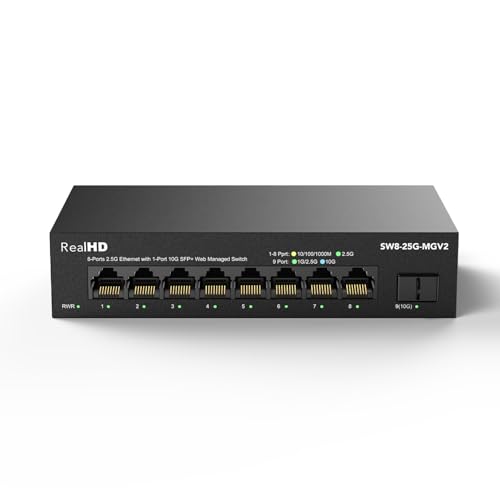 | 8-Port 2.5Gb Web ManagedBest value | 8 × 2.5G | 1 × 10G SFP+ | Web managed | $58.99 |
 | MokerLink 2.5G PoEBest with PoE | 8 × 2.5G PoE | 1 × 10G SFP+ | Web managed | $118.99 |
 | 8-Port 10G SFP+ ManagedBest for fibre | 8 × 10G SFP+ | All 10G | Web managed | $99.99 |
 | MokerLink 8-Port 10G L3Best 10G copper | 8 × 10G RJ45 | All 10G | L3 web + CLI | $275.99 |
The three tiers are marketed confusingly, so here is what separates them in practice.
Unmanaged switches forward frames and nothing else. No configuration, no VLANs, no visibility. Fine for adding ports behind a TV; useless for a lab.
Smart / web managed gives you a web interface with VLANs, QoS, link aggregation, spanning tree, port mirroring and a MAC address table. No command line, no routing. This tier covers everything a home lab genuinely needs, and it is where the value on this page sits.
Fully managed (L3) adds a CLI, inter-VLAN routing, ACLs, 802.1X authentication, SNMP and diagnostic tooling. Worth buying if you are studying for a networking certification and need CLI practice, or if you want the switch itself to route between VLANs rather than hairpinning traffic through a firewall.
The feature that justifies the whole purchase is VLANs. A home lab without them is one flat network where a compromised smart bulb sits on the same broadcast domain as your NAS. With them you can put IoT devices, guests, lab VMs and trusted machines on separate segments, and control what talks to what. If you run pfSense, OPNsense or a UniFi gateway, a managed switch is what lets you trunk those VLANs to where the devices actually plug in.
Port mirroring is the other one people underuse, it copies traffic from one port to another so you can watch it in Wireshark. For learning how networks actually behave, it is the single most useful feature on the list.
Both give you 10 gigabit. They are very different to live with, and in a house the difference decides the purchase. Before committing to either, check whether you need ten at all, because 2.5GbE against 10GbE is the more useful comparison for most homes.
Power and heat. A 10GBASE-T copper port draws roughly 4 to 6 W. An SFP+ port with a passive DAC cable draws under 1 W, a DAC has no transceiver electronics at all, just conductors. Across eight ports that is the difference between a switch that needs a fan and one that does not.
Noise. This is the practical consequence. Fanless switches are silent; switches with 40 mm fans are not, and a small high-RPM fan in a spare bedroom or an office is genuinely intrusive. Most home lab switches that get resold cheaply were sold because of the fan.
Cost per link. A 10G DAC cable is about $20 and includes both ends. A 10GBASE-T NIC costs more than an SFP+ NIC, and Cat 6a cable for 10G runs is thicker and pricier than the DAC you would use over a short rack-internal distance.
When copper wins: runs longer than about 7 m (the practical DAC limit), or connecting devices that only have RJ45. For those, either use an SFP+ to RJ45 transceiver module, which reintroduces the heat, so check your switch tolerates it, or buy a copper switch like the MokerLink 10G.
The pragmatic home lab layout: 2.5G copper to everything ordinary, and SFP+ with DAC cables between the switch, the NAS and the hypervisor. That is why the 2.5G-plus-SFP+ switches on this list at $50 to 60 are such good value.
The MS308E is the one to buy when you would rather the switch was not the interesting part of your lab. Eight 2.5 Gbps ports, a real management interface, fanless, and NETGEAR behind it.
That last point is what you are paying the premium for. The generic switches further down this list are excellent value, but firmware support depends on a seller who may not exist in three years. NETGEAR ships security updates and fixes for its smart-managed line for years, and there is documentation, a support line and a large community when something behaves oddly.
The management set is Easy Smart Managed: VLAN configuration, QoS traffic prioritisation, port monitoring and basic security. No CLI and no L3 routing, but as covered above, that covers what a home lab needs unless you are specifically practising for a certification.
Ports auto-negotiate and work over existing Cat 5e or Cat 6, so a 2.5G upgrade needs no rewiring. IEEE 802.3az Energy Efficient Ethernet cuts power draw on idle ports, which matters on a device that runs 24/7.
The obvious omission is an SFP+ uplink. Every other switch here has one, and its absence means the MS308E cannot be the aggregation point for a 10G NAS. It is an access switch, and a very good one.
Buy it if you want long-term firmware support and silence more than maximum specification per dollar.
Fifty dollars for eight 2.5 Gbps ports, a 10G SFP+ uplink and a management interface is the best value in home networking right now, and it is worth stating plainly how unusual that is.
The SFP+ port is what makes it a lab switch rather than a desk switch. Run a DAC cable from it to a NAS or a hypervisor with a 10G card and every 2.5G client on the switch can pull from that box at full speed simultaneously, the uplink is not the bottleneck. That topology used to require a $300 switch.
Management covers VLANs, QoS, link aggregation, spanning tree, MAC address table and DHCP client. That is the full useful set for segmenting a home network.
The RTL8373N chipset draws about 12 W loaded and 2.2 W idle, which is why it can be fanless in a small metal case.
Two honest caveats. The web interface is rough, the manufacturer itself warns you must click Apply and then separately Save Configuration or changes are lost on reboot, which is exactly the kind of thing that costs you an evening. And firmware support from a small seller is not something to count on. At $50, buy it knowing you are trading polish for price.
Buy it if you want VLANs and a 10G uplink for fifty dollars and can live with a rough interface.
Nine dollars more than the GoodTop, and the difference is worth understanding because it is mostly about resilience rather than features.
4 kV lightning protection on the ports is the standout. If any cable on this switch runs to a garage, a shed, an outbuilding or a PoE camera outside, that surge protection is the difference between replacing a $59 switch and replacing everything attached to it. Most switches at this price have none.
The operating range of minus 20 °C to 50 °C is unusually wide, which matters if the lab lives in a garage, loft or unheated basement, spaces where a normal consumer switch is out of specification for half the year.
Management covers VLAN, QoS, security, multicast and MAC address table, with a 60 Gbps backplane so all ports can run at line rate together. Same 8 × 2.5G plus 10G SFP+ layout as the GoodTop.
US-based support out of Chicago with published hours is a meaningful difference from an anonymous seller, being able to reach a person who understands the product matters when a config change locks you out.
The listing notes it has no VPN functionality, which is worth repeating because people expect it: a switch is not a router and does not terminate VPN tunnels.
Buy it if any cable reaches a garage, shed or outdoor camera, the surge protection earns its $9.
If the lab includes cameras or WiFi access points, PoE turns two cables and a power outlet per device into one cable, and on a ceiling-mounted access point that is the difference between a tidy install and an electrician.
135 W total across eight ports at up to 30 W each (802.3af/at). Budget realistically: a WiFi 6 access point draws 12 to 15 W, a PoE camera 4 to 12 W, a WiFi 7 access point can exceed 25 W. Six access points would exhaust this switch; a mix of two APs and four cameras sits comfortably inside it.
All eight PoE ports are 2.5 Gbps, which matters more than it used to. WiFi 6E and WiFi 7 access points can exceed gigabit over the air, so a gigabit PoE port becomes the bottleneck, this is one of the few affordable switches that does not have that problem.
The 10G SFP+ uplink means all that access point traffic can reach a NAS or router at 10 Gbps. Web GUI management covers VLAN, LACP, QoS, security and multicast.
It is fanless despite delivering 135 W, which is genuinely good engineering, most PoE switches at this power level have fans. Note it does not support passive 24 V PoE, so older Ubiquiti gear needs its original injector.
Buy it if the lab feeds cameras or ceiling access points and you want one cable per device.
Eight 10-gigabit ports for $99.99, drawing 18 W, with no fan. That combination is only possible because they are SFP+ rather than copper, and it is the clearest illustration of why SFP+ is the right choice for a home lab.
This is the switch for the fast core of a lab: hypervisors, a NAS, a workstation, all connected with $20 DAC cables and all talking to each other at 10 Gbps. Uplink one port to your 2.5G access switch and the whole network has a fast spine.
It supports both 10G/2.5G and 10G/1G modes, switchable in the interface, worth knowing, because in the default 10G/2.5G mode a 1G module will not be recognised, which is a confusing first hour if you did not read the manual.
Ports accept RJ45 copper modules, fibre modules, DAC and AOC cables. Static and dynamic link aggregation (802.3ad) supports up to eight member ports in a LAG, so you can bond links between switches for redundancy or throughput.
The manufacturer notes it gets warm when fully loaded, especially with 10G SFP+ RJ45 modules, which is exactly the power-draw problem described earlier. Use DAC or fibre where you can, and copper modules sparingly.
Buy it as the 10G core of a lab, hypervisors, NAS and workstation joined by DAC cables.
This is the switch for two specific people: someone whose 10G devices only have RJ45 ports, and someone studying for a networking certification who needs a real CLI to practise on.
Every port auto-negotiates 10G/5G/2.5G/1G/100M over copper, so anything plugs in without modules or DAC cables. That convenience is the reason to pay $276 instead of $100, and the reason it has a fan.
The Layer 3 capability is the other half. IPv4 and IPv6 routing, ARP, loopback interfaces and static routes mean the switch routes between VLANs itself, at line rate in hardware, instead of sending every inter-VLAN packet up to a firewall and back. On a busy lab that removes a real bottleneck.
The management set is genuinely enterprise: AAA and 802.1X authentication, MAC-based auth, DoS protection, dynamic ARP inspection, DHCP snooping, IP source guard, port security and storm control. Plus port mirroring, ping, traceroute, UDLD and console/RAM/flash logging.
Telnet, SSH and SNMP access with configuration file upload and download. If you are working toward a CCNA or similar, this gives you a device to configure from a command line rather than a web form, which is how the exams are actually assessed.
The trade is noise. It uses an industrial-grade fan, so it is not a spare-bedroom switch unless the room is one you leave.
Buy it if your 10G devices are RJ45 only, or you need CLI practice for a certification.
If you want VLANs, yes, and VLANs are the main reason to have one. Segmenting IoT devices, guests and lab VMs onto separate networks is the single biggest security and organisational improvement available, and an unmanaged switch cannot do it. Port mirroring for packet capture is the other feature worth the upgrade.
A smart or web-managed switch gives you a web interface with VLANs, QoS, link aggregation and spanning tree, but no command line and no routing. A fully managed switch adds a CLI, Layer 3 routing, ACLs and 802.1X. For most home labs a smart switch is sufficient; buy fully managed if you need CLI practice or hardware inter-VLAN routing.
Usually, yes. An SFP+ port with a DAC cable draws under 1 W against 4 to 6 W for a 10G copper port, which is why SFP+ switches can be fanless and silent. DAC cables also cost less than 10G copper NICs plus Cat 6a. Copper wins only for runs beyond about 7 m or devices with RJ45-only 10G ports.
Budget by device: a PoE camera draws 4 to 12 W, a WiFi 6 access point 12 to 15 W, and a WiFi 7 access point can exceed 25 W. Total your devices and add 25% headroom. A 135 W switch comfortably runs two access points and four cameras, but not six WiFi 7 APs.
No. Switching happens in hardware ASICs at line rate regardless of the management features. Only functions that require the CPU to inspect every packet, heavy ACL processing or software-based routing on a cheap switch, can add latency, and that is rare on a home lab’s traffic volumes.
Only a Layer 3 switch can. A smart or web-managed switch creates and tags VLANs but cannot route between them, that traffic goes to a router or firewall and back, which is fine at home lab scale. An L3 switch routes between VLANs in hardware, which matters when inter-VLAN traffic is heavy.
For a first managed switch, the NETGEAR MS308E at $149.99 is the low-risk choice: silent, well documented, and supported for years. But the value on this page is hard to ignore, the GoodTop 9-port at $49.99 gives you eight 2.5G ports, a 10G SFP+ uplink and full VLAN support for a third of the price, if you can tolerate a rough interface.
The layout worth building toward: a 10G SFP+ switch at $99.99 as the core, DAC cables to your NAS and hypervisor, and a 2.5G switch for everything else. That is a genuinely fast, silent, segmented lab for around $150 of switching, which two years ago would have cost four times as much and come with a fan.
Disclosure: Networking Signal is a participant in the Amazon Services LLC Associates Program. We earn a commission on qualifying purchases made through links on this page, at no additional cost to you. Prices shown were accurate at the time of writing and may change. SFP+ modules and DAC cables are sold separately unless a listing states otherwise.
Hand-picked articles you might also find useful.
 Switching
 A MAC address is a unique identifier for a network adapter. MAC addresses are used in the media…
 Switching
 The Address Resolution Protocol ( ARP ) is a critical communication protocol used on local area networks (…
 Networking Gears
 The best routers with parental controls and time limits in 2026. The ASUS RT-BE58U at $143 is the…