
BGP vs OSPF
BGP and OSPF are two of the most commonly used routing protocols in today’s IP networks. They are both capable of handling very large-scale deployments and offer a high degree of flexibility and functionality.
BGP is a path vector protocol that uses a hop-by-hop routing model. BGP routers maintain a database of all available routes and use this information to construct the best possible path to a destination.
OSPF is a link-state protocol that uses the shortest path, the first routing model. OSPF routers maintain a database of all available routes and use this information to construct the best possible path to a destination.
What is the Difference Between BGP and OSPF
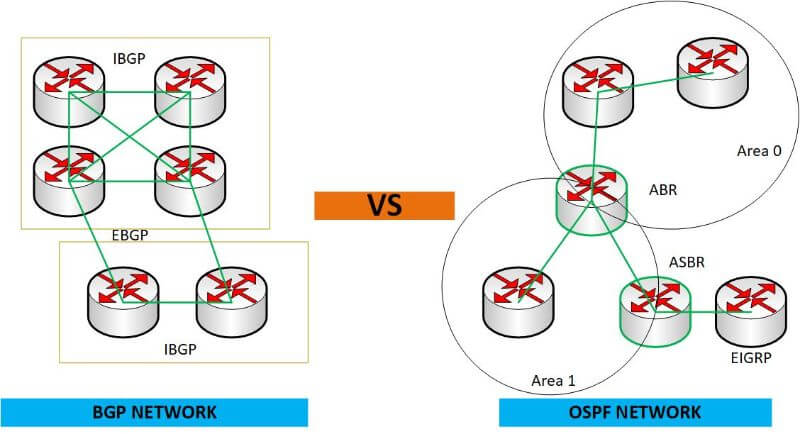
Here is a list of the key difference between BGP and OSPF:
| BGP ( Border Gateway Protocol ) | OSPF ( Open Shortest Path First ) | |
|---|---|---|
| 1 | BGP can be used to route traffic across multiple autonomous systems | OSPF is designed to route traffic within a single autonomous system |
| 2 | BGP uses an implicit withdrawal mechanism | OSPF uses an explicit withdrawal mechanism |
| 3 | BGP uses a tiered structure for routing updates | OSPF sends updates to all routers in the same area |
| 4 | BGP requires manual configuration of peers | OSPF forms adjacencies automatically |
| 5 | BGP uses a complex set of attributes to determine the best path | OSPF only uses the cost of the link to determine the best path |
| 6 | BGP is a Path Vector Protocol | OSPF is a Link State Protocol |
| 7 | BGP uses a Hop-by-Hop Routing Model | OSPF uses a Shortest Path First Routing Model |
| 8 | BGP Routers maintain a database of all available routes | OSPF routers only keep track of the routes to directly connected neighbors |
| 9 | BGP can scale to very large networks | OSPF is designed for smaller networks |
| 10 | BGP uses TCP for transport | OSPF uses UDP for transport |
| 11 | BGP updates are incremental | OSPF updates are full |
| 12 | BGP has a concept of an Autonomous System | OSPF does not concept of an Autonomous System |
| 13 | BGP uses Multiprotocol BGP for IPv6 support | OSPF supports IPv6 natively |
| 14 | BGP uses route reflectors to scale | OSPF uses area databases |
| 15 | BGP has more flexible routing policies | OSPF has simpler routing policies |
| 16 | BGP has more complex configuration options | OSPF has simple configuration options |
| 17 | BGP uses attributes to influence routing | OSPF uses link costs |
| 18 | BGP uses manual configuration of peers | OSPF uses dynamic discovery |
| 19 | BGP is commonly used for Internet Backbone routing | OSPF is commonly used for Enterprise internal routing. |
| 20 | BGP is used to exchange reachability information between different autonomous systems | OSPF is used to exchange reachability information within the same autonomous system |
| 21 | BGP is used to route between different IP address spaces | OSPF is used to route within the same IP address space |
| 22 | BGP uses MD5 authentication | OSPF uses simple password authentication |
| 23 | BGP encrypts the entire BGP message | OSPF only encrypts the portion of the message containing the routing information |
| 24 | BGP has more flexible routing policies | OSPF has simpler routing policies |