
6 Best Laptops for Cyber Security Students in 2026 (RAM First)
The best laptops for cyber security students in 2026. The ASUS V16 at $1,849 is the pick. RAM…

The Lenovo ThinkPad P16v Gen 3 with an RTX PRO 2000 Blackwell ($2,899.00) is the best laptop for SolidWorks. ISV certified GPU, 32GB of RAM, and an Ultra 9 285H reaching 5.4 GHz.
Two facts should drive this purchase and neither is on a spec sheet.
SolidWorks modelling is largely single threaded. Rebuilding a part or opening an assembly leans on one core. A 24 core chip does not open a model faster than a 14 core chip with the same clock speed. Buy peak clock speed, not core count.
The GPU must be ISV certified. NVIDIA RTX PRO and AMD Radeon Pro cards are certified by Dassault; GeForce cards are not. On an uncertified card RealView Graphics is switched off, and graphical artifacts are not supported by Dassault.
SolidWorks is Windows only. There is no macOS version.
| Product | Laptop | GPU | Certified | RAM | Price |
|---|---|---|---|---|---|
 | ThinkPad P16v, RTX PRO 2000Best overall | RTX PRO 2000 8GB | Yes | 32GB | $2,899.00 |
 | ThinkPad P16v, RTX PRO 1000Best value | RTX PRO 1000 8GB | Yes | 32GB | $2,599.00 |
 | Dell Precision 7780Largest assemblies | RTX 3500 Ada 12GB | Yes | 128GB | $3,899.99 |
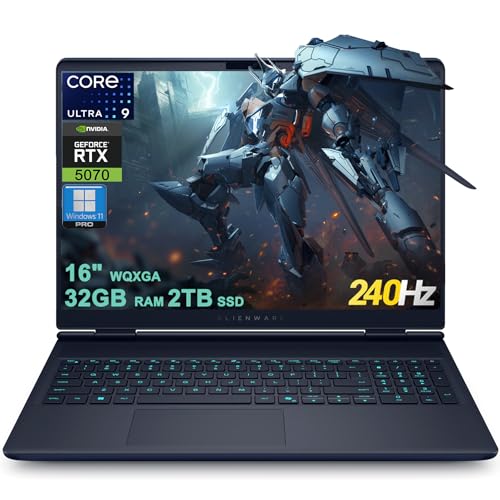 | Alienware 16X AuroraFastest chip | RTX 5070 8GB | No | 32GB | $2,399.00 |
 | ASUS V16 RTX 5070Budget pick | RTX 5070 8GB | No | 32GB | $1,849.00 |
 | Dell 16 Plus, Ultra 9Light models only | Intel Arc 140V | No | 32GB | $1,344.00 |
Most laptop advice for CAD is generic. SolidWorks has specific behaviour that changes what is worth paying for.
Opening a part, rebuilding a feature tree and manipulating an assembly are largely single threaded operations. One core does the work while the others sit idle.
So a 5.4 GHz chip with 14 cores opens a model faster than a 4.5 GHz chip with 24. Core count only pays off in a few places: rendering in SolidWorks Visualize, running Simulation studies, and some drawing and file operations.
When comparing two laptops, look at maximum turbo frequency first, and treat core count as secondary unless you spend your day rendering.
Sustained clock speed matters as much as peak. A thin laptop that hits 5.4 GHz for thirty seconds then throttles to 3.8 is slower in practice than a thicker chassis holding 4.8 GHz all afternoon. Workstation laptops are thick for that reason.
Dassault publishes a list of graphics cards and driver versions it has tested with SolidWorks. NVIDIA RTX PRO cards, previously branded Quadro, and AMD Radeon Pro cards are on it. GeForce cards are not.
Three practical consequences.
RealView Graphics is disabled on uncertified cards. RealView is the realistic material rendering in the modelling window, the feature that makes a part look like brushed aluminium rather than grey plastic. SolidWorks checks the card and switches it off. Registry workarounds circulate; they are unsupported and break with updates.
Graphical artifacts are not supported. Uncertified drivers cause flickering, disappearing faces and misdrawn edges in complex assemblies. Report it with a GeForce card and the first response is to use certified hardware.
Certified drivers are tested against SolidWorks releases. Gaming drivers are updated frequently for new games, and one of those updates can break CAD rendering. Professional drivers move slowly on purpose.
If SolidWorks is your job, buy certified. If you are a student or a hobbyist, a GeForce card runs SolidWorks perfectly well without RealView, and saves a great deal of money.
16GB is the practical minimum and handles parts and small assemblies.
32GB is the right number for most professional work, covering assemblies of a few thousand components.
64GB or more is for very large assemblies, Simulation studies and running SolidWorks alongside other engineering software.
SolidWorks loads assemblies into RAM. Run short and Windows pages to disk, at which point rotating a model becomes visibly slow no matter how fast the processor is.
This is counterintuitive. 1920 by 1200 on a 16 inch panel is the better choice for SolidWorks.
Parts of the SolidWorks interface scale poorly at high DPI, leaving small icons and inconsistent dialogue sizes. And a 4K panel makes the GPU push four times the pixels for the same model.
What is worth paying for is brightness and colour accuracy. A 500 nit panel with 100 percent sRGB shows a model correctly and stays usable in a bright office.
This hits every SolidWorks requirement without paying for things the software cannot use.
The Ultra 9 285H reaches 5.4 GHz, the highest single core clock here. Given that modelling leans on one core, that number does more for daily responsiveness than any other specification on the page.
The RTX PRO 2000 Blackwell with 8GB of GDDR7 is ISV certified, and Lenovo names SolidWorks explicitly alongside AutoCAD and Revit. That means RealView works, certified drivers are available, and graphical faults are supported rather than dismissed.
Thirty two gigabytes of DDR5 and a 1TB PCIe SSD suit assemblies of a few thousand components comfortably.
The display is the right choice rather than the flashiest: 16 inch WUXGA at 1920 by 1200, 500 nits, 100 percent sRGB. High brightness and accurate colour, without the interface scaling problems a 4K panel brings.
The chassis is the unglamorous advantage. A 16 inch workstation body dissipates heat properly, so the processor holds a high clock through a long rebuild instead of throttling after a minute.
MIL-STD-810H tested, with a 5MP camera and privacy shutter, fingerprint reader, Wi-Fi 7, Bluetooth 5.4 and a real Ethernet port, which still matters on an engineering network with a licence server.
vPro gives IT remote management, which matters in a company but not to a freelancer.
Buy this if SolidWorks is your job and you need certification, clock speed and support.
Three hundred dollars less than the model above, and for most SolidWorks users the difference will not be noticeable.
The Ultra 7 255H reaches 5.1 GHz against the Ultra 9’s 5.4. That is a six percent gap on the specification that matters most, which is real but small. If a rebuild takes twenty seconds, this takes twenty one.
The RTX PRO 1000 Blackwell is the step below the 2000 but is equally ISV certified, with the same 8GB of GDDR7. Certification is binary: you either get RealView and supported drivers or you do not. This card gets them.
Where the 2000 pulls ahead is raw throughput on very complex assemblies and any GPU accelerated rendering. For part modelling and assemblies of a few thousand components, the 1000 keeps up.
Everything else is identical: 32GB DDR5, 1TB SSD, the same 16 inch 500 nit 100 percent sRGB WUXGA display, Wi-Fi 7, Bluetooth 5.4, RJ-45 Ethernet, 5MP camera with privacy shutter, fingerprint reader and MIL-STD-810H build.
No vPro on this configuration, so no remote IT management. Irrelevant for an individual, worth checking in a managed fleet.
The $300 saved buys a second monitor or a decent mouse, both of which do more for daily CAD work than a six percent clock difference.
Buy this for professional SolidWorks work where certification matters more than the last six percent.
One hundred and twenty eight gigabytes of RAM and 12GB of certified VRAM. This is for the assemblies the other machines cannot hold.
128GB is four times the RAM of everything else here, and it is the reason to buy this. SolidWorks loads assemblies into memory, and once you run out, performance falls off a cliff regardless of processor speed. If you open assemblies with tens of thousands of components, or run Simulation alongside the model, this is the machine.
The RTX 3500 Ada with 12GB is ISV certified and Dell states the machine is optimised and tested for professional applications. Fifty percent more VRAM than the 8GB cards here, which matters once a model exceeds what the GPU can hold.
The i9-13950HX is a previous generation part. It is a 24 core chip with high clocks and plenty of muscle, but it is not the newest silicon and its single core clock does not lead the field. Given how much SolidWorks depends on single threaded speed, the newer ThinkPads feel more responsive in ordinary modelling.
So the choice is clear cut. Buy this for capacity, not for speed. It wins when RAM and VRAM are the constraint and loses when clock speed is.
The 17.3 inch chassis is large and heavy, which is a real cost if you carry it, and a benefit for thermals and screen space.
Dell manufacturer warranty runs through March 2031, which is unusually long and worth something on a machine at this price.
Buy this for very large assemblies and Simulation, where memory is the real constraint.
Faster silicon than the certified workstations, for less money, with the trade stated plainly: the GeForce RTX 5070 is not ISV certified.
The Ultra 9 275HX is a 24 core HX class chip, the desktop derived line rather than the mobile one, and it will out perform the H series parts in the ThinkPads on anything multi threaded. For SolidWorks Visualize rendering and Simulation studies, that is a genuine advantage.
What you lose is RealView Graphics, which SolidWorks disables on uncertified cards, and any support claim when a driver update causes artifacts in a complex assembly.
For a student, a hobbyist or someone doing occasional CAD alongside other work, that is an acceptable trade and saves $500. For a professional whose day is spent in SolidWorks, it is not.
Two terabytes of storage, double the certified machines, which matters more than people expect once you have a few years of project files and Toolbox libraries locally.
The display is 16 inch WQXGA at 2560 by 1600, 240 Hz, 100 percent DCI-P3 with G-SYNC. The refresh rate does nothing for CAD. The colour accuracy is genuinely useful.
A gaming chassis with strong cooling, an RJ-45 Ethernet port and Thunderbolt 4, plus Windows 11 Pro rather than Home.
Buy this if you are a student or occasional user and can live without RealView.
The cheapest way to run SolidWorks properly with a discrete GPU and 32GB of RAM. A thousand dollars less than the certified ThinkPad.
Thirty two gigabytes of DDR5 is the specification that matters most at this price, and it is what separates this from the many 16GB laptops in the same bracket. Sixteen gigabytes runs SolidWorks but starts paging on medium assemblies, and no processor recovers from that.
The RTX 5070 with 8GB is the same GPU as in the Alienware at $550 less. Not certified, so no RealView, but plenty of graphics power for modelling and viewport work.
The Core 7 240H is the compromise. It is a capable chip but its single core clock trails the Ultra 9 parts, and single core clock is what SolidWorks leans on. Expect noticeably slower rebuilds on complex parts than the ThinkPads deliver.
The 16 inch FHD+ at 1920 by 1200 is exactly the right resolution for SolidWorks, avoiding the interface scaling problems of higher DPI panels. The 144 Hz refresh rate is wasted on CAD.
Two limits to plan around. The 47Wh battery is small for a 16 inch machine with a discrete GPU, so treat this as a desk machine with occasional portability. And there is no Ethernet port, which is awkward on an engineering network with a licence server; a USB adapter solves it.
Windows 11 Home rather than Pro, so no BitLocker or domain join.
Buy this for student or hobby CAD where 32GB matters more than certification.
The cheapest machine here, and the one with the clearest limits. It has integrated graphics, which changes what SolidWorks can do on it.
The processor is strong. The Ultra 9 288V reaches 5.3 GHz, essentially matching the top ThinkPad on the single core clock SolidWorks depends on. On part modelling, this feels quick.
Memory is 32GB of LPDDR5X at 8533 MT/s, faster than the DDR5 in the workstations. That is genuinely useful because integrated graphics borrow system memory, and faster memory partly offsets the lack of dedicated VRAM.
The Intel Arc 140V is a capable integrated GPU and will run SolidWorks for parts and small assemblies. It is not certified, so no RealView, and it has no dedicated VRAM, so large assemblies with many appearances will slow the viewport noticeably.
Be realistic about where the line falls. Parts and assemblies up to a few hundred components: fine. Thousands of components, complex surfacing, or Simulation: buy a discrete GPU.
What you get in exchange is a normal laptop. Thin, light, quiet, with a proper battery, Wi-Fi 7, Thunderbolt 4, HDMI 2.1 and a 16 inch 1920 by 1200 touch display.
The Intel vPro platform is included, giving IT remote management and hardware security, which is unusual at this price.
A reasonable choice for an engineer who mostly reviews models and occasionally edits them, and wants one machine for everything.
Buy this if you mostly review models and edit occasionally and want one portable machine.
Not to run, but certification changes what you get. On an uncertified card SolidWorks disables RealView Graphics, and Dassault does not support graphical artifacts caused by uncertified drivers. NVIDIA RTX PRO and AMD Radeon Pro cards are certified; GeForce cards are not.
Not for modelling. Opening parts, rebuilding feature trees and manipulating assemblies are largely single threaded, so peak clock speed matters far more than core count. Cores help with SolidWorks Visualize rendering and Simulation studies.
Sixteen gigabytes is the practical minimum for parts and small assemblies, 32GB is right for most professional work, and 64GB or more is for very large assemblies and Simulation. Running short causes Windows to page to disk, which slows everything regardless of processor.
Not natively. SolidWorks is Windows only with no macOS version. Options are a Windows virtual machine, Boot Camp on older Intel Macs, or cloud streaming, and all three add cost and complexity over simply buying a Windows laptop.
No, and it can make things worse. Parts of the SolidWorks interface scale poorly at high DPI, and 4K makes the GPU push four times the pixels. A 16 inch panel at 1920 by 1200 with high brightness and accurate colour is the better choice.
Yes, and often quickly, because gaming laptops have strong processors and cooling. You lose RealView Graphics and driver support, and gaming drivers update frequently for games rather than CAD. Fine for students and hobbyists, risky for professional work.
If SolidWorks is your job, buy the ThinkPad P16v Gen 3 with the RTX PRO 2000 at $2,899.00. Certified graphics, 5.4 GHz single core clock and a chassis that holds that clock. The RTX PRO 1000 version at $2,599.00 gives identical certification for $300 less and only six percent less clock speed.
For very large assemblies, the Dell Precision 7780 at $3,899.99 is the only machine here with 128GB of RAM and 12GB of certified VRAM.
For students and hobbyists, the ASUS V16 at $1,849.00 gives 32GB and a discrete RTX 5070 for a thousand dollars less. You lose RealView, and that is a fair trade when SolidWorks is not paying your bills.
Disclosure: Networking Signal is a participant in the Amazon Services LLC Associates Program. We earn a commission on qualifying purchases made through links on this page, at no additional cost to you. Prices shown were accurate at the time of writing and may change. ISV certification status is set by Dassault Systemes and can change with SolidWorks releases and driver versions; check the official system requirements and certified graphics card list before buying for professional use.
Hand-picked articles you might also find useful.
 Laptops
 The best laptops for cyber security students in 2026. The ASUS V16 at $1,849 is the pick. RAM…
 Laptops
 The best laptops for working from home in 2026. The HP OmniBook 7 Flip at $1,350 is the…
 Laptops
 Having your laptop repeatedly lose connection to Wi-Fi can be incredibly frustrating. You're in the middle of an…