
What is Router in Networking?
A router is a device in computer networking that forwards data packets between computer networks. Routers are used…
Versa SD Wan and Cisco are two of the most popular choices for software-defined wide-area networking (SD-WAN). They are both well-suited for enterprise network deployments, offer a variety of features, and have a strong reputation for reliability. Here’s a closer look at each:
One of the most popular networking vendors, Cisco offers a comprehensive SD-WAN solution that is easy to deploy and manage. It offers a variety of features, including quality of service (QoS), application visibility and control, and WAN optimization. Cisco’s SD-WAN solutions are available in both on-premises and cloud-based deployments.
There are many benefits of using Cisco SD Wan, including:
Ease of deployment and management: Cisco’s SD-WAN solutions are easy to deploy and manage, thanks to their intuitive web-based interface.
Quality of service (QoS): Cisco’s QoS features allow you to prioritize traffic based on specific applications or users.
Application visibility and control: Cisco’s application visibility and control features give you granular control over how traffic is routed and prioritized.
WAN optimization: Cisco’s WAN optimization features help to improve performance by reducing latency and jitter.
Versa SD Wan is a relative newcomer to the SD-WAN market, but it has quickly gained popularity due to its flexibility and scalability. Versa’s solutions are available in both on-premises and cloud deployments, and they offer a number of features, including application-aware routing, multi-path optimization, and secure encrypted tunnels.
There are many benefits of using Versa SD Wan, including:
Flexibility: Versa’s solutions are highly flexible, allowing you to tailor them to your specific needs.
Scalability: Versa’s solutions are easy to scale, so you can add more users or applications as needed.
Application-aware routing: Versa’s application-aware routing feature ensures that traffic is routed optimally, based on the specific needs of your applications.
Multi-path optimization: Versa’s multi-path optimization feature allows you to use multiple Internet links simultaneously for increased reliability and performance.
Secure encrypted tunnels: Versa’s SD-WAN solutions use secure encrypted tunnels to protect your data.
As businesses increasingly rely on cloud-based applications and services, the need for a reliable and high-performance wide-area network (WAN) connection has never been greater. Software-defined wide-area networking (SD-WAN) is a new approach to WAN connectivity that is designed to address the challenges of traditional WANs.
SD-WAN enables businesses to connect their branches and remote locations to the cloud in a more efficient and cost-effective way. It does this by dynamically routing traffic over the best available path, whether that is a private MPLS link, a public Internet connection, or a combination of both. SD-WAN also provides built-in security and quality of service (QoS) features, making it a more attractive option for many businesses.
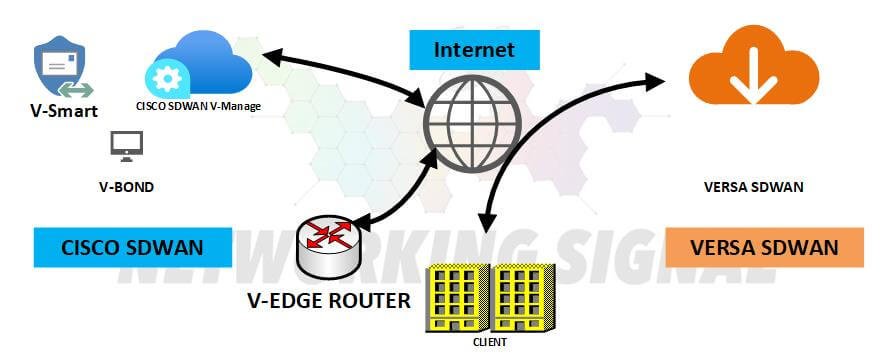
When it comes to SD-WAN, there are a few key differences between Versa and Cisco.
The right solution for you will depend on your specific needs. If you are looking for a flexible and scalable SD-WAN solution, then Versa SD Wan is a good choice. If you need an easy-to-deploy and manage solution with features like QoS and WAN optimization, then Cisco SD Wan is a good option.
No matter which solution you choose, you can be sure that you are getting a high-quality SD-WAN solution that will meet your needs.
Hand-picked articles you might also find useful.
 Routing
 A router is a device in computer networking that forwards data packets between computer networks. Routers are used…
 Routing
 What is Default Routing in Networking? Default routing, also known as static routing , is an IP routing…
 Routing
 What are Virtual Routing And Forwarding? Virtual Routing and Forwarding (VRF) is a technology that enables the creation…
One response to “Versa SDWAN vs Cisco SDWAN: Detail Explained”
Like cisco sdwan uses OMP protocol between vedge and v smart devices .which protocol uses between versa controller and versa custumer side device .
Difference between versa headent and cisco headent device