
Software Load Balancer: Types, Working, Choosing, and Set Up
What is Software Load Balancer ? A software load balancer is a type of load balancer that uses…
A hardware load balancer is a physical device that helps to distribute the workload across multiple servers by using a variety of methods such as round robin, least connection, and so on. This ensures that no single server is overwhelmed with requests and that each server gets a fair share of the traffic. This type of load balancer is usually used in large enterprises where a large number of users need to be supported.
F5 Networks is one of the most popular manufacturers of hardware load balancers. Its products are used by some of the largest organizations in the world, such as Facebook, Google, and Yahoo. Other companies that make hardware load balancers include A10 Networks, Barracuda Networks, and Cisco Systems.
There are four main types of hardware load balancers.
Layer 4 hardware load balancers direct traffic based on layer 4 information such as IP address and source port number. This type of load balancer is the fastest and most efficient but lacks the sophisticated features of other types.
Layer 7 hardware load balancers direct traffic based on layer 7 information such as HTTP headers or URLs. This type of load balancer is more feature-rich than layer 4, allowing for advanced routing decisions to be made and providing deeper insight into user activity.
Global Server Load Balancing (GSLB) is a specialized type of load balancer designed for distributing traffic across multiple data centers. It allows organizations to ensure geographic redundancy, high availability, and improved performance.
Application Delivery Controllers (ADCs) are powerful hardware devices that provide advanced features such as caching, compression, and SSL offloading. An ADC is the most feature-rich type of load balancer available and provides a comprehensive solution for any organization looking to optimize its application performance.
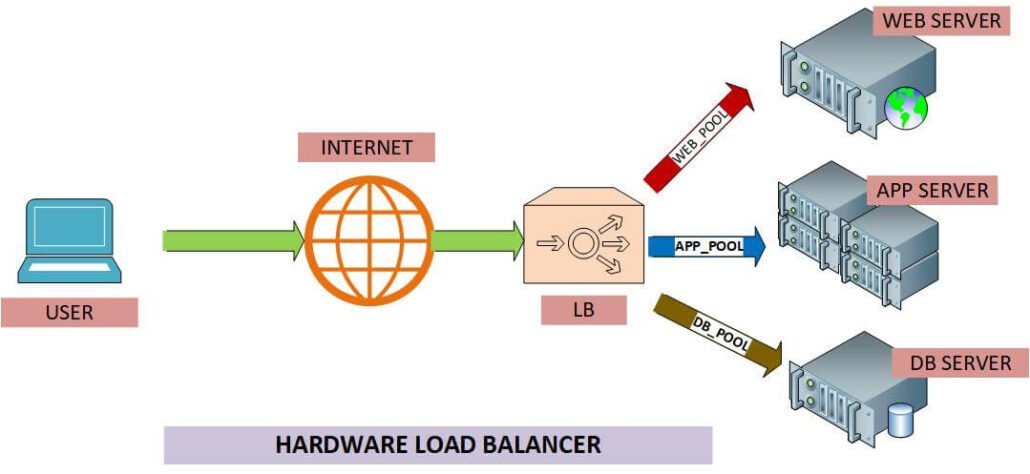
A hardware load balancer typically consists of two main components: a control plane and a data plane.
The control plane is responsible for managing the load balancer and its configuration. It is typically implemented as a software program that runs on a dedicated server.
The data plane is responsible for forwarding traffic to the servers that are being loaded balanced. It is typically implemented as a piece of hardware, such as an ASIC or FPGA.
The control plane and data plane are usually connected to each other using a high-speed link, such as an Ethernet connection.
Here are the Steps:
There are several advantages of using a hardware load balancer, such as:
There are also some disadvantages of using a hardware load balancer, such as:
Hand-picked articles you might also find useful.
 Load Balancing
 What is Software Load Balancer ? A software load balancer is a type of load balancer that uses…
 Load Balancing
 What is a Load Balancer ? A load balancer is a device that evenly distributes network traffic among…
 Load Balancing
 There are two common ways to deal with excessive traffic on a website: load balancing and rate limiting…
2 responses to “Hardware Load Balancer: Working and Advantages of HLB”
[…] Hardware load balancers […]
[…] This type of load balancer is often used in web farms and other high-traffic applications where hardware load balancers cannot keep up with the demand. Software load balancers can be either physical or virtual […]