
Ethernet Frame Format — Fields, Size and How It Works
An Ethernet frame carries the destination and source MAC, an EtherType or length field, the payload, and a…
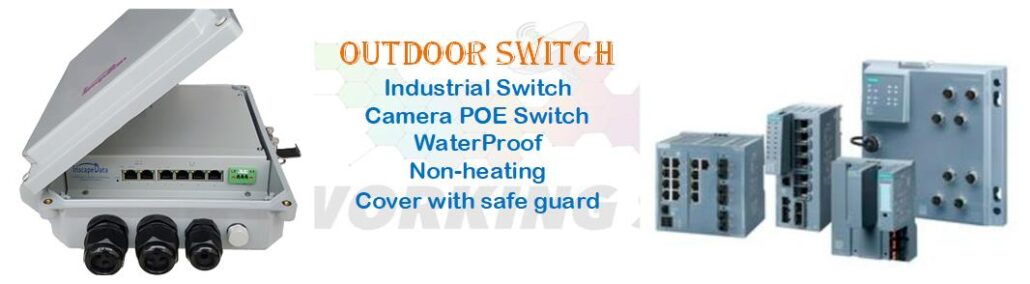
For most outdoor jobs the Industrial 8-Port Gigabit PoE+ DIN-Rail switch ($105.99) is the right buy, 120 W of PoE, two uplinks, aluminium housing, minus 40 °C to 85 °C, mounted inside a weatherproof enclosure.
The mistake almost everyone makes: “industrial” does not mean “weatherproof”. Nearly every switch sold as industrial is IP40, dust-resistant, but with no water protection at all. It is designed to live inside a sealed enclosure or a control cabinet. Mount one on an exterior wall and rain will kill it.
Only IP67 units survive direct exposure. If the switch has to sit unprotected on a pole or a wall, the IP67 PoE passthrough switch at $69.99 is what you actually need.
| Product | Switch | Rating | Ports | PoE budget | Price |
|---|---|---|---|---|---|
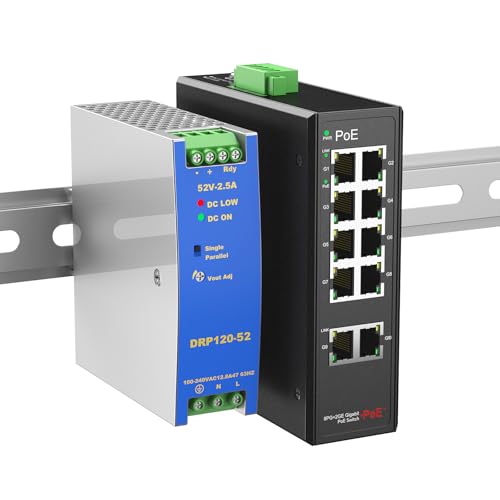 | Industrial 8-Port PoE+ DIN-RailBest overall | IP40, enclosure | 8 PoE + 2 uplink | 120 W | $105.99 |
 | IP67 PoE PassthroughBest true outdoor | IP67, exposed | 1 in, 2 out | 90 W in | $69.99 |
 | MokerLink 5-Port IndustrialBudget pick | IP40, enclosure | 4 PoE + 1 uplink | 60 W | $45.99 |
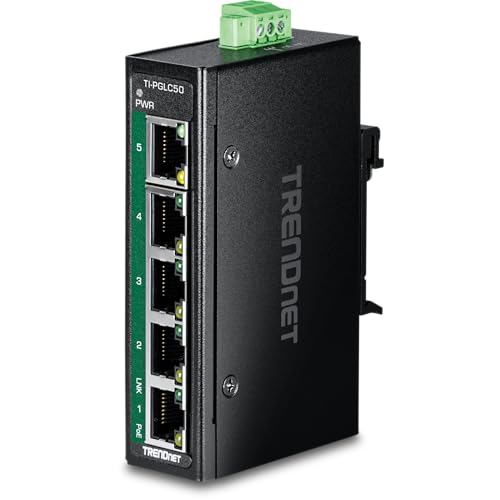 | TRENDnet TI-PGLC50Best brand | Industrial, enclosure | 4 PoE+ + 1 | Gigabit PoE+ | $79.99 |
 | 5-Port 12 to 48V DC IndustrialBest for solar | IP40, minus 40 to 75 °C | 5 PoE | 120 W | $92.90 |
 | 4-Port Outdoor IP67 ExtenderMost rugged | IP67, exposed | 4 PoE | Gigabit PoE | $323.30 |
An IP rating has two digits. The first is protection against solids, the second against water, and the second is the one that gets ignored.
IP40, protected against solid objects over 1 mm. Second digit is 0: no water protection whatsoever. This describes the overwhelming majority of switches sold as “industrial” or “outdoor”, including three on this page. They are built for temperature extremes, vibration and dust, inside an enclosure or a control cabinet. Rain will destroy one.
IP65, dust-tight and protected against water jets from any direction. Suitable for exposed mounting in normal weather.
IP67, dust-tight and protected against temporary immersion in up to 1 m of water. This is what you want for a pole mount, an unprotected wall, or anywhere that floods.
So there are two valid approaches:
An IP40 industrial switch inside a weatherproof enclosure. A NEMA 4X or IP66 enclosure costs $40 to 80 and gives you room for the switch, a power supply, surge protectors and spare cable. This is what professional installers do, and it is cheaper and more flexible than buying an IP67 switch, you can service it, expand it, and replace the switch without replacing the housing.
A genuinely IP67 switch mounted directly. Right when there is nowhere to put an enclosure, or the run is a simple camera chain along a fence. More expensive per port and harder to expand, but there is nothing to install beyond the switch itself.
Whichever you choose, fit surge protection. Any cable that leaves a building is a lightning path, a nearby strike induces a surge that travels back into your switch and everything attached to it. Ethernet surge protectors cost $15 to 30 and are the cheapest insurance in the job.
Temperature range is not marketing. A consumer switch is typically rated 0 °C to 40 °C. An unheated garage in winter and a sealed enclosure in July summer sun both fall outside that. Industrial switches rated minus 40 °C to 75 °C exist because those conditions are real. Remember that a dark enclosure in direct sun runs far hotter than ambient air, 60 °C inside is common on a 35 °C day.
Fanless is mandatory outdoors. A fan pulls in moisture, dust, insects and pollen, and it is a moving part that fails. Every switch here is passively cooled through an aluminium housing, which is the only sensible design for an unattended location.
DIN rail mounting is the standard for a reason. A 35 mm DIN rail inside an enclosure lets you clip in the switch, a power supply and surge protectors side by side, and swap any of them in seconds without tools. If you are building an enclosure, use a rail.
Check the input voltage. Some industrial switches accept a wide 12 to 48 V DC range, which is what lets them run from a solar controller, a vehicle system or an existing 12 V supply at a remote site. Others need a fixed 48 V or 52 V adapter. On an off-grid installation this decides whether the switch works at all.
PoE passthrough is worth knowing about for camera runs: the switch is itself powered by PoE from upstream and passes power on to devices downstream. That means no local power at all, one cable arrives and everything works, which is what makes a chain of cameras along a fence line practical.
Eight gigabit PoE+ ports plus two uplinks, 120 W of power and a minus 40 °C to 85 °C range for $106, this is the sensible core of most outdoor installations, mounted inside an enclosure.
The port count is what makes it the default. Four-port switches are cheap, but outdoor projects grow: the camera at the gate becomes four cameras, an access point in the garden and a switch in the shed. Eight PoE ports plus two uplinks gives you room to expand without a second enclosure.
The two uplink ports matter more than they look. One goes back to the house; the second can chain to another switch further out, or provide a redundant path. Most industrial switches at this price have one uplink and force a daisy chain.
An industrial 52 V DIN-rail power supply is included, with short-circuit, over-voltage and overload protection, buying a separate industrial PSU would cost $30 to 40 on its own.
The 85 °C upper limit is the highest here, which matters specifically for enclosures in direct sun where internal temperature far exceeds ambient.
To be clear about the rating: this is IP40. It goes in an enclosure. Budget another $40 to 80 for a NEMA 4X box and plan the mounting before you buy.
Buy it as the core of an outdoor install inside an enclosure, cameras, APs and an outbuilding.
This is the switch for when there is genuinely nowhere to put an enclosure, a pole in a field, a fence post, the underside of a soffit.
IP67 means dust-tight and able to survive temporary immersion in a metre of water. The cable interfaces sit inside the shell behind waterproof caps, so the only weak point is the seal you make during installation. Note the assembly order: the cable passes through the waterproof cap first, and only then do you crimp the RJ45 connector, get that backwards and the plug will not fit through the gland.
PoE passthrough is the real feature. The switch takes up to 90 W of 802.3bt power in over its uplink and passes it on: 60 W on output port 1 and 30 W on port 2. It needs no local power at all. One cable arrives from the house, and two powered devices work at the far end.
Three-level cascading is supported, so you can chain these along a fence line, camera, camera, camera, with a single cable feeding the whole run. That is the classic use case and this does it well.
Two limitations worth planning around. Passive 24 V PoE is not supported, so older Ubiquiti gear needs its own injector. And two output ports is not many, this extends and splits a run rather than serving as a hub.
Buy it when there is nowhere to mount an enclosure and no power at the far end.
At $45.99 including a UL-certified power supply, this is the cheapest way to get genuinely industrial temperature tolerance into an outdoor enclosure.
Four PoE ports at up to 30 W each with a 60 W total budget covers a realistic small install: two or three cameras, or two cameras and an access point. The fifth port uplinks back to the house.
The protection set is the reason to choose it over a consumer switch: anti-lightning, anti-static and anti-overload protection, with dual power supply input and automatic fault switching. Reverse-polarity protection means a miswired supply will not destroy it, genuinely useful when wiring in a cramped enclosure with a headtorch.
Aluminium alloy housing with surface grooves for heat dissipation, an integrated DIN-rail clip, and IP40 rating across minus 40 °C to 75 °C.
The significant limitation is speed: 10/100 Mbps only, not gigabit. For IP cameras that is usually fine, a 4K camera stream is typically 8 to 16 Mbps, so four cameras fit comfortably in 100 Mbps. For an access point or anything moving real data, it is a hard cap. Check what you are connecting before choosing this over the gigabit options.
Buy it for two or three IP cameras where 100 Mbps is ample and budget is tight.
Two things separate the TRENDnet from the generic industrial switches: it is genuinely tiny, and it clears government procurement rules.
At 3.95″ × 2.36″ × 1″ it is among the smallest industrial PoE switches made. That matters when the enclosure is already crowded with a power supply, surge protectors and a service loop of cable, a switch that takes half the rail space of a competitor can be the difference between a tidy install and a second enclosure.
NDAA and TAA compliance is the other reason to pay the premium. Any installation for a government agency, school, municipality or defence-adjacent contractor will require it, and generic imports do not qualify. If your project has procurement rules, this is often the only switch on this page you are allowed to use.
Four gigabit PoE+ ports plus one gigabit uplink, full gigabit throughout, unlike the cheaper MokerLink’s 10/100 ports.
TRENDnet backs it with a 2-year warranty and English-speaking support during business hours. On an outdoor install that may be running unattended for years, having a manufacturer to call is worth something real.
Like the others, this is enclosure hardware, industrial-rated for temperature and vibration, not weatherproof on its own.
Buy it for a tight enclosure or a project with procurement rules, size and compliance are the reasons.
The wide 12 to 48 V DC input is the whole reason this switch exists, and for off-grid sites it is decisive.
Most PoE switches demand a fixed 48 V or 52 V supply. At a remote site, a solar-powered camera post, a boat, a vehicle, an agricultural building running on 12 V, you do not have that, and adding an inverter to make mains to then make 48 V is wasteful and fragile.
This switch takes whatever you have between 12 and 48 V and boosts it internally to the 48 V that PoE requires. Connect it straight to a solar charge controller or a battery bank and it works, delivering 802.3at at up to 30 W per port with a 120 W total budget.
It also supports redundant power input, so you can wire both a solar supply and a backup and have it switch automatically.
Physically it is tiny, 3.74″ × 2.76″ × 1.18″, in an industrial aluminium housing rated minus 40 °C to 75 °C, with both DIN-rail and wall-mount hardware included.
Five gigabit ports total. There is no separate uplink, so one of the five carries the return path, leaving four for devices.
Buy it for an off-grid or solar-powered site, a boat, or a vehicle running on 12 V.
This is specialist hardware at a specialist price, and it is worth being clear about when the $323 is justified and when it is not.
It combines IP67 weatherproofing with four gigabit PoE ports, a combination almost nothing else offers. The $69.99 IP67 unit above has only two outputs; the eight-port options are all IP40 and need enclosures. If you need four powered devices at a fully exposed location, this is close to the only answer.
It also works as a PoE repeater, regenerating both data and power to extend a run beyond the 100 m Ethernet limit, useful along a long perimeter where an enclosure and a local power feed would be impractical.
The honest calculation: an eight-port industrial switch at $106 plus a good NEMA 4X enclosure at $60 comes to $166 for twice the ports and easier servicing. That is the better buy whenever there is somewhere to mount a box.
Buy the IP67 unit when there genuinely is not: a pole in open ground, a mast, a structure you cannot attach an enclosure to, or a marine environment where salt spray would find its way into any box you built.
The product listing is unusually sparse on specification, so confirm the exact PoE budget and port speeds with the seller before ordering at this price.
Buy it only when an enclosure is genuinely impossible, a mast, open ground, or a marine site.
Only in a heated, ventilated one, and then barely. A consumer switch is rated 0 °C to 40 °C, and a sealed enclosure in summer sun regularly exceeds 60 °C inside while winter takes it below freezing. Industrial switches rated minus 40 °C to 75 °C cost $46 upward, which is less than replacing a consumer switch each year.
IP65 or IP67 for direct exposure. IP40, which covers most “industrial” switches, offers no water protection and must go inside a weatherproof enclosure. Check the second digit of the rating: 0 means no water protection at all, regardless of how rugged the housing looks.
Usually yes, where you can mount one. An IP40 industrial switch plus a NEMA 4X enclosure costs less than an equivalent IP67 switch, gives you more ports, and leaves room for surge protectors, a power supply and spare cable. You can also service or replace the switch without touching the housing. IP67 wins only where there is nowhere to put a box.
Yes. Any Ethernet cable that leaves a building is a lightning path, a nearby strike, not a direct hit, induces a surge that travels into the switch and everything connected to it. Ethernet surge protectors cost $15 to 30 each and belong at both ends of any outdoor run.
A PoE passthrough switch is powered by PoE from upstream and passes power on to devices downstream, so it needs no local power supply. It is what makes a chain of cameras along a fence practical: one cable from the house powers the whole run. You need it when there is no mains supply at the switch’s location.
Not directly, 100 m is the Ethernet limit and PoE voltage drop makes long runs marginal before that. Use a PoE extender or a passthrough switch at the midpoint to regenerate both data and power. Also use 23 AWG solid copper cable rather than 24 AWG, which meaningfully reduces voltage drop over distance.
For most outdoor installations, buy the Industrial 8-Port Gigabit PoE+ DIN-Rail switch at $105.99 and put it in a NEMA 4X enclosure. That gives you eight PoE ports, two uplinks, 120 W and an 85 °C ceiling for around $166 all-in, more capable and easier to service than any sealed unit at the price.
Buy the IP67 PoE passthrough switch at $69.99 instead when there is nowhere to mount a box and no power at the far end, a fence line, a pole, a chain of cameras. And whichever route you take, fit surge protectors at both ends. Every outdoor run is a lightning path, and $30 of protection is cheaper than the switch, the cameras and the router behind them.
Disclosure: Networking Signal is a participant in the Amazon Services LLC Associates Program. We earn a commission on qualifying purchases made through links on this page, at no additional cost to you. Prices shown were accurate at the time of writing and may change. Enclosures, surge protectors and mounting hardware are sold separately unless a listing states otherwise.
Hand-picked articles you might also find useful.
 Switching
 An Ethernet frame carries the destination and source MAC, an EtherType or length field, the payload, and a…
 Switching
 In the world of modern technology, networking plays a crucial role in enabling seamless connectivity between devices. One…
 Switching
 A managed switch gives you VLANs, STP, SNMP and port control; an unmanaged switch just forwards frames. Here…