
Cyber Security Goals and Three Pillar of Cyber Security
What is the Goal of Cyber Security? The goal of cyber security is to protect electronic information and…
ESP Encapsulating Security Payload is a data security protocol that provides confidentiality, authenticity, and integrity for data in transit. It is often used in conjunction with the Internet Protocol Security (IPsec) suite of protocols.
ESP uses a symmetric key algorithm to encrypt data and can optionally use an asymmetric key algorithm to authenticate the sender. ESP can be used in both transport and tunnel modes.
ESP has two main parameters:
The SPI is a 32-bit value used to identify a packet’s particular security association.
The sequence number is a 32-bit value used to protect against replay attacks.
ESP also has several optional parameters, such as the padding length, the IV, and the authentication data.
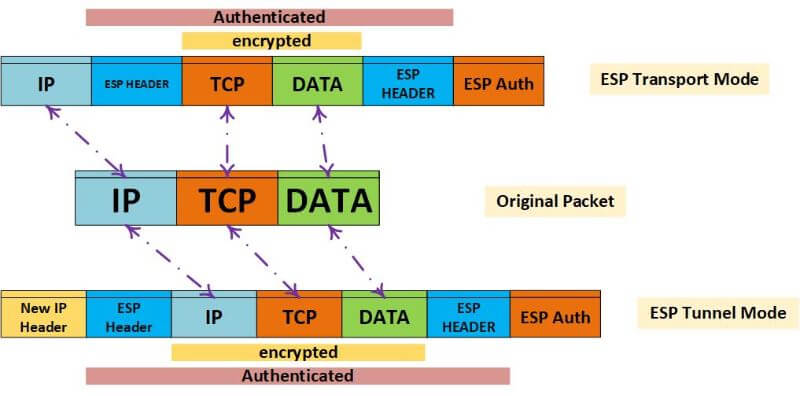
Here are the steps of the process:
1. The sending host encapsulates the data to be protected with an ESP header.
2. The sending host encrypts the data using a symmetric key algorithm.
3. The sending host optionally authenticates the data using an asymmetric key algorithm.
4. The sending host sends the encapsulated and encrypted data to the receiving host.
5. The receiving host decapsulates the data and verifies the authenticity of the data.
6. The receiving host decrypts the data using a symmetric key algorithm.
7. The receiving host optionally authenticates the data using an asymmetric key algorithm.
8. The receiving host delivers the decrypted data to the application.
The key size for ESP Encapsulating Security Payload is 128 bits. We can use a larger key size, but it is not recommended as it can impact performance.
ESP is a key protocol for providing data security in cyberspace. It is often used in conjunction with IPsec to provide a complete security solution for data in transit. ESP can help to protect data from eavesdropping, tampering, and replay attacks.
Hand-picked articles you might also find useful.
 Security
 What is the Goal of Cyber Security? The goal of cyber security is to protect electronic information and…
 Security
 Denial-of-service (DoS) attacks are a significant threat to any organization with an online presence. These attacks attempt to…
 Security
 Windows Firewall logging is off by default. How to turn it on per profile, where the log lives,…