
192.168.0.1 Router Login — Default IP, Username & Password
How to access 192.168.0.1 router login page — step-by-step guide, default username and password for all brands, troubleshooting,…
The ASUS RT-BE86U ($199) is the best router for a PS5, not because it is fast, but because its 2.6 GHz quad-core processor runs QoS and adaptive traffic prioritisation without adding latency of its own. For gaming, consistent low latency is the whole game.
Two PS5 hardware facts change what is worth buying. The console has a gigabit Ethernet port, so a router’s 2.5 Gbps and 10 Gbps ports do nothing for it. And its wireless is WiFi 6 only, not 6E, not WiFi 7, so a 6 GHz band and Multi-Link Operation are unusable by the console. Buy those features for the rest of your house if you want, but not for the PS5.
And wire it. A $10 Ethernet cable improves PS5 latency more than any router on this page.
| Product | Router | Processor | Gaming QoS | PS5 can use | Price |
|---|---|---|---|---|---|
 | ASUS RT-BE86UBest overall | 2.6 GHz quad | Adaptive QoS | 5 GHz + 1G port | $199.00 |
 | TP-Link Archer AXE75Best value | 1 GHz dual | Basic QoS | 5 GHz + 1G port | $99.00 |
 | ASUS RT-BE58UBest mid-range | Quad-core | Adaptive QoS | 5 GHz + 1G port | $144.99 |
 | TP-Link Archer BE600Premium pick | Multi-core | HomeShield QoS | 5 GHz + 1G port | $189.99 |
 | TP-Link Deco X55 (3-pack)If PS5 is far away | Mesh | Basic QoS | 5 GHz + 3 × 1G | $149.97 |
 | TP-Link Archer AX55Budget pick | Dual-core | Basic QoS | 5 GHz + 1G port | $74.99 |
 | TP-Link Archer AX21Cheapest | Dual-core | Basic QoS | 5 GHz + 1G port | $59.99 |
Before spending anything, it is worth knowing exactly what the console’s network hardware supports, because a lot of router money gets spent on features the PS5 physically cannot touch.
Ethernet: gigabit only. The PS5 has a single 1 Gbps port. A router’s 2.5 Gbps or 10 Gbps ports are irrelevant to the console. Buy them if your PC or NAS will use them, not for the PlayStation.
Wireless: WiFi 6, and nothing newer. The PS5 supports 802.11ax on 2.4 and 5 GHz. It does not support WiFi 6E, so it cannot see or use a 6 GHz band. It does not support WiFi 7, so Multi-Link Operation and 320 MHz channels do nothing for it. A tri-band or WiFi 7 router still benefits your household, by moving other devices off 5 GHz and leaving it clearer for the console, but the console itself gains nothing directly.
Bandwidth is not the constraint anyway. Online play uses very little: most competitive titles send a few hundred kilobits per second. What ruins the experience is latency variance, ping that sits at 25 ms and then spikes to 200 ms when someone starts a download. Downloads want bandwidth; gameplay wants consistency.
So the specification that matters is the router’s processor and QoS quality. Good Quality of Service holds the console’s traffic at the front of the queue when the network is busy, and it takes real processing power to do that without adding delay. This is the one place where a $200 router genuinely beats a $60 one for gaming.
Run an Ethernet cable. This is not optional advice if you care about competitive play. A wired PS5 has lower and far more consistent latency than any wireless setup, eliminates interference entirely, and removes packet loss. A 25-foot Cat 6 cable costs about $10 and will do more than a $200 router. Flat cables run under carpet edges and along skirting if a visible cable is the objection.
Enable QoS and prioritise the PS5. Find your console’s MAC address under Settings → System → System Software → Console Information, then set it as the highest-priority device in your router’s QoS settings. This is what stops a family member’s 4K stream from spiking your ping mid-match.
Check your NAT type. Go to Settings → Network → Connection Status. NAT Type 1 or 2 is fine. Type 3 will cause matchmaking failures and party chat problems, and usually means double NAT, two routers both doing network address translation, typically an ISP gateway plus your own router. Put the ISP gateway in bridge mode to fix it. Enabling UPnP on your router also helps the console open the ports it needs automatically.
The RT-BE86U is the best PS5 router because of its processor, which is an unglamorous thing to pay $199 for and also the correct thing.
Quality of Service works by inspecting traffic and deciding what goes first. Doing that at gigabit speeds requires real computation, and on an underpowered router the QoS engine itself becomes a source of latency, which is why enabling QoS on a cheap router sometimes makes gaming worse. A 2.6 GHz quad-core CPU has the headroom to classify and prioritise traffic without adding measurable delay.
ASUS’s Adaptive QoS goes further than a simple priority list: it identifies gaming traffic by type and keeps it ahead of downloads and streaming automatically, without you having to maintain rules. Set the PS5 as a priority device once and it stays correct.
ASUS skips the 6 GHz band here, which for a PS5 owner is the right decision, the console cannot use 6 GHz anyway, and the money goes into the CPU and the wired side instead. The 10 Gbps port will not help the PS5, but it does mean a gaming PC or NAS on the same network never competes with the console for wired bandwidth.
AiProtection Pro is included permanently with no subscription, and Guest Network Pro lets you segment IoT devices onto their own SSID so smart-home chatter stays off the band your console is using.
Buy it if you play competitively on a busy household network and need QoS that actually works under load.
The AXE75 helps your PS5 in an indirect but genuinely effective way: by getting everything else out of its way.
The console cannot use the 6 GHz band, but your phone, your laptop and your tablet probably can. Move them onto 6 GHz and the 5 GHz band becomes far less crowded, which is exactly the band the PS5 is using. You are not making the console faster; you are giving it a quieter road.
That is a more useful $99 than it first appears, and it is the reason a tri-band router is worth considering even though the PS5 will never touch the third radio.
The 1 GHz dual-core CPU with 512 MB of RAM is well ahead of what $99 usually buys, and it is enough to run basic QoS without the engine becoming its own bottleneck. It is not ASUS’s Adaptive QoS, but for a household of four rather than eight it holds up.
Gigabit ports only, which for the PS5 is exactly right, the console has a gigabit port and nothing faster would be used.
Buy it if you have WiFi 6E phones and laptops, move them off 5 GHz and the PS5 gets a clear band.
If the RT-BE86U is more than you want to spend, the RT-BE58U keeps the software that matters, ASUS’s Adaptive QoS and AiProtection Pro, for $54 less.
Adaptive QoS is the reason to choose ASUS for a console. Rather than a static priority list you have to maintain, it recognises traffic types and keeps gaming ahead of downloads and streaming automatically. On a household network where someone is always downloading something, that is the difference between stable ping and unpredictable ping.
Dual-WAN with USB tethering failover is a genuinely useful feature for online play. If your broadband drops mid-session, the router switches to a tethered phone rather than disconnecting you. Speeds drop, but for a game sending a few hundred kilobits per second, a 4G connection is often enough to finish the match.
Three SSIDs let you separate IoT devices from the band the console uses, worth doing, since smart-home devices generate frequent small transmissions that consume airtime out of proportion to their data.
The processor is quad-core but slower than the RT-BE86U’s 2.6 GHz. Under very heavy load, several 4K streams plus large downloads, the more expensive model holds its QoS performance better.
Buy it if you want ASUS’s QoS without RT-BE86U pricing and value the failover connection.
The BE600 is here for the household where the PS5 is one device among many demanding ones, rather than the main event.
Its value for the console is the same indirect argument as the AXE75, but stronger: a full tri-band WiFi 7 radio set means every other device in the house can be moved off the 5 GHz band the PS5 needs. Phones on 6 GHz, smart-home devices on 2.4 GHz, and 5 GHz left comparatively empty for the console.
The 10 Gbps port and four 2.5 Gbps ports do nothing for the PS5 directly, the console maxes out at gigabit. What they do is ensure a gaming PC, a NAS or a multi-gig internet connection never competes with the console for router capacity.
2,600 sq ft of coverage with six antennas is useful if the PS5 sits in a bedroom or basement rather than next to the router, though even then, a cable remains the better answer.
Be clear about the trade: at $190 this is $10 less than the RT-BE86U, and ASUS’s Adaptive QoS is better for gaming specifically. Choose the BE600 if the whole household matters more than the console alone.
Buy it if the whole household is demanding and the PS5 is one device among many.
If your PS5 is two floors from the router and shows a weak connection, no single router fixes that, and this is the situation where a mesh system genuinely beats a better router.
The reason it works for gaming is not the wireless. It is that each node has three gigabit Ethernet ports. Put a node in the room with the console and plug the PS5 in with a short cable. You now have a wired console, with all the latency benefits of wiring, without running Ethernet through the house.
That is the single best outcome available for a distant PS5, and it costs $150 rather than the price of getting a cable installed through walls.
If you can wire the node itself back to the main unit, do, wired backhaul removes the relay penalty entirely and the console performs as though plugged directly into the router. If not, the wireless backhaul is still far better than the console connecting to a distant router directly.
The caveat for competitive play: a wireless mesh backhaul does add a few milliseconds of latency compared with a direct wired run. For most players that is invisible; for ranked competitive play, wire the backhaul.
Buy it if the PS5 is far from the router, a node in that room lets you wire the console cheaply.
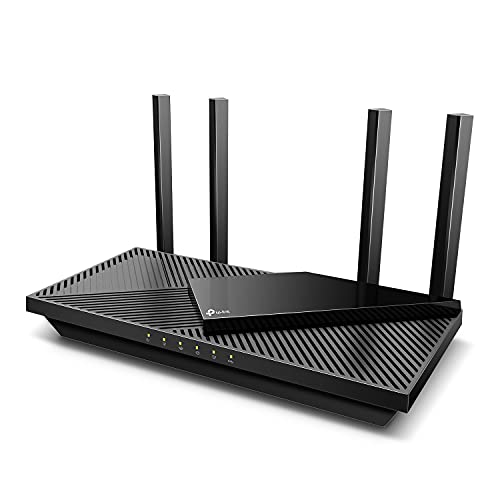
For a wired PS5 on a normal household network, the AX55 at $75 does everything the console can benefit from. Its gigabit ports match the PS5’s gigabit port exactly, and AX3000 on 5 GHz far exceeds what the console needs wirelessly.
The cooling design deserves a specific mention for gaming. A router that thermally throttles produces exactly the symptom players complain about: fine for the first twenty minutes of a session, then rising ping and stutter. TP-Link reworked the AX55’s heatsink and case specifically to avoid that, and it is a more relevant improvement for a long gaming session than any speed figure.
QoS is basic rather than adaptive, you set the console as a priority device manually and it stays there. That is enough for a household of three or four. In a house of eight with constant downloads, ASUS’s adaptive system handles it better.
The honest framing: if your PS5 is wired and your household is normal, this router and a $10 cable give you within a few milliseconds of what the $199 ASUS delivers. The extra $124 buys headroom for a busier network, not lower baseline latency.
Buy it if your PS5 is wired and the household is normal, this is the sensible amount to spend.
Online console gaming uses remarkably little bandwidth, typically well under 1 Mbps for gameplay itself, so AX1800 is not a limitation for the PS5 in any meaningful sense. Game downloads want more, but those are background tasks where an extra few minutes does not matter.
Four gigabit LAN ports mean you can wire the PS5, a TV and a PC without adding a switch, and wiring the console is the highest-value thing you can do regardless of which router you buy.
WiFi 6’s OFDMA still helps indirectly. It lets the router serve multiple devices within one transmission slot rather than queueing them, which reduces how long other devices occupy the channel, and that reduces the airtime contention that causes ping spikes when the network gets busy.
OneMesh gives you an upgrade path if the console turns out to be too far from the router: a $30 OneMesh extender with an Ethernet port lets you wire the PS5 to it, for a total of $90.
What you give up: QoS here is basic and the processor modest, so on a busy network the priority system will not hold up as well as ASUS’s. For a one- or two-person household with a wired console, that will not matter.
Buy it if you want to spend as little as sensibly possible and put the savings into a good cable.
No. The PS5 supports WiFi 6 (802.11ax) on 2.4 and 5 GHz only. It cannot see or connect to a 6 GHz band, and it cannot use WiFi 7 features such as Multi-Link Operation or 320 MHz channels. A tri-band or WiFi 7 router still helps indirectly by moving your other devices off the 5 GHz band, but the console gains nothing directly.
No, it has a gigabit port. A router’s 2.5 Gbps or 10 Gbps ports cannot be used by the console. Those ports are worth having for a gaming PC or a NAS, but they do not improve PS5 performance.
Yes, substantially, and it is the single most effective change you can make. Ethernet gives lower and far more consistent latency, no interference, and no packet loss from wireless contention. A $10 cable improves PS5 gaming more than a $200 router does.
Under 30 ms is good, 30 to 60 ms is playable, and over 100 ms is noticeable in fast-paced games. Consistency matters more than the number: a steady 45 ms feels far better than a connection averaging 25 ms but spiking to 200 ms. Your baseline ping is set by your ISP and the distance to the game server, no router lowers it, but a good one stops it spiking.
NAT Type 3 almost always means double NAT, two devices doing network address translation, usually your ISP gateway plus your own router. Put the ISP gateway into bridge mode so only your router routes. Enabling UPnP on your router also lets the console open the ports it needs automatically. Check the result under Settings → Network → Connection Status.
Not your baseline ping, which is determined by your ISP’s routing and your distance to the game server. What a good router does is prevent ping spikes when your network is busy, by prioritising console traffic ahead of downloads and streams. That is the improvement players actually feel, and it depends on the router’s processor and QoS quality rather than its advertised speed.
Wire your PS5 first. A $10 Ethernet cable does more for latency than any router here, and every recommendation below assumes you have done it.
After that, the ASUS RT-BE86U at $199 is the best choice for a busy household, because its 2.6 GHz quad-core processor runs Adaptive QoS without becoming a source of latency itself. For a normal household with a wired console, the Archer AX55 at $75 gets you within a few milliseconds of that, the extra money buys headroom for a busier network, not a lower baseline. And if the console sits far from the router, the Deco X55 three-pack lets you put a node in that room and wire the PS5 to it, which beats every wireless option regardless of price.
Disclosure: Networking Signal is a participant in the Amazon Services LLC Associates Program. We earn a commission on qualifying purchases made through links on this page, at no additional cost to you. Prices shown were accurate at the time of writing and may change. We are not affiliated with Sony Interactive Entertainment; PS5 hardware specifications cited are from Sony’s published documentation.
Hand-picked articles you might also find useful.
 Router Login
 How to access 192.168.0.1 router login page — step-by-step guide, default username and password for all brands, troubleshooting,…
 Routers
 Tri-band means a third radio — either a second 5 GHz band or a 6 GHz band on…
 Routers
 Having an internet connection that is split between two wireless routers can help you to have faster, more…
2 responses to “7 Best Routers for PS5 in 2026 (What the Console Can Actually Use)”
Good evening.
I want to buy a gaming router. Can you advise me on the best router for gaming on PS5?
I was looking at two routers GT-AX11000 Republic Of Gamers WiFi 6
Al Mesh Gigabit tri-band wireless
ASUS ROG Rapture GT-AXE16000 gaming router
Perhaps you can suggest better options, or which of these routers will work better with PS5
Thank you very much
I will go with ASUS ROG Rapture GT-AXE16000 gaming router.