
What is VOIP Voice Over Internet Protocol?
f you’ve ever had to deal with complicated telephone networks or outdated equipment, you know how frustrating it…
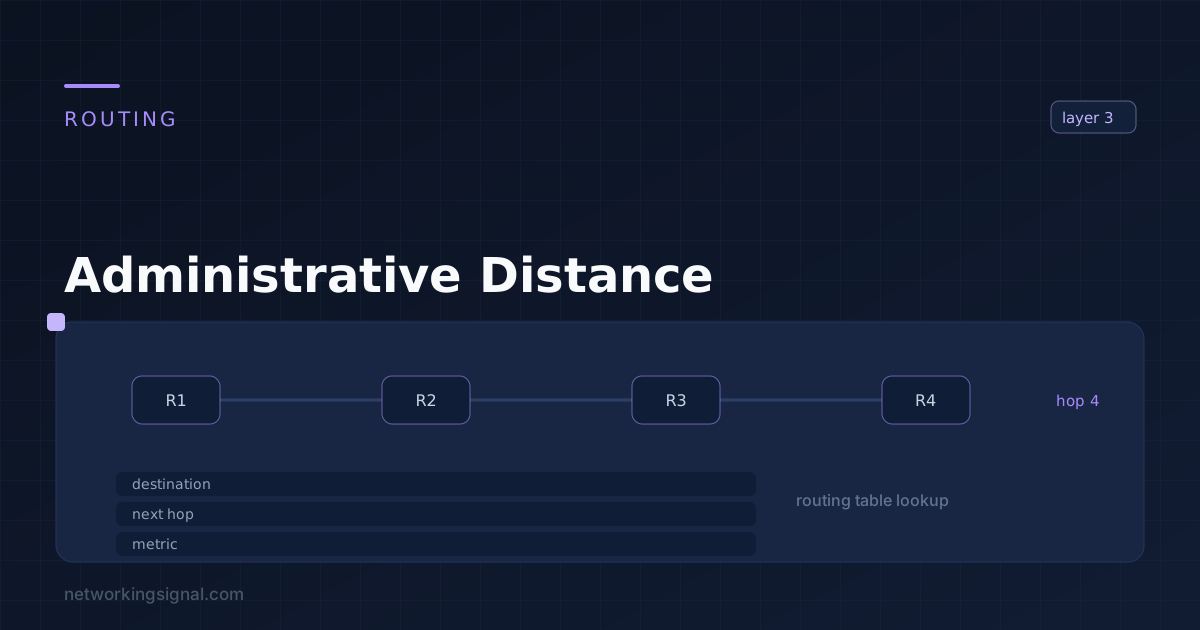
Administrative distance (AD) is how a router decides which source of routing information to trust when more than one offers a path to the same destination. It is a trustworthiness rating from 0 to 255, and lower is more trusted.
If OSPF and EIGRP both learn a route to 10.20.0.0/16, the router does not compare their metrics, the metrics are not comparable, since one counts cost and the other bandwidth and delay. It compares administrative distance. EIGRP’s 90 beats OSPF’s 110, so the EIGRP route is installed in the routing table and the OSPF one is not.
| Route source | AD |
|---|---|
| Connected interface | 0 |
| Static route | 1 |
| EIGRP summary route | 5 |
| External BGP (eBGP) | 20 |
| Internal EIGRP | 90 |
| IGRP | 100 |
| OSPF | 110 |
| IS-IS | 115 |
| RIP | 120 |
| External EIGRP | 170 |
| Internal BGP (iBGP) | 200 |
| Unknown / unreachable | 255 |
An AD of 255 means the route is never installed. Setting a route’s AD to 255 is a way of administratively disabling it without deleting it.
| Administrative distance | Metric | |
|---|---|---|
| Compares | Different routing protocols | Different paths within one protocol |
| Evaluated | First | Only after AD ties |
| Scope | Local to the router | Local to the router |
| Based on | Trust in the source | Cost, bandwidth, delay, hop count |
The router’s decision order for identical prefixes is:
/24 beats a /16 regardless of AD or protocol. This trumps everything else.Step 1 is the one people forget. A more specific route from RIP will be used over a less specific route from OSPF, because prefix length is compared before trust.
AD is not carried in any routing update. It exists only in the router evaluating the route. You can set EIGRP to 200 on one router and leave it at 90 everywhere else, and only that one router changes behaviour.
That makes AD a precise tool, and a source of extremely confusing routing loops if applied inconsistently, because two routers can each believe the other is the better next hop.
Router(config)# ip route 10.20.0.0 255.255.0.0 192.168.1.1 210The trailing 210 is the AD. This is the floating static route, the most common legitimate use of AD manipulation.
You want a backup path that is used only when the primary protocol-learned route disappears:
! Primary: learned via OSPF, AD 110

! Backup: static route via the secondary link, AD 210
Router(config)# ip route 0.0.0.0 0.0.0.0 203.0.113.2 210
Because 210 is worse than OSPF’s 110, the static route sits inactive. If OSPF loses the route, the static installs itself immediately. When OSPF recovers, it takes over again. Set the AD above the protocol you are backing up, and below 255.
! OSPF, all routes, or selectively
Router(config-router)# distance 115
Router(config-router)# distance ospf external 130

! EIGRP, internal and external separately
Router(config-router)# distance eigrp 90 170

! BGP, external, internal, local
Router(config-router)# distance bgp 20 200 200Router(config)# access-list 10 permit 10.20.0.0 0.0.255.255
Router(config-router)# distance 150 192.168.1.1 0.0.0.0 10This changes AD to 150 only for routes matching ACL 10 received from neighbour 192.168.1.1.
Router# show ip route
Router# show ip route 10.20.0.0
Router# show ip protocols
In show ip route, each entry shows [AD/metric]:
D     10.20.0.0/16 [90/2172416] via 192.168.1.1, 00:04:12, GigabitEthernet0/1
                    └┬┘ └───┬──┘
                    AD    metric
show ip route <prefix> is the command to reach for when a route is not behaving, it shows the AD, the metric, the source protocol and the last update time in one place.
The safe rule: change AD when you have a specific reason, document it, and apply it consistently across every router that participates in the affected paths.
More trustworthy. The route source with the lowest AD wins and its route is installed in the routing table.
eBGP carries routes from outside your autonomous system, and you do not want your IGP overriding an external path. iBGP carries routes inside your AS, where your IGP has better topological knowledge, so iBGP is deliberately rated below every IGP at 200.
No. It is entirely local to the router making the decision. Changing it on one router affects only that router.
A static route configured with an AD higher than the routing protocol it backs up, so it stays inactive until the protocol-learned route disappears. It is the standard way to configure a backup WAN link.
Yes, if they come from the same protocol and have equal metrics, the router load balances across them. Routes from different protocols with the same AD is an unusual state that generally means someone has manipulated AD and should reconsider.
It marks the route as untrusted, and the router will never install it. It is a way to disable a route without removing the configuration.
No. Juniper calls the concept route preference and uses different defaults, OSPF internal is 10, static is 5. The mechanism is identical; the numbers are vendor-specific, so never assume Cisco’s table applies elsewhere. More in the routing protocols guide.
Hand-picked articles you might also find useful.
 Routing & Switching
 f you’ve ever had to deal with complicated telephone networks or outdated equipment, you know how frustrating it…
 Routing & Switching
 An Ethernet Splitter and an Ethernet Switch are two different devices that can offer a variety of capabilities…
 Routing & Switching
 A hub is one collision domain; each switch port is its own. A switch is one broadcast domain;…