
What is Network Administrator and Its Skills, and Role
What is Network Administrator? A Network Administrator is a professional responsible for the maintenance, configuration, and reliable operation…
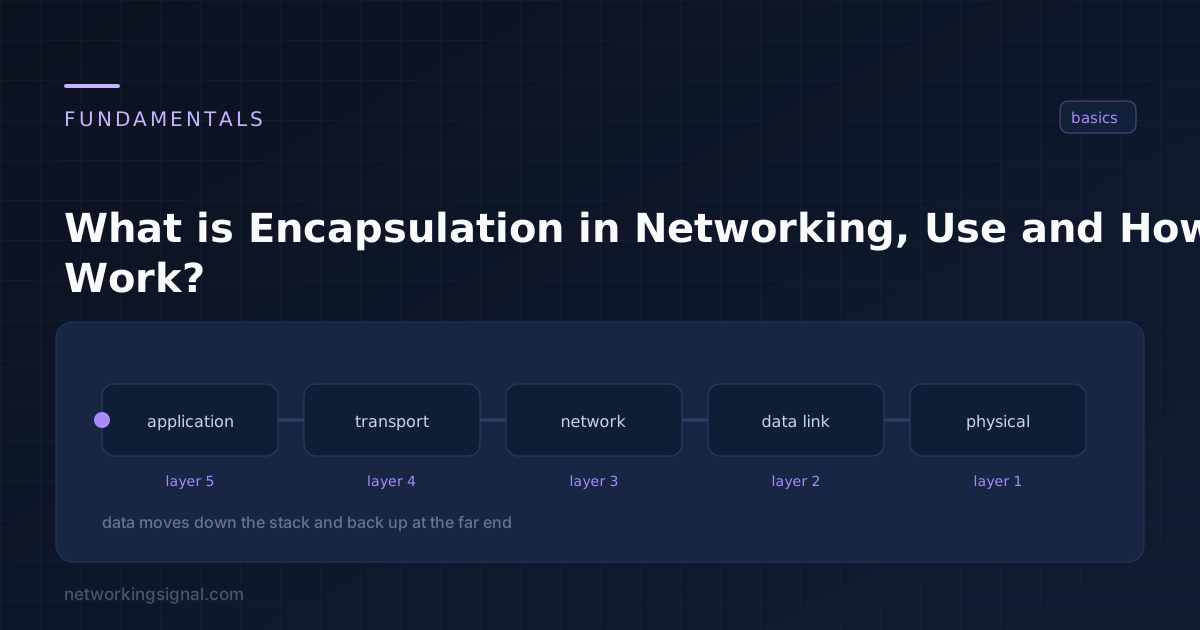
In computer networking, encapsulation is the process of packaging data in a format that can be transmitted over a network. Encapsulation allows different types of networks to communicate with each other by providing a standard way to pack and unpack data.
Encapsulation is used in various protocols, such as Ethernet, Asynchronous Transfer Mode (ATM), and Point-to-Point Protocol (PPP).
For Example:
Encapsulation has several benefits, including the following:
Encapsulation has several disadvantages, including the following:
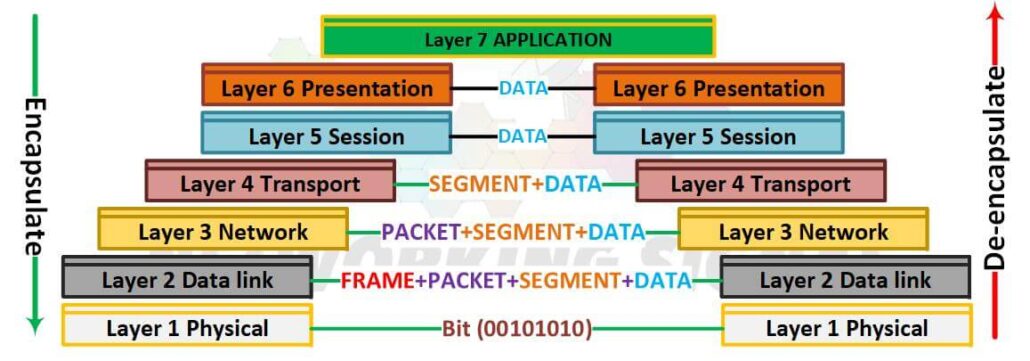
Encapsulation is typically implemented in software, but it can also be implemented in hardware.
Ethernet uses encapsulation to transmit data over Layer 2 networks. An Ethernet frame encapsulates data from the upper layers by adding a header and trailer around it. The header contains the destination and source MAC addresses.
The trailer contains a Frame Check Sequence (FCS) for error detection. This allows multiple upper-layer protocols like IP and ARP to be transmitted over Ethernet networks.
The Internet Protocol (IP) provides internetwork encapsulation. An IP datagram encapsulates the upper layer data by adding an IP header. The IP header contains the source and destination IP addresses which allows routing of packets between different networks.
It also contains fields for fragmentation, Quality of Service (QoS), etc. This allows upper-layer protocols like TCP and UDP to be transmitted between hosts across diverse interconnected networks.
Virtual Private Networks (VPNs) use encapsulation to create secure “tunnels” through public networks. Technologies like IPSec encapsulate upper-layer data with authentication and encryption headers to create VPN tunnels.
This encapsulation hides the original payload and protects its confidentiality and integrity as it traverses public networks. The endpoint VPN devices decrypt the encapsulated data to retrieve the original payload.
Encapsulation is the process of packaging data in a format that can be transmitted over a network.
The most commonly used encapsulation methods are a bit, frame, and packet.
Encapsulation is important in networking because it allows different types of networks to communicate with each other.
Without encapsulation, each type of network would have to use its own unique set of protocols and standards.
Encapsulation makes it possible for different types of networks to interoperate by providing a standard way to pack and unpack data.
Hand-picked articles you might also find useful.
 Routing & Switching
 What is Network Administrator? A Network Administrator is a professional responsible for the maintenance, configuration, and reliable operation…
 Routing & Switching
 An Ethernet Splitter and an Ethernet Switch are two different devices that can offer a variety of capabilities…
 Routing & Switching
 The Internet of Things, or IoT, refers to the interconnectedness of physical objects and devices that are equipped…