
What Does a Router Look Like? Ultimate Guide
When it comes to networking, routers are the backbone of the entire system. Whether it's your home or…

The TP-Link Deco XE75 Pro ($280) is the best mesh system for Xfinity because it has a 2.5 Gbps port, the thing Xfinity’s Gigabit and Gigabit X2 tiers actually need, and the thing most mesh systems still lack. On a plan of 1 Gbps or slower, the Deco X55 three-pack at $150 does everything you need for far less.
Skip the xFi Pods. At $119 each they cost more than a full three-node mesh system, they only work with a rented Xfinity gateway, and they are plug-in extenders rather than a proper mesh. Replacing the gateway’s WiFi entirely is both cheaper and better.
| Product | System | WiFi | Fast port | Coverage | Price |
|---|---|---|---|---|---|
 | TP-Link Deco XE75 Pro (3-pack)Best overall | WiFi 6E tri-band | 2.5 Gbps | 7,200 sq ft | $279.99 |
 | TP-Link Deco X55 (3-pack)Best value | WiFi 6 AX3000 | 1 Gbps × 3 | 6,500 sq ft | $149.97 |
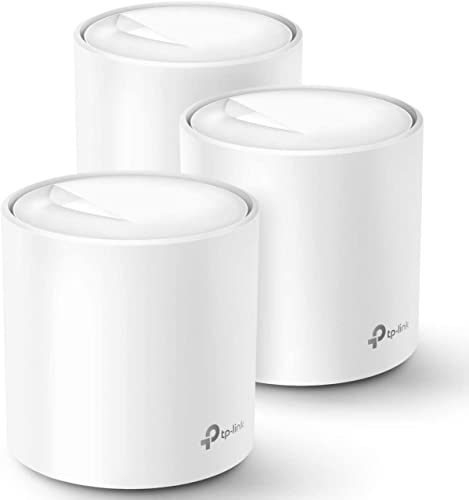 | TP-Link Deco X20 (3-pack)Budget pick | WiFi 6 AX1800 | 1 Gbps × 2 | 5,800 sq ft | $129.97 |
 | Amazon eero 7 (3-pack)Premium pick | WiFi 7 dual-band | 2 × 2.5 Gbps | 6,000 sq ft | $399.99 |
 | ASUS ZenWiFi XT8 (2-pack)Best control | Tri-band AX6600 | 2.5 Gbps | 5,500 sq ft | $249.99 |
 | NETGEAR Orbi 370 (3-pack)Best WiFi 7 value | WiFi 7 dual-band | 2.5 Gbps ready | 6,000 sq ft | $299.99 |
 | Amazon eero 6+ (3-pack)Easiest setup | WiFi 6 gigabit | 1 Gbps × 2 | 4,500 sq ft | $299.99 |
Xfinity sells its own extenders, xFi Pods, at $119 each, and they are the default suggestion when you call support about a dead zone. They are the wrong purchase for almost everyone, and it is worth being specific about why.
The price is not competitive. Two Pods cost $238. A three-node Deco X55 system costs $150 and covers more area with better hardware. Even the XE75 Pro, with a 2.5 Gbps port and a dedicated backhaul radio, costs $280 for three nodes.
They only work with a rented gateway. Pods pair exclusively with an Xfinity xFi Gateway. If you ever buy your own modem to stop paying the $15 monthly rental, which saves $180 a year, your Pods become useless. You are buying hardware that locks you into the fee you should be trying to escape.
They are plug-in extenders, not proper mesh nodes. Pods plug directly into a wall socket, which means they sit at socket height, usually low and often behind furniture. A mesh node you can place on a shelf at head height in open air performs noticeably better for reasons that have nothing to do with its radio.
The better plan is straightforward: put the gateway into bridge mode, or replace it with your own Xfinity-approved modem, and run a real mesh system behind it.
There are two routes, and which you pick depends on whether you want to keep renting the gateway.
Route one, bridge mode (keep the gateway). Sign in at xfinity.com, open the Internet section, select your gateway, and choose Enable Bridge Mode. The gateway stops routing and stops broadcasting WiFi, becoming a plain modem. Connect your mesh system’s main unit to one of its Ethernet ports and set that unit to DHCP. The whole thing takes about five minutes and the gateway restarts once.
Two things to know. Bridge mode disables the xFi app’s device controls, speed tests and pausing, your mesh system’s app replaces all of them, usually with better versions. And bridge mode cannot be enabled if your plan includes Xfinity Voice, because the gateway has to keep routing for the phone service.
Route two, your own modem (stop renting). Buy an Xfinity-approved modem, activate it, return the gateway, and stop paying $15 a month. No bridge mode needed, because a standalone modem does not route in the first place. This saves $180 a year, and over a five-year modem lifespan the saving comfortably exceeds the cost of both the modem and the mesh system.
Whichever route you take, avoid running the gateway and your mesh both in routing mode. Double NAT breaks port forwarding, degrades VoIP and online gaming, and confuses smart-home device discovery. It is the single most common mistake people make when adding a mesh system to Xfinity.
Xfinity’s tiers now reach past 1 Gbps in most markets, and that changes which mesh systems are adequate.
On a plan of 600 Mbps or less, any system here exceeds your connection comfortably. Buy for coverage and features, not for speed.
On a 1 Gbps plan, a mesh with gigabit ports is theoretically at its limit but fine in practice, since you will rarely see the full rated speed over WiFi anyway.
On Gigabit Extra or Gigabit X2, plans above 1 Gbps, a gigabit port becomes a hard cap. The mesh system physically cannot pass more than 1 Gbps through a 1 Gbps port no matter what its radios do. This is where a 2.5 Gbps port stops being a specification and starts being a requirement, and it is why the XE75 Pro and eero 7 lead this list.
Uploads are a separate question. Xfinity’s mid-split rollout raises upload speeds substantially in upgraded areas, but that depends on your modem, not your mesh system, our Xfinity modem guide covers which models support it.
The XE75 Pro is the mesh system that matches what Xfinity actually sells. Its 2.5 Gbps WAN/LAN port means a Gigabit X2 plan is not throttled at the front door, and the tri-band design keeps a dedicated 6 GHz backhaul so satellite nodes are not stealing airtime from your devices.
That combination is rarer than it should be. Plenty of mesh systems have a fast WAN port but a dual-band radio, or a dedicated backhaul but gigabit ports. Getting both under $300 is what puts this at the top for Xfinity specifically.
Coverage is rated at 7,200 sq ft for up to 200 devices, the widest here. Each unit also carries two gigabit LAN ports alongside the 2.5 Gbps one, so a node in a media room can wire a TV and a console directly.
The 6 GHz band defaults to backhaul, but you can switch it to serve clients instead if you have WiFi 6E devices and would rather use it that way. In a typical Xfinity household with a mix of older phones and laptops, leaving it on backhaul is the better choice.
Buy it if you are on Gigabit Extra or Gigabit X2 and want nothing between you and the speed you pay for.
For the majority of Xfinity customers, anyone on 1 Gbps or below, the X55 is the sensible buy, and the $130 you save against the XE75 Pro buys nothing you would use.
AX3000 gives 2,402 Mbps on 5 GHz and 574 Mbps on 2.4 GHz, comfortably above a gigabit plan’s real-world delivery over WiFi. Coverage is 6,500 sq ft for 150 devices.
Three gigabit Ethernet ports on every node is the standout feature at this price. It makes wired backhaul practical, connect nodes with Ethernet and each performs like a main router, while still leaving two free ports at each location for a TV, console or desktop.
It pairs cleanly with a bridged xFi Gateway or with your own modem, and the Deco app replaces the xFi app’s device management with a version that has better parental controls and no requirement to keep renting anything.
Buy it if your plan is 1 Gbps or slower, this covers a large home properly for a third of the flagship price.
At $130 for three WiFi 6 nodes, the X20 is the cheapest system here that still feels like a proper mesh rather than a compromise. It covers 5,800 sq ft and handles 150 devices, the same device ceiling as the X55.
Against the X55 you lose 5 GHz throughput (1,201 Mbps versus 2,402) and one Ethernet port per node. On an Xfinity plan of 400 or 600 Mbps, neither costs you anything real: your connection runs out long before the radio does.
The 2.4 GHz radio still runs at 574 Mbps, which matters for the smart-home devices that make up a growing share of a typical household’s connections and are almost all 2.4 GHz only.
Wired backhaul is supported on both ports, so if you have Ethernet in the walls this system punches well above its price.
Buy it if you are on a 400 to 600 Mbps Xfinity plan and the problem is coverage, not speed.
The eero 7 is the only system here with two auto-sensing 2.5 Gbps ports on every unit, and that is a genuinely useful layout on Xfinity. One takes the incoming connection at full speed; the other gives you a 2.5 Gbps wired link at each node, for a NAS, a desktop, or a wired backhaul that is not itself the bottleneck.
Support for plans up to 2.5 Gbps covers everything Xfinity currently sells, with headroom for whatever comes next. WiFi 7 brings Multi-Link Operation, which keeps latency stable when the network is busy, the improvement you notice in a full house, as opposed to the speed figure you do not.
eero’s setup and TrueMesh routing are still the most reliable in the category. It detects a bridged Xfinity gateway without any configuration and does the right thing.
The cost is the argument against. $400 is more than double the X55, and on a 1 Gbps plan the practical difference is small. It earns its price on Gigabit X2 with wired devices at multiple nodes, and nowhere else.
Buy it if you have Gigabit X2 and wired devices at more than one node, the dual 2.5G ports are the reason.
If losing the xFi app bothers you because you actually used its controls, the XT8 is the system that gives you more than you had rather than less. ASUS exposes real settings, VLANs, per-device QoS, VPN client and server, three separate SSIDs, where TP-Link and eero simplify them away.
Lifetime AiProtection from Trend Micro is included with no subscription, and it is a meaningfully better package than what xFi offers: intrusion prevention, infected-device quarantine, and parental controls with real scheduling and category filtering. That is the free tier, not an upsell.
The tri-band design uses a dedicated 5 GHz backhaul rather than 6 GHz, which reaches further through walls than newer 6E systems do. Combined with a 2.5 Gbps WAN port, it handles a gigabit-plus Xfinity plan without capping.
Two limitations. It is a two-pack covering 5,500 sq ft, so a large home needs a third node, though AiMesh lets that be any compatible ASUS router rather than a matched unit. And the interface is denser than the Deco or eero apps; that is the trade for the control.
Buy it if you want more control than xFi ever gave you and security features without a subscription.
Orbi has historically started at $500 and gone up, so a three-node WiFi 7 system at $300 is a real shift. For an Xfinity household wanting WiFi 7 without eero 7 money, this is the way in.
It is ready for plans up to 2.5 Gbps and works with any provider’s equipment, so a bridged Xfinity gateway or your own modem both connect without fuss. Enhanced Backhaul mitigates the airtime cost of relaying on a dual-band system, not as good as a dedicated third radio, but better than a plain dual-band mesh.
Coverage is 6,000 sq ft across three nodes. WiFi 7’s benefits show up most in local traffic and in a house with many simultaneous devices, where MLO keeps latency flat rather than raising peak speed.
Two caveats. The 70-device ceiling is the lowest here, well under the Deco X55’s 150, which is worth checking against your actual device count, since a modern household with smart bulbs, sensors and cameras reaches 70 faster than people expect. And NETGEAR’s advanced security is a subscription where ASUS and TP-Link include comparable features.
Buy it if you want WiFi 7 across three nodes at the lowest price and your device count stays under 70.
If the reason you are reading this is that the Xfinity gateway’s WiFi frustrates you and you want the problem to go away permanently, eero is the least demanding way to do that. The app walks through everything, detects a bridged gateway automatically, and then largely runs itself.
TrueMesh routing decides which node each device uses and re-routes when conditions change, without any configuration. Firmware updates apply automatically overnight, a genuine advantage over systems where a stalled update is a common cause of degraded performance months later.
It supports plans up to a gigabit, which covers most Xfinity tiers but not Gigabit Extra or X2. If you are on one of those, the eero 7 is the model to look at instead.
Coverage is 4,500 sq ft, the narrowest here, so a large home may need a fourth node. And the parental controls and content filtering are behind eero Plus, worth factoring in, since replacing xFi’s controls is often the reason people buy in the first place.
Buy it if you want to stop thinking about WiFi and your plan is a gigabit or below.
Yes, if you keep the Xfinity gateway. Without bridge mode both devices route, producing double NAT, which breaks port forwarding, degrades VoIP and gaming, and disrupts smart-home discovery. Enable it at xfinity.com under Internet, then your gateway settings. If you use your own modem instead, no bridge mode is needed.
Rarely. At $119 each they cost more than a complete three-node mesh system, they only work with a rented Xfinity gateway, and they are plug-in extenders rather than true mesh nodes. A $150 Deco X55 three-pack outperforms two Pods for less money and does not tie you to the $15 monthly rental.
Yes, bridge mode disables xFi’s device management, pausing and speed tests. Your mesh system’s own app replaces them, and generally with better versions: TP-Link’s HomeShield and ASUS’s AiProtection both offer more capable parental controls than xFi, without a monthly fee.
One with a 2.5 Gbps WAN port. A gigabit port is a hard cap, the system cannot pass more than 1 Gbps through it regardless of its wireless capability. The TP-Link Deco XE75 Pro, ASUS ZenWiFi XT8 and Amazon eero 7 all have 2.5 Gbps ports; most cheaper mesh systems do not.
Yes, but not in bridge mode. Xfinity Voice requires the gateway to keep routing for the phone service, so bridge mode is unavailable. The workaround is to disable the gateway’s WiFi where the app allows it and accept double NAT, or to place phone service on a separate line. Expect port forwarding and some smart-home features to misbehave.
If your plan does not include Xfinity Voice, usually yes. A $130 modem eliminates the $15 monthly gateway rental, paying for itself in about nine months and saving $180 a year after that. It also removes the need for bridge mode, since a standalone modem does not route.
On Gigabit Extra or Gigabit X2, buy the TP-Link Deco XE75 Pro, the 2.5 Gbps port is not a luxury on those tiers, it is what stops your mesh from capping the speed you are paying for.
On 1 Gbps or below, which is most Xfinity customers, the Deco X55 three-pack at $150 covers a large home with three Ethernet ports per node and leaves $130 in your pocket. Whichever you choose, enable bridge mode first, or better, buy your own modem and stop paying the rental entirely, which over five years saves more than the mesh system costs.
Disclosure: Networking Signal is a participant in the Amazon Services LLC Associates Program. We earn a commission on qualifying purchases made through links on this page, at no additional cost to you. Prices shown were accurate at the time of writing and may change. We are not affiliated with Comcast or Xfinity; plan names, speeds and equipment fees are set by Comcast and vary by market.
Hand-picked articles you might also find useful.
 Routers
 When it comes to networking, routers are the backbone of the entire system. Whether it's your home or…
 Routers
 If you're like most people, you probably have a router in your home that you use to connect…
 Routers
 A dual band router broadcasts on 2.4 GHz and 5 GHz at once. What that buys you, how…