
Navigating NAS Data Recovery: What You Need to Know
Data recovery is quickly becoming a general knowledge requirement for everyone. Of course, many people now use data…
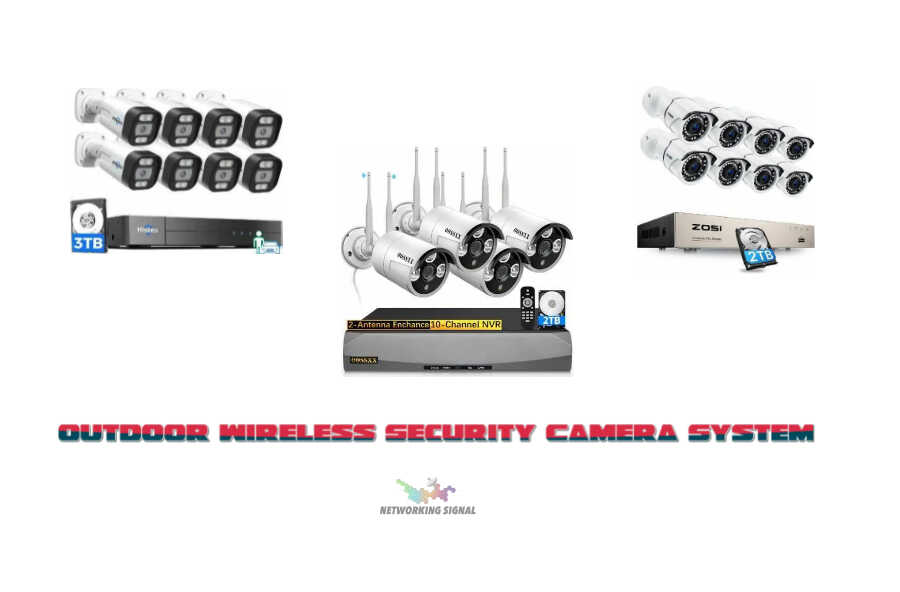
The ANNKE 16CH WiFi kit ($429.99) is the best value wireless NVR system: twelve cameras, a 2TB drive and no subscription.
But read this first, because it changes the decision. Wireless here means no video cable, not no cable. Every camera still needs mains power at the mounting point. ANNKE says so in the listing: the box contains thirteen power adapters.
So you are running a cable to each camera regardless. Once that is true, PoE is strictly better, because one Ethernet cable carries power and video together, with no WiFi interference and no bandwidth ceiling. The Reolink RLK8-800B6 ($799.99) is the system to buy if you can run cable.
Choose wireless only when there is already a power socket where the camera goes.
| Product | System | Link | Cameras | Storage | Price |
|---|---|---|---|---|---|
 | ANNKE 16CH WiFi, 12 camerasBest wireless | WiFi | 12 x 2K | 2TB | $429.99 |
 | Reolink RLK8-800B6Best overall | PoE | 6 x 4K | 2TB | $799.99 |
 | ANNKE 16CH WiFi, 8 camerasBest value | WiFi | 8 x 3MP | 2TB | $303.99 |
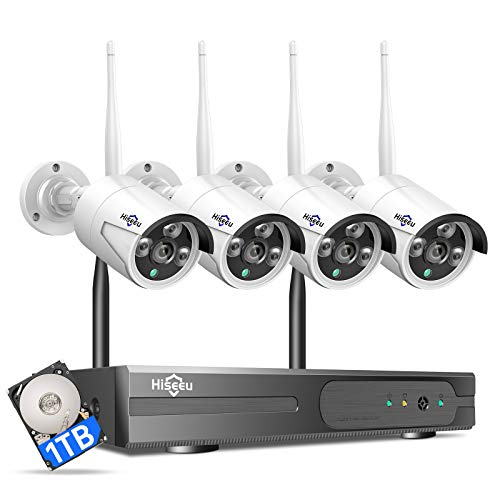 | Hiseeu 4 camera kitBudget pick | WiFi | 4 x 3MP | 1TB | $169.99 |
 | Hiseeu 8 camera, 3TBMost storage | WiFi | 8 x 5MP | 3TB | $299.99 |
 | Hiseeu 4K PTZ, 4 camerasBest tracking | WiFi | 4 x 4K PTZ | 1TB | $233.99 |
 | ANNKE 16CH 4K PoE, 4TBBest for large sites | PoE | 8 x 4K | 4TB | $839.99 |
This is the single most useful thing to understand before spending money here, and the marketing works hard to obscure it.
An NVR camera system needs two things at each camera: power and a video path. A wireless system removes the video cable. It does not remove the power cable, because these cameras record 24 hours a day and no battery supports that.
ANNKE is admirably direct about it, opening its listing with a note that wireless means no video cables are needed, but every camera and the NVR must be plugged into a power adapter, and listing thirteen adapters in the box.
So the install is the same amount of work either way. You are getting a cable to each camera position regardless.
And once a cable is going there, PoE does both jobs with one cable. One Ethernet run carries power and video, up to 300 feet, with no radio interference and no bandwidth limit.
Choose wireless when there is already a weatherproof outdoor socket at each camera position, when you are renting and cannot drill, or when a camera sits on a detached building you cannot run Ethernet to.
Choose PoE when you are running new cable anyway, which is most installations.
Look carefully at the wireless listings. Several are described as a “4K NVR Kit” and ship with 3MP cameras.
Both statements are true and they are not the same thing. The NVR can record and output 4K. The cameras included are 3MP, which is about 2048 by 1536, well under 4K’s 3840 by 2160.
The 4K figure describes what the recorder could handle if you bought better cameras later. It does not describe the picture you will get out of the box.
There is a technical reason wireless kits ship lower resolution cameras. WiFi bandwidth is shared, and eight 4K streams running continuously will saturate a 2.4 GHz link. H.265+ compression helps, cutting bandwidth roughly in half against H.264, but eight true 4K wireless streams remain unrealistic. PoE has no such limit, because each camera has its own dedicated cable.
Listings claim 45 days of continuous recording from 2TB. That figure assumes few cameras, modest resolution and efficient compression all at once.
A rough working number with H.265+ is 10 to 15 GB per camera per day at 3MP, and 25 to 40 GB at 4K.
So eight 3MP cameras use around 100 GB a day, which is about 20 days from 2TB, not 45. Eight 4K cameras use around 260 GB a day, roughly 8 days from 2TB.
If you need a month of history, size the drive for it or set motion triggered recording instead of continuous. Most of these systems accept a larger drive later.
AI human detection rather than plain motion detection. Motion triggers on rain, moving branches, cats and headlights, and a system that alerts fifty times a night gets ignored within a week. Every system here does human detection.
Local storage with no subscription. All of these record to an internal drive with no monthly fee, which is the main advantage of an NVR system over cloud cameras. Over five years that saves several hundred dollars.
If you can run Ethernet, buy this. It costs more than the wireless kits and it is a different class of system.
Six true 4K cameras, 3840 by 2160 at 8 megapixels, not a 4K recorder paired with 3MP cameras. That resolution is what lets you read a number plate or recognise a face at distance rather than seeing that a person was there.
PoE means one Ethernet cable per camera up to 300 feet, carrying power and video together. No WiFi congestion, no dropouts when the microwave runs, and Reolink is blunt that PoE gives a lossless video signal and a more stable connection than wireless.
Night vision uses 18 infrared LEDs reaching 100 feet with 3D-DNR noise reduction. Noise reduction matters more than it sounds, because infrared images are grainy and grain both wastes storage and confuses motion detection.
Smart detection separates people, vehicles and animals by shape, and you can choose which types trigger an alert. That is the difference between a useful system and one you mute.
Two terabytes preinstalled, expandable to 16TB across two bays, plus an external drive for backup. At 4K across six cameras, plan on more than 2TB if you want a month.
Two year warranty with lifetime technical support.
Be clear on the limits. These cameras only work with a Reolink PoE NVR, they are not WiFi cameras, and they do not work with Alexa. It is a closed, self contained system.
Buy this if you can run Ethernet. It is the better system by a clear margin.
Twelve cameras and a 2TB drive for $429.99, which is about $36 per camera. Nothing else here covers a property this comprehensively for the money.
ANNKE earns trust by leading with the caveat rather than burying it: wireless means no video cables, and thirteen power adapters are in the box because every camera needs mains power. That honesty is rare in this category.
Dual band 2.4 and 5.8 GHz is the specification that makes twelve wireless cameras workable. Spread across two bands, the streams are not all fighting for the same spectrum. On a single band 2.4 GHz system, twelve cameras would be a problem.
Cameras are 2K, and the system expands to 8MP across 16 channels, so you can add better cameras later without replacing the recorder.
Night vision gives 100 feet of infrared and 33 feet of full colour. The colour range is the useful number, because colour footage identifies a person or a vehicle far more reliably than monochrome infrared, and 33 feet covers a driveway or a doorway.
Two way audio through a built in mic and speaker, AI human detection to suppress false alarms, and email alerts with screenshots attached, which is genuinely handy for checking an alert without opening the app.
Two terabytes expandable to 8TB, with no subscription. Note that 24/7 recording must be turned on manually, because it ships in motion triggered mode. Worth doing on day one.
Buy this to cover a large property on a budget where power is already available outside.
The same platform with eight cameras instead of twelve, for $126 less. For most houses eight is the right number.
Eight covers a typical property properly: front door, back door, driveway, garden, side access, garage and two spare positions. Twelve starts covering areas nobody watches, and every extra camera adds storage load and another power cable.
Nine power adapters are included, eight for cameras and one for the NVR. Same honest framing as the larger kit.
Dual band 2.4 and 5.8 GHz WiFi, expandable to 8MP across 16 channels, so the recorder has headroom whether you add cameras or upgrade them.
Same 2K resolution, same 100 feet of infrared and 33 feet of colour night vision, same AI human detection with app and email alerts, same two way audio.
Two terabytes preinstalled and expandable to 8TB. Eight cameras at 3MP is roughly 100 GB a day, so expect around 20 days of continuous recording rather than the 45 claimed.
At $38 per camera it is marginally more per unit than the twelve camera kit, and still the cheapest sensible eight camera system here.
As with the larger kit, enable 24/7 recording manually after setup.
Buy this for a typical house where eight positions cover everything that matters.
A hundred and seventy dollars for four cameras, a recorder and a 1TB drive. The cheapest way into a proper NVR system rather than individual cloud cameras.
Four cameras covers the essentials: front, back and two sides. For a flat, a small house or a workshop that is enough.
The feature that makes this practical is local viewing without internet. Plug a monitor into the NVR and it works standalone, no WiFi and no account needed. If your connection drops or you would rather nothing left the property, the system keeps recording and stays viewable.
WiFi Pro gives 100 feet between camera and NVR on dual band 2.4 and 5 GHz. That hundred foot figure is the real planning constraint, and it is line of sight through open air. Through two brick walls, expect considerably less.
IP66 rated and specified to work in heavy snow, high winds and sub zero temperatures.
Three recording modes, continuous, motion triggered or a custom schedule, with H.265+ compression cutting bandwidth roughly in half against H.264.
One terabyte across four 3MP cameras is around 50 GB a day, so about 20 days continuous. Expandable to 16 channels later if the property grows.
Audio is one way only, so you can listen but not speak.
Buy this for a flat, small house or workshop where four positions cover everything.
Eight 5MP cameras and a 3TB drive for $299.99. Both the resolution and the storage beat the ANNKE eight camera kit at a similar price.
Five megapixels is 2560 by 1920, meaningfully sharper than the 3MP cameras in the comparable kits and enough to make a face or a plate recognisable rather than merely present.
Three terabytes is the standout. Eight 5MP cameras use roughly 130 GB a day, so 3TB gives about 23 days of genuine continuous recording. The listing claims 45; the honest number is still the best storage to camera ratio here.
Dual band 2.4 and 5 GHz WiFi Pro with 100 feet of range, and H.265+ compression halving bandwidth against H.264, which is what makes eight 5MP wireless streams practical at all.
IP66 rated for heavy snow, high winds and sub zero conditions, with AI human detection filtering out pets and shadows.
Wired power to all cameras and the NVR gives genuine 24/7 recording with no battery gaps, in continuous, motion triggered or custom scheduled modes.
One way audio only, so listening but no speaking. If two way conversation matters, take the ANNKE instead.
Expandable to 16 channels for later growth.
Buy this if recording history matters and you want the longest retention per dollar.
The only wireless kit here with true 4K cameras, and the only one that moves.
Four PTZ cameras with 355 degrees of pan and 90 degrees of tilt covering nearly everything around each mounting point. Four of these can watch a property that would need eight fixed cameras.
Auto human tracking is the feature that changes what the system does. A fixed camera records someone crossing its view. A tracking camera follows them, keeping them framed as they move. For a driveway or a yard, that is the difference between footage showing a figure passing and footage showing what they did.
Genuine 3840 by 2160 at 8MP with an IR cut filter that switches automatically between colour daytime and infrared night imaging.
Dual band 2.4 and 5 GHz WiFi keeps four 4K streams moving, and two way audio through the HiseeuCloud app lets you speak to whoever is there. Access can be shared with up to four users.
One terabyte with no subscription, expandable to 16 cameras.
Two honest caveats. 1TB across four 4K cameras is roughly 10 days of continuous recording, so budget for a larger drive. And PTZ cameras have motors, which are a moving part that eventually wears, unlike a fixed camera with nothing to fail.
Buy this for wide open areas such as a yard or driveway where tracking beats fixed views.
Sixteen channels, eight true 4K cameras and a 4TB drive. This is the system for a site too large for the Reolink kit to reach.
The headline capability is range. Enable long distance mode with Cat6 cable and PoE runs reach 1000 feet, against 300 for a standard PoE system. That covers a farm, a yard, a car park or several buildings from one recorder.
Eight 8MP cameras at 3840 by 2160 with 120 dB wide dynamic range. WDR is the specification that matters at an entrance: without it, a camera facing a bright doorway shows a silhouette against a blown out background, and 120 dB is what keeps the face visible.
Colour night vision is selectable rather than only monochrome infrared. Colour footage identifies clothing and vehicles far better, though it needs some ambient light to work.
AI Motion Detection 2.0 separates people and vehicles with real time phone alerts, and there is a built in mic for one way audio recording that can be switched off in the menu, which matters where recording audio has legal implications.
Four terabytes preinstalled across two SATA bays supporting up to 16TB. At eight 4K cameras, roughly 260 GB a day, 4TB gives about 15 days.
Sixteen channels means eight spare for later expansion without a new recorder.
This is a serious install. Eight Cat6 runs, ideally Cat6 for the long distance mode, is a day’s work or a contractor.
Buy this for a farm, car park or multi building site where standard PoE cannot reach.
Yes, for power. Wireless removes the video cable, not the power cable, because these cameras record continuously and no battery supports that. ANNKE ships thirteen power adapters with its twelve camera kit for exactly this reason.
Usually, yes. One Ethernet cable carries power and video together, with no radio interference, no bandwidth ceiling and a lossless signal. Since a wireless camera needs a power cable anyway, PoE is the better choice unless there is already a socket where the camera goes.
Because the 4K figure describes the recorder, not the bundled cameras. It means the NVR can handle 4K if you buy better cameras later. WiFi bandwidth is also shared, so eight true 4K wireless streams are not realistic, which is why wireless kits ship lower resolution cameras.
Roughly 10 to 15 GB per camera per day at 3MP, and 25 to 40 GB at 4K, using H.265+. So eight 3MP cameras need about 2TB for 20 days. Claims of 45 days from 2TB assume fewer cameras and lower resolution than most people run.
No. Every system here records to a local hard drive with no cloud fee, which is the main advantage over subscription cameras. Remote viewing through the manufacturer’s app is also free.
Yes. The NVR records locally regardless of internet, and you can view live footage and playback on a monitor plugged into the recorder. Only remote viewing through the phone app needs a connection.
If you can run Ethernet, buy the Reolink RLK8-800B6 at $799.99. Six genuine 4K cameras on PoE, one cable each for power and video, with none of the bandwidth and interference limits wireless brings.
If power is already available outdoors and running Ethernet is not, the ANNKE 12 camera kit at $429.99 covers a large property for about $36 per camera, and the eight camera version at $303.99 suits a typical house. For the longest retention, the Hiseeu 5MP kit with 3TB at $299.99 gives roughly 23 days.
Whichever you choose, size the drive for the history you actually want and turn 24/7 recording on, because several of these ship in motion triggered mode by default.
Disclosure: Networking Signal is a participant in the Amazon Services LLC Associates Program. We earn a commission on qualifying purchases made through links on this page, at no additional cost to you. Prices shown were accurate at the time of writing and may change. Storage estimates are approximate and vary with scene activity, frame rate and compression settings. Recording audio and video of people is subject to local law; check your obligations before installing cameras that cover public areas or neighbouring property.
Hand-picked articles you might also find useful.
 Networking Gears
 Data recovery is quickly becoming a general knowledge requirement for everyone. Of course, many people now use data…
 Cables
 The best fiber optic cleaning kits in 2026. The D YEDEMC kit at $60 covers both cleaning types,…
 Modems
 The best Cox approved modems for 2026. The Motorola MB8611 at $130 suits most plans and pays back…