
7 Best Modem For Xfinity in 2025 ( Updated )
The best modems for Xfinity in 2025 are the ARRIS SURFboard S33 (best overall, DOCSIS 3.1, 2.5G port),…
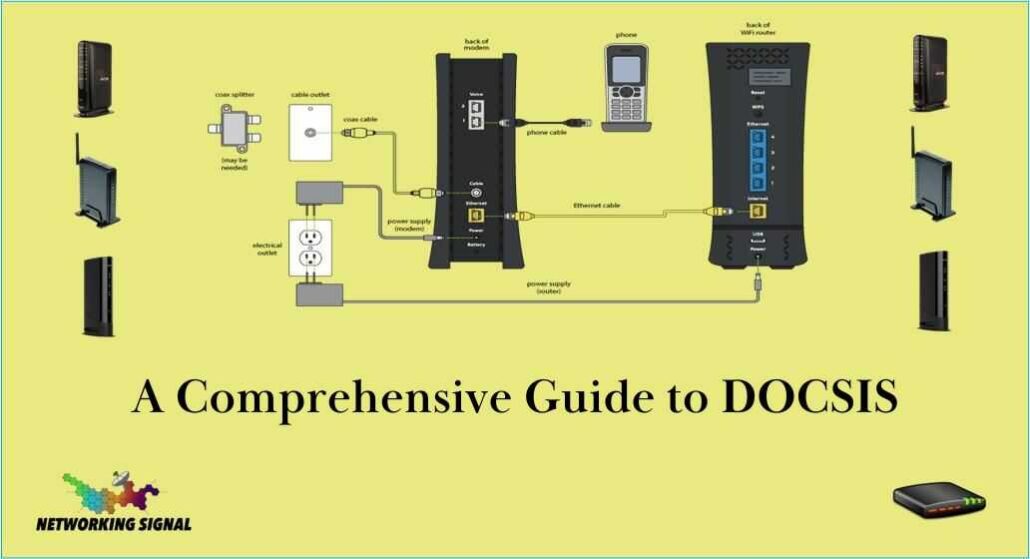
DOCSIS (Data Over Cable Service Interface Specification) is an international telecommunications standard published by CableLabs that defines the requirements for data transmission and internet access over existing cable TV (CATV) networks.
It allows cable operators to leverage their hybrid fiber-coaxial (HFC) infrastructure to deliver high-speed broadband services to homes and businesses.
DOCSIS specifies the functional requirements and technical details for both cable modems at customer premises and cable modem termination systems (CMTS) located at the cable operator’s head end. This enables two-way data communication between cable providers and their customers.
Look Here
The development of the DOCSIS standard has played a pivotal role in the widespread deployment of broadband internet access via cable TV networks worldwide.
DOCSIS has enabled cable operators to offer internet speeds comparable to, and even faster than, digital subscriber line (DSL) and fiber-based services.
This has significantly increased competition in the broadband market, providing more options for high-speed internet access for both residential and business customers.
DOCSIS technology has allowed cable companies to evolve from delivering entertainment video to providing full-fledged data and voice services.
The DOCSIS standard has progressed through several iterations since its inception in the 1990s, from DOCSIS 1.0, 1.1, 2.0, 3.0, 3.1, and 4.0, to the most recent 4.0, published in 2020.
Each successive version has brought substantial leaps in broadband speeds, quality of service, security, reliability, and overall performance.
The latest DOCSIS 4.0 standard incorporates cutting-edge technologies such as OFDM and OFDMA modulation, low latency functionality, and the capacity to deliver up to 10 Gigabits per second (Gbps) downstream and 1 Gbps upstream.
DOCSIS networks utilize separate downstream and upstream channels over the hybrid fiber-coaxial architecture.
The downstream channels operate at frequencies between 50 and 1000 MHz and carry data from the cable operator’s headend facility to customer locations.
Upstream channels operate between 5 and 42 MHz and carry data from customer cable modems back to the headend.
At the customer premises, a DOCSIS-compliant cable modem is used to send and receive data over the HFC network. It encodes/decodes signals over the cable plant and connects to customer equipment over Ethernet.
At the cable provider’s headend facility, a cable modem termination system (CMTS) serves as the control point for all DOCSIS modems on the network.
It connects the cable TV network to the internet backbone and manages the registration, provisioning, and traffic shaping of cable modems.
The HFC network starts with high-capacity fiber optic cables that run up to neighborhood nodes, and then coaxial copper cables run from these nodes to individual homes and businesses.
This combines the gigabit speeds and backhaul capacity of fiber with the cost-effectiveness and widespread reach of coaxial cable into customer premises.
DOCSIS defines a protocol stack for reliable and secure data transfer over HFC networks. Key elements include the MAC layer, which governs upstream and downstream traffic
Key features
Limitations
Enhancements over 1.0
Advantages
Major improvements
Benefits for users and ISPs
Channel bonding
Next-generation features
Benefits of Gigabit speeds
Full Duplex DOCSIS
Latest advancements
Expected benefits
DOCSIS cable modems can be installed professionally by the ISP or cable provider, or self-installed by the customer. The coaxial cable from the wall outlet connects to the modem, and an Ethernet cable connects the modem to the computer or home router.
The modem is powered on and goes through initialization, including acquiring an IP address from the DHCP server, registering with the CMTS, and establishing network connectivity. Indicator lights on the modem confirm successful DOCSIS lock and upstream/downstream connectivity.
Connection problems can arise from low signal strength, loose cabling, firewall conflicts, driver issues, or a defective modem. Technicians use spectrum analyzers to diagnose RF-layer problems over the coaxial portion.
DOCSIS broadband networks support a wide array of residential, business, and mission-critical services – high-speed internet access, streaming UHD video, online gaming, smart home/IoT, telecommuting, cloud applications, etc.
DOCSIS networks employ sophisticated traffic prioritization mechanisms to provide service-level assurances and consistent performance. Service flows are configured based on application requirements such as committed rates, latency sensitivity, and loss tolerance.
The high throughput of DOCSIS 3.0 and 3.1 enables smooth streaming of 4K and 8K Ultra HD video; the low latency facilitates real-time multiplayer online gaming; and the QoS capabilities ensure clear voice quality on Voice over IP calls.
DOCSIS 4.0 aims to make multi-gigabit broadband mainstream in the cable industry. Future generations will continue to evolve at speeds upwards of 10G, 20G, and beyond. Extended-spectrum, new modulation techniques, and full-duplex operation will drive future capacity gains.
DOCSIS platform innovations will be key in significantly increasing the broadband capacity and gigabit speed potential of existing coaxial cable infrastructure. This will better position cable to compete as a next-generation wired access technology.
DOCSIS will integrate with fiber, DSL, 5G wireless, and LEO satellite networks to enable ubiquitous, high-speed broadband with seamless fixed-mobile convergence across access technologies.
DOCSIS leverages existing cable TV infrastructure to deliver high-speed broadband services to homes and businesses. It standardizes two-way IP data transmission over hybrid fiber-coaxial networks between cable modems and the operator’s headend facility.
DOCSIS has enabled cable operators to effectively compete head-to-head with telecom companies in the broadband market. It provides the speed and capacity to meet the growing demands of Internet applications.
With future DOCSIS versions and integration with fiber/wireless, cable broadband capabilities will continue to evolve with multi-gigabit speeds, low latency, high security, and enhanced reliability.
Hand-picked articles you might also find useful.
 Internet & ISP
 The best modems for Xfinity in 2025 are the ARRIS SURFboard S33 (best overall, DOCSIS 3.1, 2.5G port),…
 Modems
 A modem is a hardware device that allows computers to connect to the internet. It converts data from…
![[Easy Way] How to Reset Xfinity Modem?](https://www.networkingsignal.com/wp-content/uploads/2023/08/how-to-reset-xfinity-modem_optimized-768x417.jpg "[Easy Way] How to Reset Xfinity Modem? 18") Modems
Modems Resetting your Xfinity modem can help troubleshoot connectivity issues, improve speeds, or clear out old settings and customizations.…