
5 Best Starlink Ethernet Adapters in 2026 (Gen 2 Only)
The best Starlink Ethernet adapters for 2026. The LUCMO Gen 2 adapter at $17.99 does the job. Most…

trueCABLE Cat6 Riser ($213.99 per 1000 ft) is the best bulk cable for most installs, 23 AWG solid bare copper, individually tested on a Fluke DSX-8000, ETL listed, with a forever warranty. On a budget, DG Cat6 Riser at $156 is the same specification for $58 less.
Two rules that are not preferences:
1. Fire rating is code. CMR (riser) is for vertical runs between floors and inside walls. CMP (plenum) is required in air-handling spaces, above a drop ceiling that returns air, or under a raised floor. Using CMR where CMP is required fails inspection and is a genuine fire-safety issue.
2. Never buy CCA. Copper-clad aluminium violates NEC 800.179, which requires copper conductors. It cannot safely carry PoE, and it is the most common reason a cheap 1000 ft box exists at all.
| Product | Cable | Rating | Conductor | Certification | Price |
|---|---|---|---|---|---|
 | trueCABLE Cat6 RiserBest overall | CMR, 550 MHz | 23 AWG solid | Fluke DSX-8000 | $213.99 |
 | DG Cat6 RiserBest value | CMR, 550 MHz | 23 AWG solid | ETL listed | $156.00 |
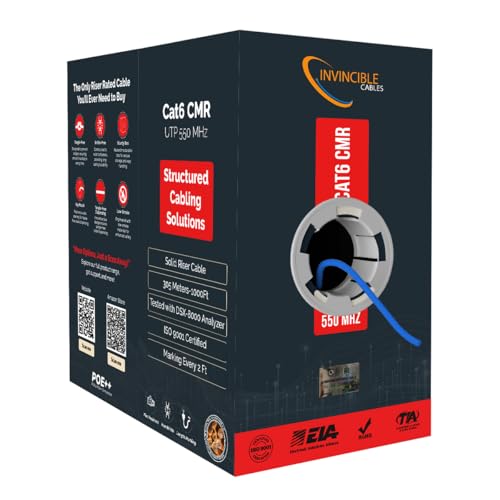 | Invincible Cables Cat6Budget pick | CMR, 550 MHz | 23 AWG solid | UL + Fluke | $178.99 |
 | ICC Cat6 CMR RiserBest for compliance | CMR, 500 MHz | 23 AWG solid | TAA + Section 889 | $189.00 |
 | AiCat Cat6 RiserBest for PoE++ | CMR, 550 MHz | 23 AWG solid | UL 444 listed | $194.99 |
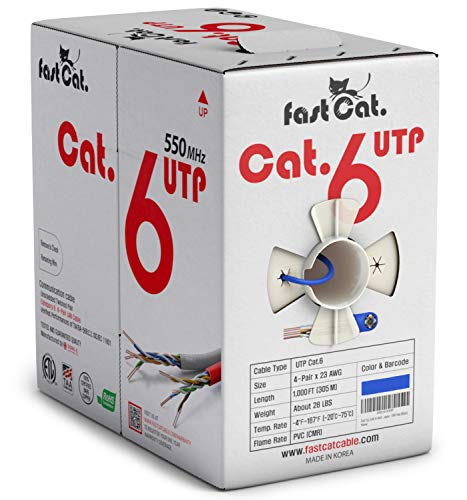 | fast Cat. Cat6Best pull box | CMR, 550 MHz | 23 AWG solid | CSA + ETL | $209.99 |
This is the part of buying bulk cable that is not a matter of taste. The jacket rating determines where the cable may legally be installed, and inspectors do check.
CM / CMG (general purpose), surface runs within a single room, cable trays, exposed installations. The cheapest jacket and the most limited.
CMR (riser), vertical runs between floors, inside walls, and general in-wall use. Flame-retardant enough to resist carrying fire from one floor to the next through a riser shaft. This is what almost every home installation needs. Every cable on this list is CMR.
CMP (plenum), required in plenum spaces: any area used to circulate air for heating or cooling. In practice that means above a drop ceiling that acts as an air return, or under a raised access floor. Plenum jackets are low-smoke and low-toxicity, because smoke in a plenum gets distributed through the whole building. CMP costs roughly 50 to 80% more than CMR.
How to tell if you need plenum: if the space above your ceiling tiles has no separate ductwork for the return air, the air simply flows through the open ceiling void back to the HVAC unit, that is a plenum. Most detached houses do not have one. Most office buildings do.
Getting this wrong is not a technicality. CMR jackets produce dense toxic smoke when they burn, and in a plenum that smoke reaches every room in the building through the air handling system. It will also fail inspection and can invalidate insurance.
If you find 1000 ft of “Cat 6” for $60, it is copper-clad aluminium: an aluminium core with a thin copper skin. It is worth understanding exactly what is wrong with it, because it is the single biggest trap in this category.
It violates the National Electrical Code. NEC Section 800.179 requires that conductors in communications cables be copper. CCA is not compliant, and an inspector who spots it will fail the install.
It cannot safely carry PoE. Aluminium has roughly 60% the conductivity of copper, so it heats up more carrying the same current. PoE++ pushes up to 100 W down the cable. In a bundle inside a wall cavity, that heat has nowhere to go, and CCA is a documented fire risk in exactly that scenario.
It breaks. Aluminium is brittle. It snaps at the punch-down and at any tight bend, often weeks after installation, producing intermittent faults in a cable you have already sealed inside a wall.
It fails certification. Higher resistance means it will not pass a Fluke test at full length, so a professional installer cannot certify the run.
The cable is the one part of a network you cannot easily replace, it is inside the walls. Spending $150 more on solid copper for a job you will not redo for twenty years is not a close call.
Buy solid for in-wall runs. Solid conductors have lower attenuation over distance and hold their position when punched down into a keystone jack or patch panel. Stranded is for patch cables, the short flexible ones between a wall port and a device, because it survives repeated bending. All six cables here are solid, which is correct for permanent runs.
One consequence worth knowing: solid cable needs the right RJ45 connectors. Standard plugs designed for stranded wire have contacts that pierce between the strands, and they make an unreliable connection on solid conductors. Buy connectors explicitly rated for solid, or use pass-through connectors. Better still, terminate into keystone jacks and patch panels rather than crimping plugs at all, it is more reliable and easier to fix later.
Cat 6 versus Cat 6a is the other real decision. Cat 6 carries 10 Gbps to about 55 m and gigabit to the full 100 m. Cat 6a carries 10 Gbps to the full 100 m but is thicker, stiffer, harder to pull through conduit, and roughly 40% more expensive.
For a house, Cat 6 is almost always right, runs are short, so you get 10 Gbps anyway. For a commercial building with runs approaching 100 m, or if you want certainty for the next twenty years, Cat 6a is worth the extra work. The labour of pulling cable dwarfs the material cost, so this is the one place where over-buying has a real argument behind it.
trueCABLE is what professional installers reach for at this price point, and the reason is testing rather than specification, every competitor here claims 23 AWG solid copper at 550 MHz.
trueCABLE tests with a Fluke DSX-8000 Versiv CableAnalyzer, the instrument that certification bodies use, and publishes compliance with ANSI/TIA 568.2-D. That is the difference between “designed to meet Cat 6” and “measured against Cat 6”. If you are installing cable you intend to have certified, starting from cable that already passes is not optional.
Performance is rated for 1 and 5 Gigabit to 328 ft, and 10 Gigabit to about 165 ft depending on the environment. PoE++ (802.3bt) up to 100 W is supported across all four pairs, relevant if you are feeding cameras or WiFi 7 access points, which draw far more than older PoE devices.
The 1000 ft comes pre-spooled in a tangle-free pull box. That sounds like packaging trivia until you have had a cheap box tangle 200 ft in, mid-pull, inside a ceiling. It is a genuine time saving on a real job.
trueCABLE also names the specific RJ45 connectors it has validated against, which removes the guesswork on the most common failure point of a self-installed network.
Buy it if the install will be certified or must simply not be revisited, this is the professional default.
At $156 per 1000 ft this is the cheapest genuinely compliant cable here, ETL certified, 100% pure copper, TIA/EIA compliant, and it saves $58 against trueCABLE for a specification that reads almost identically.
The distinctive choice is that DG omits the spline, the plastic cross-separator that keeps the four pairs apart inside the jacket. Most Cat 6 has one; DG compensates with additional insulation on each pair instead.
That trade is genuinely useful for a self-installer. A spline has to be cut back before termination, and doing it neatly on 40 keystone jacks is tedious and easy to get wrong, trim too deep and you nick a conductor, leave too much and the pairs will not seat. No spline means faster, more consistent terminations.
The cost is a slightly less rigid geometry between the pairs, which is what a spline maintains. DG rates the cable at 550 MHz and gigabit to 328 ft, so it is meeting the specification without one, but at the very top of Cat 6’s range a splined cable has more margin.
For a house with runs under 100 ft and dozens of terminations to make by hand, this is the sensible buy and the easier install.
Buy it for a house with many hand terminations, the missing spline saves real time.
This sits between DG and trueCABLE on price and, unusually for the middle option, gives up very little to either.
Every 1000 ft length is individually tested on a DSX-8000 Versiv, the same instrument trueCABLE uses, for $35 less. Per-box testing rather than batch sampling is the meaningful distinction, because cable faults are usually manufacturing defects in a specific run rather than a design problem.
It is UL certified, ANSI/TIA 568.2-D compliant, RoHS-3, and carries a forever warranty. It also keeps the crosstalk-suppression spline that DG omits, so it has more margin at the top of Cat 6’s range.
The jacket is specified for improved heat dissipation under PoE and PoE++ load. That is a real consideration when cables are bundled: a tightly packed group of PoE runs in a confined space builds heat, and heat raises resistance, which degrades both power delivery and data.
Sequential footage markings along the jacket let you track how much is left and cut runs accurately without measuring, a small thing that saves genuine time on a job with twenty drops.
Buy it if you want per-box Fluke testing without trueCABLE pricing, the best compromise here.
If the install is for a government agency, a school, a healthcare facility, or any organisation with procurement rules, this is the cable that clears the paperwork.
TAA compliance (Trade Agreements Act) means it is manufactured in an approved country, which is mandatory for most US federal purchases. Section 889 certification means it is free of prohibited telecommunications equipment, a requirement that has quietly disqualified a great many cheap imported cables from institutional projects.
ICC also documents NEC Section 800.179 compliance explicitly, along with the 75 °C and 300 V ratings. Buyers who need to submit a compliance package rather than just buy a cable will find everything already stated.
The REELEX II pull box is the best packaging here. Unlike a standard spool in a carton, REELEX pays out from the centre with no twisting and no tangling, from the first foot to the last. On a large job that is a meaningful labour saving, and it is why ICC is common on commercial sites.
It is rated at 500 MHz rather than the 550 MHz of others here. Cat 6 requires 250 MHz, so both figures are comfortably above the standard and the difference has no practical effect.
Buy it if the job has procurement rules, government, education, healthcare or enterprise.
AiCat is the pick when the cable will be carrying serious power as well as data, a building full of PoE cameras, WiFi 7 access points and VoIP phones.
The distinguishing credential is UL 444 listing alongside the CMR fire rating under UL 1666. UL 444 is the safety standard for communications cable specifically, and it is a stricter and less common certification than the ETL verification most competitors carry. Where PoE++ is pushing 100 W through bundled cables inside a wall, that additional scrutiny is worth having.
It supports full IEEE 802.3af/at/bt across all four pairs at up to 100 W, with a PVC cross separator keeping the pairs apart to control both crosstalk and heat.
Every box is Fluke DSX-8000 verified, lot-tracked and barcode traceable. Traceability matters more than it sounds on a large install: if one run fails certification, being able to identify which manufacturing lot it came from tells you whether to suspect the whole box or just that pull.
It is also compliant with TIA/EIA 568.2-D, NEMA WC-66, ISO/IEC 11081 and RoHS, a broader set of standards than anything else here.
Buy it if the run will carry PoE++ cameras or WiFi 7 access points at real power levels.
fast Cat. has built its reputation on the parts of a cable install that waste time rather than the parts that appear on a spec sheet, and for a solo installer that focus is worth paying for.
The FastReel box is rigid with a splash-proof coating, so it survives being dragged around a construction site, kicked across a loft and left on a damp garage floor. Standard cardboard cable boxes collapse, and a collapsed box tangles, and a tangle 300 ft into a pull costs an hour.
Electrically it matches the field: 23 AWG solid bare copper, 550 MHz, four twisted pairs with a PVC cross separator. The separator also stiffens the cable, which makes it easier to push through a wall cavity without a fish tape, a practical benefit when working alone.
Certification is thorough: CSA and ETL certified, TAA and RoHS compliant, CMR flame resistant to IEC 60332-3. Every cable is part of a lot tracking system with barcode traceability.
At $209.99 it is near the top of this list without trueCABLE’s per-box Fluke testing. You are paying for the packaging and the handling, which on a large job genuinely pays back, and on a single 20 ft run does not.
Buy it if you are pulling cable alone across a whole house and the box will take a beating.
A box of cable is roughly half of what a structured wiring install requires. Budget for the rest before you start.
Keystone jacks and a patch panel, not crimped plugs. Terminating into jacks at the wall and a patch panel at the other end is more reliable than crimping RJ45 plugs onto solid cable, easier to test, and far easier to fix when one run misbehaves. A 24-port patch panel and matching keystones cost less than the labour of re-terminating a bad crimp.
A punch-down tool with a 110 blade. About $20, and it seats and trims the conductor in one motion. Doing this with a screwdriver produces intermittent connections that will haunt you.
A cable tester. Test every run as you finish it, not at the end. Finding a miswired pair while the ladder is still up takes two minutes; finding it after the drywall is closed takes an afternoon. Our guide to the best network cable testers covers the options.
Follow the pulling rules. Do not exceed 25 lbs of pulling tension, keep the bend radius above four times the cable diameter, and never run Ethernet parallel to mains cable within 12 inches, cross it at 90 degrees if you must. Violating any of these degrades the cable permanently and invisibly.
If you have never run cable through a wall, our walkthrough on running Ethernet cable through walls covers the practical sequence.
CMR (riser) is rated for vertical runs between floors and general in-wall use. CMP (plenum) is required in spaces used to circulate air, typically above a drop ceiling acting as an air return, or under a raised floor, because its jacket produces low smoke and low toxicity when burning. CMP costs 50 to 80% more. Using CMR where CMP is required fails inspection.
No. Copper-clad aluminium violates NEC Section 800.179, which requires copper conductors. It heats up more under PoE load, which is a fire risk inside a wall cavity; it is brittle and snaps at terminations; and it will not pass a certification test at full length. The saving is not worth it on cable you are sealing into a wall.
Cat 6 for most homes, it carries 10 Gbps to 55 m and gigabit to 100 m, and home runs are short. Cat 6a carries 10 Gbps over a full 100 m but is thicker, stiffer, harder to pull and about 40% more expensive. For commercial runs near 100 m, or if the labour of ever redoing it would be prohibitive, Cat 6a is the safer choice.
Measure each run along its actual path, not straight-line distance, and add 15 to 20% for routing around obstacles and for slack at both ends. A typical home drop consumes 60 to 100 ft once it has gone up a wall, across a loft and back down. A 1000 ft box usually covers 10 to 15 drops in an average house.
Solid, for any permanent in-wall run. It has lower attenuation over distance and holds position when punched down into a jack or patch panel. Stranded is for short patch cables that get flexed repeatedly. If you use solid cable, buy RJ45 connectors specifically rated for solid conductors, standard plugs are designed for stranded and make an unreliable connection.
100 metres (328 ft) total channel length for Cat 5e, Cat 6 and Cat 6a at gigabit. That figure includes the patch cables at both ends, so plan on 90 m of permanent cable plus up to 10 m of patch leads. For 10 Gbps on Cat 6 specifically, the limit drops to about 55 m.
trueCABLE Cat6 Riser at $213.99 is the cable to buy if the install matters, Fluke-tested against the actual standard, full PoE++ support, and a pull box that does not fight you. It is what you want inside a wall you are not going to open again.
If the budget is tight, DG Cat6 Riser at $156 is genuinely compliant solid copper, and its missing spline makes hand terminations faster, a real advantage on a house with twenty drops. Whatever you choose, confirm the fire rating your space requires before ordering, and do not buy CCA at any price.
Disclosure: Networking Signal is a participant in the Amazon Services LLC Associates Program. We earn a commission on qualifying purchases made through links on this page, at no additional cost to you. Prices shown were accurate at the time of writing and may change. Fire rating and code requirements cited are US National Electrical Code; local codes vary and an inspector’s determination governs, check before installing.
Hand-picked articles you might also find useful.
 Cables
 The best Starlink Ethernet adapters for 2026. The LUCMO Gen 2 adapter at $17.99 does the job. Most…
 Cables
 In today's interconnected world, having a reliable and high-speed internet connection is essential . Ethernet cables play a…
 Cables
 In today's fast-paced digital world, having a reliable and efficient network connection is crucial. Ethernet cables play a…