
Flat Ethernet Cable vs Round: Which to Use and When
When setting up a wired local area network , one of the most basic but important decisions is…
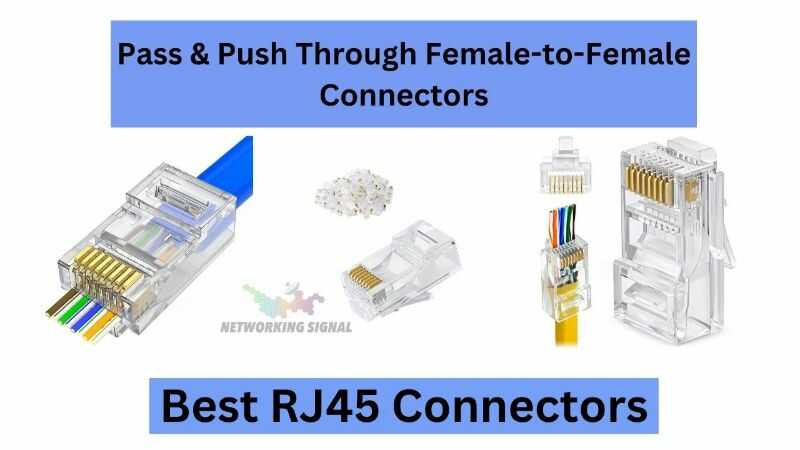
Cable Matters Cat 6 pass through connectors ($14.39 per 100) are the ones to buy. They carry 50 micron gold plating, which is roughly double the usual flash coating, they are rated for 10 Gigabit, and they take both solid and stranded cable from 23 to 24 AWG.
Buy pass through, not standard. Pass through connectors let the wires exit the front of the plug so you can see all eight in the correct order before you crimp. That single change is why a beginner can hit a 90 percent success rate instead of 50 percent. You do need a crimper with a flush cutting blade, because the tool trims the protruding wires as it crimps.
The mistake that ruins terminations: using a connector rated for stranded wire on solid cable, or the reverse. The contact geometry differs, and the wrong pairing gives you a link that works on the bench and fails in the wall. Every connector on this page states which it supports.
| Product | Connector | Type | Plating | Pack | Price |
|---|---|---|---|---|---|
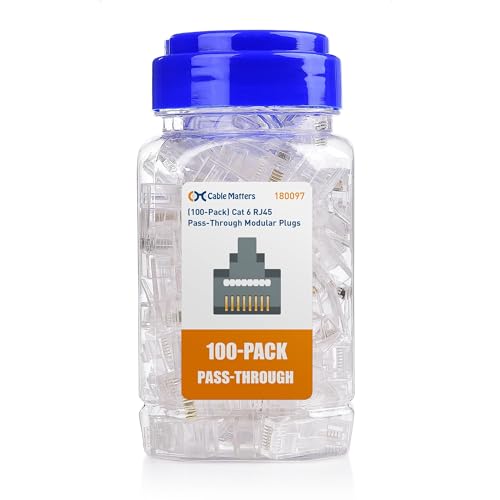 | Cable Matters Cat 6 Pass ThroughBest overall | Pass through | 50 micron gold | 100 | $14.39 |
 | ZOERAX Cat6 Pass ThroughCheapest | Pass through | Gold contact layer | 100 | $9.99 |
 | VCE Cat6 Pass ThroughBest value | Pass through | Gold, UL certified | 100 | $13.99 |
 | ZOERAX Shielded Pass ThroughBest shielded | Shielded FTP | Metal body | 100 | $19.99 |
 | Cable Matters 200 PackBest bulk buy | Pass through | 50 micron gold | 200 | $29.99 |
 | AMPCOM Cat6 Pass ThroughToughest latch | Pass through | Gold plated | 100 plus stripper | $12.90 |
A standard RJ45 plug is a closed box. You cut all eight conductors to exactly the same length, arrange them in the right order, slide them blind into eight tiny channels, and hope every one reached the front. If one wire fell short, the contact never pierces it, and you find out later with a tester or a mysterious intermittent fault.
A pass through connector has open channels. The wires go all the way through and out the front of the plug, where you can see them. You check the colour order visually, confirm all eight are present, and then crimp. The crimper’s blade shears off the protruding ends flush with the plug face in the same motion.
Three things follow from that. Wire order is verified rather than assumed. You do not need to trim all eight to identical length first, which is the fiddliest part of the job. And because the conductors can be pulled fully through, the twists in each pair stay closer to the contacts, which is genuinely better for crosstalk performance at Cat 6 speeds.
The requirement: you need a crimper with a flush cutting blade designed for pass through plugs. A conventional crimper will crimp the plug but leave the wires sticking out of the front, and the plug will not seat in a port. This is the most common complaint about pass through connectors, and it is a tool problem rather than a connector problem.
Standard closed connectors still have a place if you already own a conventional crimper and do not want to buy another. They cost about the same. They are simply harder to get right.
This is where most failed terminations come from, and the listings state it clearly if you know to look.
Solid conductor cable is what runs inside walls. Each conductor is a single wire. It has lower attenuation over distance and holds its position when punched into a jack.
Stranded conductor cable is what patch leads are made of. Each conductor is many fine strands twisted together, so it survives repeated bending.
Connectors are built for one or the other, and the difference is in the contact. A contact designed for stranded wire has a pointed profile that pushes between the strands. A contact for solid wire has a pair of prongs that straddle the conductor and bite either side. Use a stranded connector on solid cable and the point sits alongside the conductor rather than gripping it, giving a connection that passes a continuity test and fails under vibration or temperature change months later.
Three prong contacts, which every connector on this page uses, are designed to work with both. That is why they have become the standard, and it is why a listing that says “solid or stranded” is telling you something real rather than marketing.
Check the AWG range too. Cat 6 solid cable is usually 23 AWG, which is thicker than the 24 to 26 AWG most connectors quote. Several products here support 23 AWG for solid cable only. If you bought 23 AWG bulk cable, confirm the connector takes it, or the conductors will not fit the channels.
For permanent in wall runs, terminating into a keystone jack at the wall and a patch panel at the other end is more reliable than crimping plugs, and it is what professionals do.
Punch down terminations are more forgiving than crimps, easier to inspect, and trivial to redo if one goes wrong. A faulty crimp on a cable buried in a wall means pulling slack through and starting again, assuming you left any slack. A faulty punch down takes thirty seconds to fix.
Crimped plugs are the right choice for patch cables, for temporary runs, and for the short leads between a wall port and a device. Use both in the right places. Our guide to patch panels for home and office racks covers the other half of the job.
If you are crimping, one more thing worth knowing: T568B is the more common wiring standard in the United States and T568A is more common in some other regions. It does not matter which you pick, as long as both ends of a cable use the same one. Mixing them produces a crossover cable, which modern equipment auto corrects for but which will confuse anyone troubleshooting it later.
The specification that separates these from every cheaper option is 50 micron gold plating on the contacts. Most connectors use a gold flash, which is a thin decorative layer measured in fractions of a micron. Fifty microns is a real plating thickness, and it matters for two reasons: it resists corrosion in humid or coastal environments, and it survives repeated insertion cycles without wearing through to the nickel beneath.
For a patch cable that gets plugged and unplugged weekly, that is the difference between a connector that lasts years and one that develops an intermittent fault.
They are rated for 10 Gigabit rather than just gigabit, and take 23 to 24 AWG conductors with 0.97 to 1.07 mm insulation and up to 6.1 mm outer diameter. That 23 AWG support is important, because it covers the solid bulk cable most people buy for in wall runs.
Three point staggered contacts work with both solid and stranded, so one jar covers your patch cables and your permanent runs.
They ship in a screw top storage jar, which sounds trivial until you have spilled a hundred connectors into a toolbag. Cable Matters also sells matching strain relief boots, which are worth adding for patch cables that get handled.
Buy these if you want connectors that will still be reliable in five years, especially on patch cables that get handled.
Ten dollars for a hundred pass through connectors is about as cheap as this gets from a seller who documents what they are actually selling.
ZOERAX is unusually straightforward about the plating, and it is worth quoting the substance: the pins are pure copper, nickel coated for protection, with a gold layer only at the contact points. They state plainly that the pin is not fully gold plated. That is honest, and it describes how most connectors in this price range are actually made, including several that imply otherwise.
For a connector that gets crimped once and left in a wall port, gold only at the contact point is entirely adequate. The plating protects the surface that carries signal. For a patch cable plugged in and out weekly, the thicker Cable Matters plating will last longer.
They take 24 to 26 AWG round or flat stranded wire up to 6.1 mm outer diameter, with 23 AWG supported for solid cable only. Check your cable gauge before ordering, because that is a narrower range than some competitors.
The sealed pull ring packaging protects against humidity, which matters more than it sounds. Connectors stored loose in a damp garage develop surface oxidation on the contacts long before they are used.
Buy these for in wall runs that get crimped once and then left alone.
VCE is the only manufacturer here that states its connectors are Fluke tested and UL certified, and for a component that sits inside a wall that is worth forty cents over the ZOERAX.
Fluke testing means the connectors were validated on the same certification hardware professional installers use to sign off a cable run. UL certification is a safety listing. Neither guarantees a good crimp, which depends on your technique and your tool, but both mean the part itself has been measured rather than assumed.
The transparent housing is a practical detail worth calling out. You can see the conductors seated inside the plug after crimping, which lets you confirm the colour order visually even after the job is done. Diagnosing a suspect cable becomes a matter of looking at both ends rather than reaching for a tester.
They are rated to 10 Gbps, with VCE noting honestly that 10 Gigabit on Cat 6 is limited to roughly 35 to 55 metres. That is a real specification of the cable standard rather than the connector, and stating it is a sign of a manufacturer who understands the product.
Compatible with 24 to 26 AWG solid or stranded, with 23 AWG solid supported. An 18 month support period is included.
Buy these if you want certification behind the part without paying a premium for it.
If your cable is shielded, your connectors must be too, and this is the only shielded option here.
A shielded connector has a metal body that makes contact with the cable’s foil or braid screen, carrying the shield through the plug and into the port. Without it, the shield stops at the plug and does nothing. Terminating shielded cable with unshielded plugs is a surprisingly common mistake, and it means you have paid for shielded cable and thrown away its only benefit.
The shield needs somewhere to go. It should be bonded to ground at one end only of the run. Grounding both ends between two areas with different ground potentials creates a ground loop, which injects noise into the cable rather than removing it. In practice this means using shielded keystone jacks or a shielded patch panel that is properly earthed at the equipment end, and leaving the far end floating.
The pass through design and three layer copper, nickel and gold pin structure are the same as ZOERAX’s unshielded version, so termination technique does not change.
Worth being clear about who needs this: shielded cable is for industrial environments, runs alongside mains cable, and outdoor runs where interference is a genuine problem. In a normal home, unshielded is the right choice and this connector is unnecessary complexity.
Buy these only if your cable is shielded, and ground the shield at one end of the run.
Identical to the hundred pack in every specification, at 15 cents per connector instead of 14.4 cents. The saving is trivial, so the reason to buy this is quantity rather than price.
That reason is real if you are wiring a house. A twelve drop installation needs 24 connectors if every crimp is perfect. Nobody’s crimps are all perfect. Budget one failed termination in five while you are learning, plus spares for the patch cables you will make afterwards, and 200 stops being generous.
It is also the right buy if you are terminating both ends of patch leads rather than punching down into panels. Fifteen patch cables consumes 30 connectors before any mistakes.
Everything else matches the hundred pack: 50 micron gold plating, 10 Gigabit rating, three point staggered contacts for solid or stranded, 23 to 24 AWG support, and the screw top storage jar.
If your project is a handful of cables, buy the hundred. If you are wiring a house or you expect to keep doing this, the 200 pack means not stopping mid job to reorder.
Buy these if you are wiring a whole house or expect to make cables regularly.
The feature worth paying attention to here is the latch, which is the part of an RJ45 plug that actually breaks.
The little plastic tab that clicks into the port is fragile on cheap connectors. Pull a cable out of a crowded patch panel by the lead rather than the tab, catch it on a rack rail, or bend it back while reaching behind a switch, and it snaps. A plug with a broken latch does not stay seated, which produces an intermittent fault that looks like a bad crimp.
AMPCOM specifies an engineered polycarbonate tab that withstands more than 40 full 180 degree bends without breaking. That is a meaningful claim for anyone working in a rack, where connectors get abused constantly.
The AWG range is the widest here at 23 to 26, covering both thick solid bulk cable and thin stranded patch cable from one jar, with no compatibility checking required.
A mini stripper is included in the jar. It is a basic tool rather than a good one, but for someone buying their first connectors it removes a purchase and gets the job started.
AMPCOM states compliance with TIA/EIA-568-C.2 for Cat 6 and rates the contacts for more than 5,000 insertion cycles. The listing also confirms PoE, PoE+ and PoE++ support, which matters if these will feed cameras or access points.
Buy these for patch cables in a rack, where the latch takes more punishment than the contacts.
Strip about 40 mm of jacket, more than you think you need. You need enough length to untwist the pairs, straighten them and get them in order. Trim back afterwards.
Untwist only as much as necessary. The twist in each pair is what cancels crosstalk, and every millimetre you untwist degrades performance. At Cat 6 speeds the standard allows about 13 mm of untwisted conductor at the termination. Pass through connectors help here, because you can pull the conductors through and keep the twists tight against the plug body.
Keep the jacket inside the plug. When you insert the conductors, push until the cable jacket itself is inside the connector body and under the strain relief crimp. If only bare conductors are gripped, any pull on the cable transfers straight to the contacts and the termination fails.
Crimp firmly and completely. Squeeze the handles until the tool releases. A partial crimp leaves the contacts short of the conductors, which gives you a connection that works today and fails when the cable is moved.
Test every cable. A basic continuity tester costs under $20 and checks all eight conductors and their order in a few seconds. Test as you go, not at the end, because finding a fault while the tools are still out takes a minute. Our guide to network cable testers covers what to buy. For the full sequence, see our walkthrough on how to crimp an Ethernet cable.
Pass through connectors have open channels that let the conductors exit the front of the plug, so you can verify all eight wires and their order before crimping. The crimper trims them flush in the same motion. Standard connectors are closed, so the wires must be cut to exact length and inserted blind. Pass through is significantly easier to get right, but requires a crimper with a flush cutting blade.
Traditionally yes, because the contact geometry differs. Modern three prong contacts, used by every connector on this page, are designed to work with both. Always check the listing, since using a stranded only connector on solid cable produces a connection that tests fine initially and fails later.
Physically they are the same 8P8C format and Cat 6 connectors are backward compatible with Cat 5e cable. Cat 6 connectors have tighter internal tolerances and better crosstalk control, and they accommodate the thicker 23 AWG conductors that Cat 6 cable uses. Cat 5e connectors may not physically fit 23 AWG conductors.
Not with pass through connectors, which is one of their main advantages. A load bar is a small plastic insert that holds the eight conductors in order before they enter a standard closed plug, and it is genuinely helpful with thick Cat 6 solid cable in a conventional connector. Pass through plugs make it unnecessary.
Only if your cable is shielded. A shielded connector carries the cable’s foil or braid screen through to the port, and without one the shield does nothing. On ordinary UTP cable a shielded connector adds cost and no benefit. Where you do use them, ground the shield at one end of the run only, because grounding both ends can create a noise inducing ground loop.
Two per cable if you are crimping both ends, but budget generously for mistakes. A twelve drop house needs 24 connectors in theory, and realistically 40 or more once you account for failed crimps while learning and the patch cables you will make afterwards. Connectors cost about 14 cents each, so buying 200 rather than 100 removes any reason to ration them.
Buy the Cable Matters Cat 6 pass through connectors at $14.39 per hundred. The 50 micron gold plating is genuinely thicker than the flash coating on cheaper alternatives, they are rated for 10 Gigabit, and they take the 23 AWG solid cable that most in wall installations use.
If the budget is tight, the ZOERAX at $9.99 is honest about what it is and perfectly adequate for connectors that get crimped once and left in place. And whichever you choose, make sure your crimper has a flush cutting blade for pass through plugs, because that tool mismatch causes more frustration than any connector ever will.
Disclosure: Networking Signal is a participant in the Amazon Services LLC Associates Program. We earn a commission on qualifying purchases made through links on this page, at no additional cost to you. Prices shown were accurate at the time of writing and may change. Pass through connectors require a compatible crimping tool, which is sold separately.
Hand-picked articles you might also find useful.
 Cables
 When setting up a wired local area network , one of the most basic but important decisions is…
 Cables
 Cat5e, Cat6, Cat6A, Cat7 and Cat8 compared by speed, distance, shielding and price — plus which one you…
 Cables
 The best Starlink Ethernet adapters for 2026. The LUCMO Gen 2 adapter at $17.99 does the job. Most…