
2.5GbE vs 10GbE: Which Multi-Gig Is Worth It at Home?
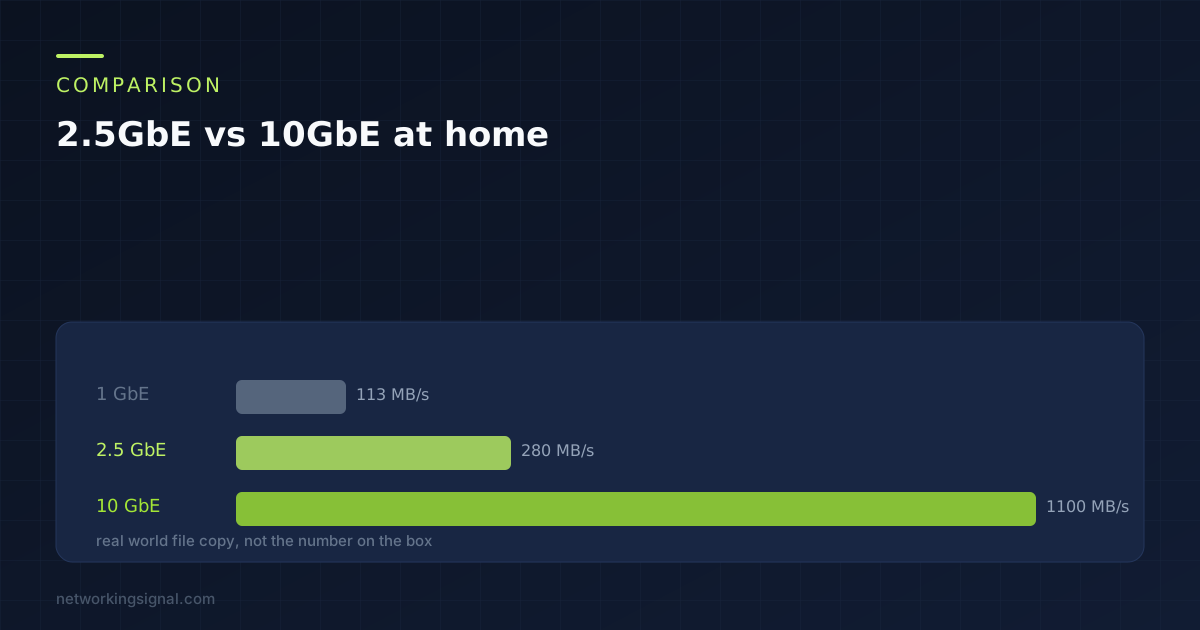
2.5GbE runs on the Cat5e already in your walls and matches what home storage can actually deliver. 10GbE…
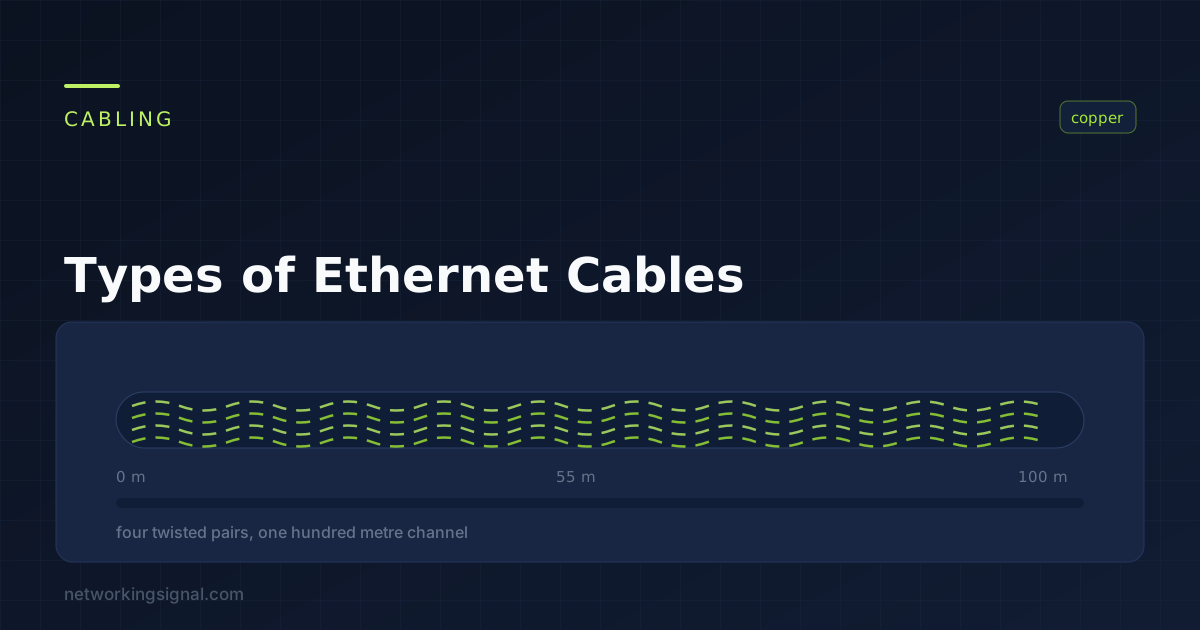
Ethernet cables are sorted into categories, Cat5e, Cat6, Cat6A, Cat7, Cat8, and each category specifies a bandwidth and a maximum distance at a given speed. Every one of them uses the same eight-wire twisted pair construction and the same RJ45 connector, so they are physically interchangeable. What changes is how tightly the pairs are twisted, whether there is shielding, and how much crosstalk the cable is certified to reject.
The short answer for most people: buy Cat6. It costs barely more than Cat5e, handles 10 Gigabit over the runs found in a house or small office, and is what you would install anyway if you were doing it properly.
| Category | Max speed | Bandwidth | Max distance at top speed | Shielding | Status |
|---|---|---|---|---|---|
| Cat5 | 100 Mbps | 100 MHz | 100 m | UTP | Obsolete, no longer sold |
| Cat5e | 1 Gbps (2.5 Gbps in practice) | 100 MHz | 100 m | UTP | Budget minimum |
| Cat6 | 10 Gbps | 250 MHz | 55 m at 10 Gbps 100 m at 1 Gbps | UTP or shielded | Recommended default |
| Cat6A | 10 Gbps | 500 MHz | 100 m | Usually shielded | Best for new structured cabling |
| Cat7 | 10 Gbps | 600 MHz | 100 m | S/FTP (always) | Non-standard for RJ45, see below |
| Cat7A | 10 Gbps | 1000 MHz | 100 m | S/FTP | Same problem as Cat7 |
| Cat8 | 25/40 Gbps | 2000 MHz | 30 m | S/FTP | Data centre short runs only |
Cat6 at 10 Gbps only reaches 55 metres, not 100. Past that it falls back to 1 Gbps. For a home this is irrelevant, very few residential runs exceed 55 m. For an office floor it matters a great deal, and it is the entire reason Cat6A exists.
Cat8 only reaches 30 metres. It is designed for top-of-rack to server patching in a data centre, not for running through a building. Buying Cat8 for a home network is paying a premium for a specification you cannot use, your equipment does not do 40 Gbps over copper, and if it did, the run would have to be under 30 m.
Cat7 is a genuine ISO/IEC cable specification, but it was designed around the GG45 and TERA connectors, not RJ45. TIA, the body that defines structured cabling in North America, never recognised it. In practice this means:
If someone is selling you “Cat7” patch leads for a home network, Cat6 or Cat6A does the same job for less money and terminates properly.
| Code | Construction | Use when |
|---|---|---|
| U/UTP | Unshielded, no foil at all | Homes and offices, the default, and fine for almost everything |
| F/UTP | Overall foil screen, unshielded pairs | Moderate interference, near fluorescent lighting or power runs |
| S/FTP | Braid screen plus foil around each pair | Industrial environments, motors, lift shafts, high-EMI plant rooms |
Shielding only helps if the shield is bonded to ground at the patch panel and the connectors are shielded too. An ungrounded shield can pick up interference and inject it into the pairs. For a house, unshielded is almost always the right answer, cheaper, more flexible, and easier to terminate correctly.
This distinction causes more real-world failures than the category does:
Terminating solid core into an RJ45 plug designed for stranded (or vice versa) causes intermittent faults that are miserable to diagnose. Check the plug is rated for the conductor type.
Building codes care about what happens to a cable in a fire:
Using non-plenum cable in a plenum space is a code violation, and it is the kind of thing that gets found during an inspection years later.
| Situation | Buy | Why |
|---|---|---|
| Patch lead, router to PC or console | Cat6 UTP stranded | Cheap, flexible, far more capable than the link needs |
| Wiring a house in-wall | Cat6 or Cat6A solid, CMR | Labour dominates the cost, install once, install well |
| Office structured cabling | Cat6A | 10 Gbps at the full 100 m, and PoE++ heat handling |
| Long run over 55 m needing 10 Gbps | Cat6A | Cat6 drops to 1 Gbps past 55 m |
| Rack patching at 25/40 Gbps | Cat8 | The only category that does it, within 30 m |
| High-interference industrial site | Cat6A S/FTP | Shielding, correctly grounded |
| Replacing one failed cable on a 1 Gbps network | Cat5e or Cat6 | Anything above this changes nothing |
“A longer cable is slower.” No. Within the specified distance, a 90 m Cat6 run performs identically to a 3 m one. Past the limit the link does not slow down gracefully, it drops to a lower speed or fails to negotiate at all.
“A higher category makes my internet faster.” Only if the cable was the bottleneck, which it almost never is. If you have a 500 Mbps connection and Cat5e, the cable is not limiting you, Cat5e carries a full gigabit.
“Coaxial is a type of Ethernet cable.” It was, in 10BASE2 and 10BASE5, and has not been since the early 1990s. Modern Ethernet over copper is twisted pair only.
“Cat8 is future-proofing my house.” It is not, because 40GBASE-T over 30 m is a data centre technology that will never appear in residential equipment. Fibre is the actual future-proofing answer for long runs.
Yes, for anything you are installing rather than just plugging in. The price difference is small, and Cat6 gives you a path to 10 Gbps on runs under 55 m. On an existing 1 Gbps network with working Cat5e, replacing it changes nothing.
Yes. All categories use the same RJ45 connector and are backward compatible. The link runs at whatever the slowest component supports.
100 metres for a permanent link at 1 Gbps, for every category from Cat5e up. At 10 Gbps, Cat6 is limited to 55 m and Cat6A to 100 m. Cat8 is 30 m. Beyond those, use fibre or an intermediate switch.
Almost never. Unshielded twisted pair rejects interference well through the twisting itself, and an improperly grounded shield can make things worse. Shielding is for industrial environments.
Yes, indirectly. Higher-power PoE (802.3bt, up to 90 W) generates heat in the bundle. Cat6A’s thicker conductors dissipate heat better and are recommended for high-power PoE, especially in large bundles or conduit.
Not for anything you can buy. Both do 10 Gbps to 100 m. Cat7 has higher rated bandwidth but is not recognised by TIA (the same applies when comparing Cat7 against Cat8) and was not designed for RJ45, so a Cat7 patch lead with RJ45 ends is not delivering what the label implies.
Hand-picked articles you might also find useful.
 Cables
 2.5GbE runs on the Cat5e already in your walls and matches what home storage can actually deliver. 10GbE…
 Cables
 RJ11 is a 6-position phone connector using 2 or 4 wires; RJ45 is an 8-position Ethernet connector using…
 Cables
 How to run Ethernet Cable Through Walls ? If you're looking to add an Ethernet connection to your…