
Cat6 vs Cat6a vs Cat7 vs Cat8: Which Ethernet Cable You Actually Need
Cat6, Cat6a, Cat7 or Cat8? Cat6 is right for almost every home and office. Cat7 is not a…
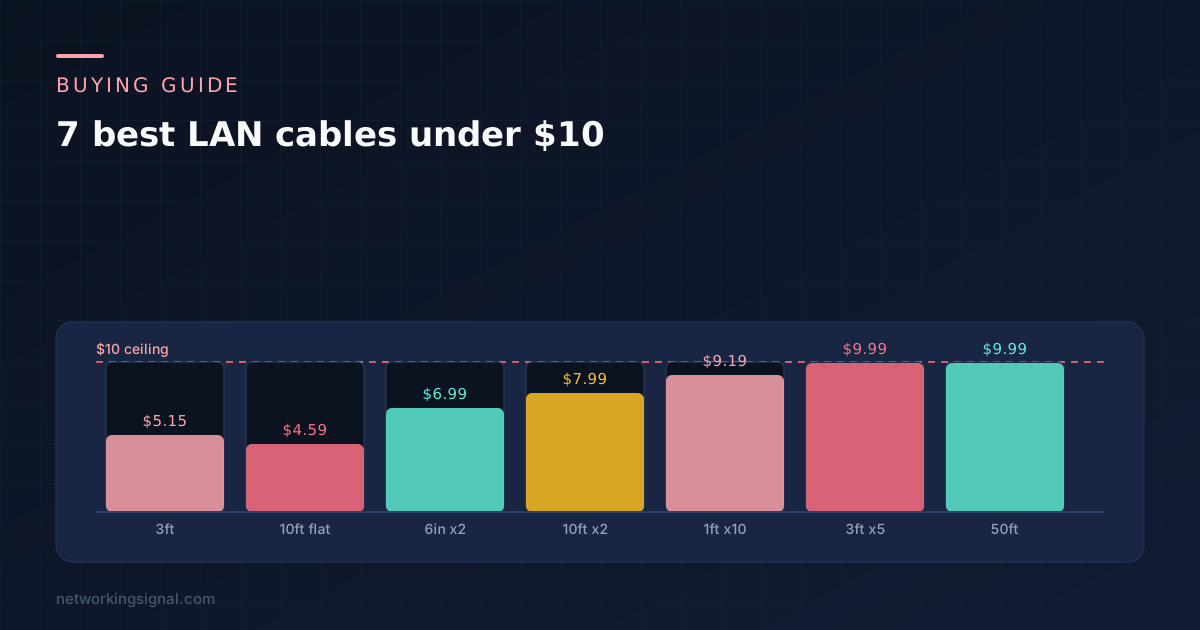
The best LAN cables under $10 are all short ones, and which you want depends on how many. For one cable to replace a lost one, Amazon Basics Cat 6 3 ft at $5.15 is the cheapest thing worth buying. If you need several, Cable Matters 5-pack of 3 ft at $9.99 is the best built cable on this page, because it is the only one here using thick 24 AWG copper.
The one rule at this price: under $10 you are buying thin cable, and thin cable is a length limit rather than a quality problem. At 3 ft nobody can measure the difference between a $5 cable and a $50 one. At 50 ft you can.
| Product | Length | Gauge | Best for | Price | |
|---|---|---|---|---|---|
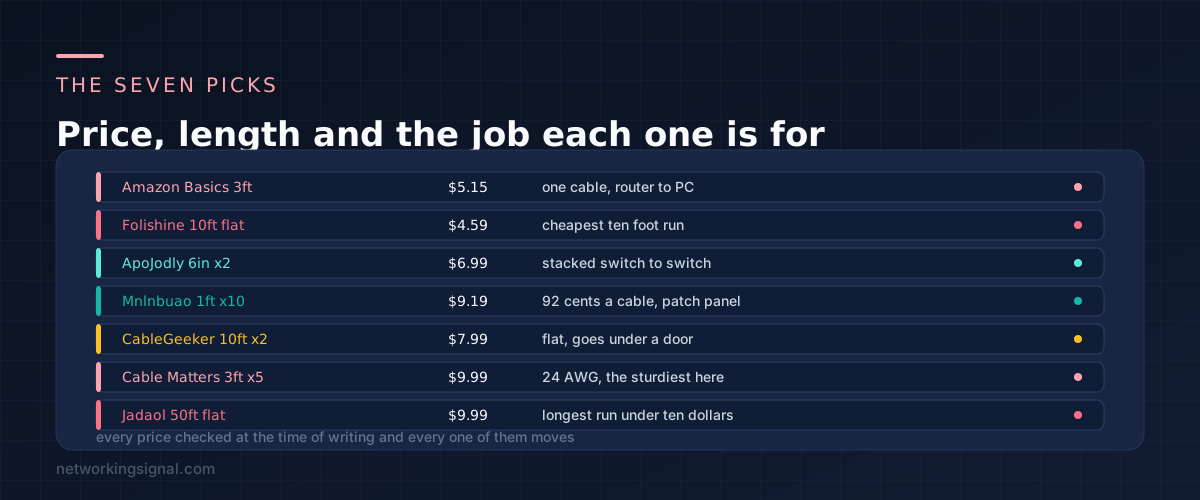
 | Amazon Basics Cat 6Best single cable | 3 ft | Not stated | Router to PC | $5.15 |
 | Folishine Flat 10 ftCheapest here | 10 ft | Flat, thin | Along a skirting board | $4.59 |
 | ApoJodly 6 in, 2-packShortest | 0.5 ft | 26 AWG | Stacked switches | $6.99 |
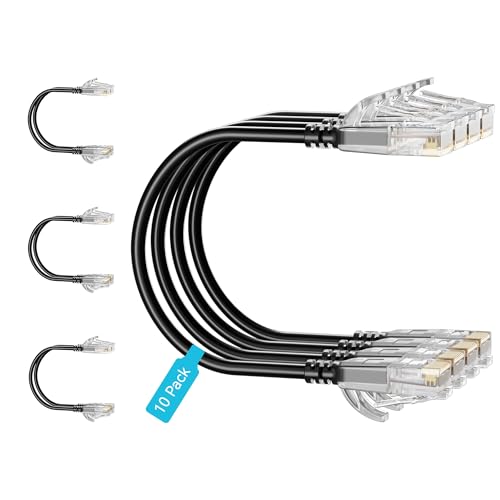 | Mnlnbuao Slim, 10-packBest value | 1 ft | 30 AWG | Patch panel to switch | $9.19 |
 | CableGeeker Flat, 2-packBest flat pair | 10 ft | Flat, bare copper | Under a door | $7.99 |
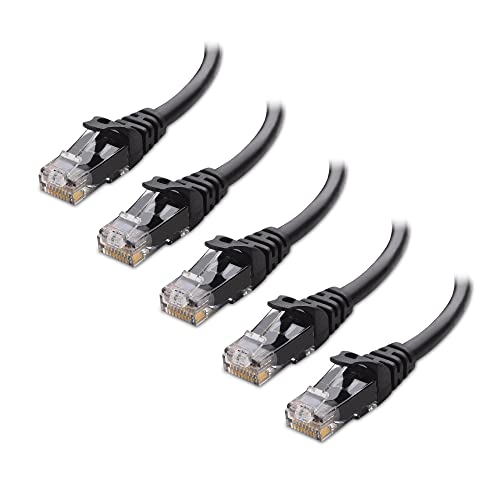 | Cable Matters, 5-packBest built | 3 ft | 24 AWG | A rack you will keep | $9.99 |
 | Jadaol Flat 50 ftLongest run | 50 ft | 30 AWG | Across a room, once | $9.99 |
A patch cable is a simple object. Four twisted pairs, a jacket, two plugs. There is not much room for a manufacturer to save money without it showing, which is why the cheap ones mostly work.
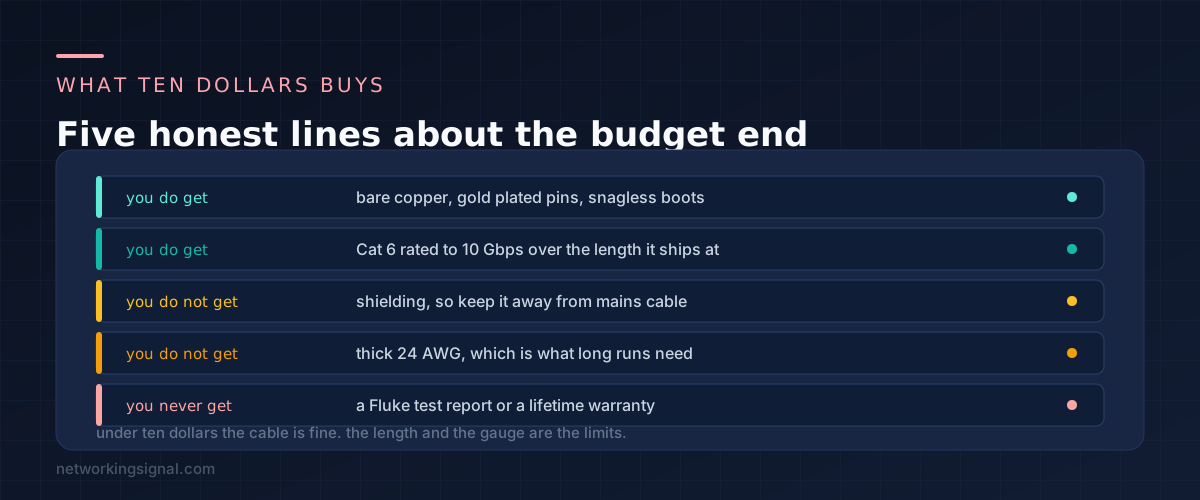
At this price you still get bare copper conductors on every cable listed here, gold plated contacts on the plugs, and snagless boots on most of them. You also get genuine Cat 6 performance over the short lengths these cables ship at, which means gigabit with a lot of headroom and 10 Gbps if your gear supports it.
What you give up is more specific than “quality”. You give up shielding, so a cheap cable should not be run alongside mains wiring. You give up thick conductors, which is the whole subject of the next section. And you give up any certification: no cable at this price has been individually tested on a Fluke analyser, and none carries a warranty worth reading.
For a 3 ft run between a router and a console, none of those three things matter. For a 50 ft run carrying power to a camera, all three do.
Buyers look at the category number on the jacket. Cat 6, Cat 7, Cat 8. On a patch cable that number tells you very little, and on a cheap patch cable it is often just printing.
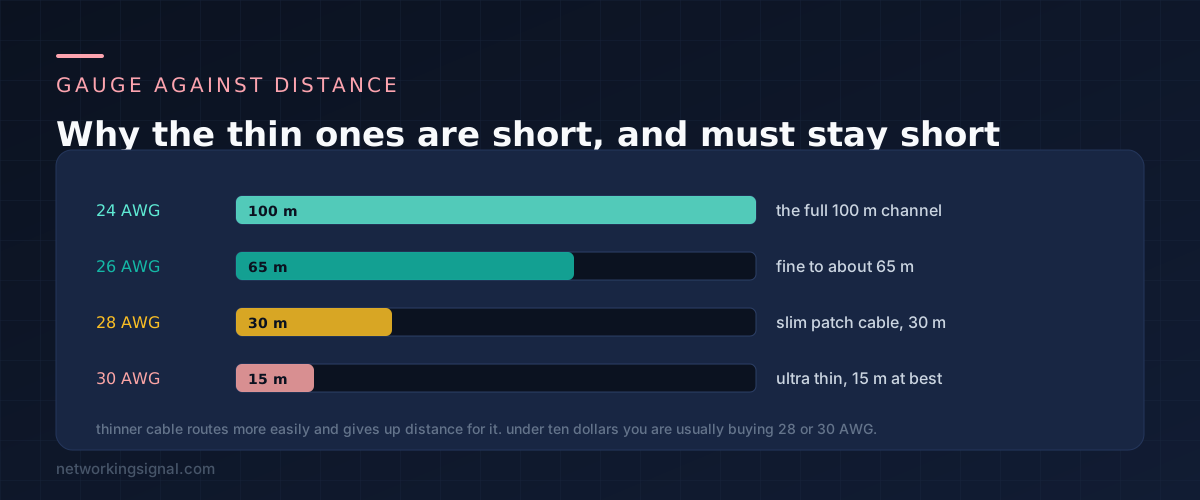
The number that decides what a cable can actually do is the conductor gauge, written as AWG. It runs backwards: a bigger AWG number means a thinner wire. Thinner wire has more resistance, more resistance means more signal loss per metre, and that is what sets the usable length.
TIA allows shorter maximum channel lengths as the conductor gets thinner. Roughly, 24 AWG reaches the full 100 m, 26 AWG manages around 65 m, 28 AWG around 30 m and 30 AWG only about 15 m. Those figures are for the whole channel, patch leads included.
Almost everything under $10 is 26 to 30 AWG, because thin copper is the only place left to save money once the plugs and the jacket are accounted for. That is completely fine at 1 to 10 ft, which is what most of these cables are.
The two places it stops being fine are long runs and Power over Ethernet. Thin conductors heat up more carrying the same current, so a 30 AWG cable feeding a PoE camera is a genuinely bad idea even at short length. If a cable will carry power, buy 24 AWG, and that usually means going over $10.
When you need exactly one cable because the old one went missing behind a desk, this is the answer and there is not much to discuss.
It is a plain 3 ft Cat 6 patch cable with gold plated contacts. Amazon rates it at 1 Gbps rather than claiming 10, which is unusually conservative labelling in a category where everyone else prints the biggest number the category allows. Over 3 ft the cable will carry 10 Gbps regardless of what the listing says.
It does not state a conductor gauge, which is the one thing worth knowing and the one thing missing. Given the price and the flexibility, assume it is on the thin side, and keep it short. At 3 ft that is not a constraint you will ever notice.
Buying a single cheap cable from a seller who will still exist next year is worth something on its own. Returns are trivial and the part is genuinely replaceable.
Buy it when you need one cable today and do not want five spares in a drawer.
Four dollars and change for ten feet is the cheapest genuine cable on this page, and the flat jacket is what makes it useful rather than merely cheap.
A flat cable sits under a carpet edge, along a skirting board or beneath a door without the door catching on it. That is the actual reason to buy one. It is about 1.5 mm thick, so it disappears in places a round cable would trip somebody.
The listing calls it “Cat 6e”, which is worth naming plainly: there is no such category. TIA defines Cat 6 and Cat 6a, and nothing in between. The label means nothing at all, and it is a good sign of how much of the printing on cheap cable is decoration rather than specification.
Underneath the marketing it is an ordinary unshielded Cat 6 cable with bare copper pairs, which at 10 ft is entirely sufficient. Flat construction means the pairs cannot be twisted around each other the way a round cable’s are, so keep it away from mains flex and do not use it for a long run.
Buy it to get a cable across a room without anyone tripping on it.
Six inches sounds absurd until you have two switches sitting on top of each other and a 3 ft cable looping out the front of the rack and back in.
This is the cable for gear that is physically adjacent: a switch to the switch above it, a modem to the router beside it, a NAS to the port directly under it. Two of them cost less than seven dollars and they remove the single ugliest thing about a small rack.
At 26 AWG it is thicker than most slim patch cables, which is meaningless over six inches but does mean the plugs are properly supported. The snagless boot matters more here than on a long cable, because a six inch cable gets unplugged and moved constantly while you are reorganising.
The obvious caveat is that six inches is either exactly right or completely useless. Measure before ordering. If the two ports are more than a hand’s width apart, buy the 1 ft version from the same seller instead.
Buy it for equipment stacked directly on top of each other, and measure first.
Ten cables for $9.19 works out at 92 cents each, which is the best value on this page and not close.
The reason to want ten identical 1 ft cables is a patch panel. Every port on the panel connects down to a port on the switch below it, and doing that with mismatched 3 ft cables produces the tangle that every home lab photo on the internet is trying to hide. Ten short cables of the same length turn it into something you can trace.
These are slim cables at 30 AWG, roughly half the diameter of standard patch cable. In a dense rack that is a real benefit beyond tidiness: thinner cables let air move through the bundle, and a switch that can breathe runs cooler.
The cost of 30 AWG is distance. TIA caps this gauge at around 15 m of total channel, and the manufacturer’s own listing says not to exceed it. At 1 ft you are using about 2% of that budget, so it is irrelevant here. Do not buy the same seller’s longer slim cables for a run across a room, and do not put PoE through them.
Buy it if you have a patch panel above a switch and want it to look deliberate.
Two flat ten foot cables for eight dollars, which is the sensible buy if the Folishine single cable is what you want but you need two of them.
CableGeeker states bare copper conductors and moulded strain relief boots explicitly, which several cheaper listings avoid mentioning. It also skips the fictional category names and just says Cat 6, which after reading a hundred cable listings is oddly reassuring.
Flat cable has one property worth understanding before you commit to it. In a round cable the four pairs sit in a helix around a centre, which averages out interference between them. Laid flat side by side, the outer pairs are further from the centre pairs than they would otherwise be. Over 10 ft this makes no measurable difference. Over 100 ft it would.
The practical rule is that flat cable belongs on a surface you can see, and round cable belongs in a wall. Do not run flat cable inside a wall cavity even if it fits more easily, because the jacket is not rated for it and you cannot replace it later.
Buy it if you need two surface runs of about ten feet that people will walk over.
This is the only cable on the page built to the specification you would choose if price were not the question, and it still comes in under ten dollars because you are buying five short ones.
The distinguishing number is 24 AWG. Everything else here is 26 to 30 AWG. Thicker conductors mean lower resistance, the full 100 m channel length if you ever needed it, and enough copper to carry PoE without the cable warming up. Cable Matters states support for PoE, PoE+ and PoE++ across all four pairs, which no other cable here can honestly claim.
It is rated to 550 MHz against the 250 MHz that Cat 6 requires, and meets TIA/EIA 568-C.2. That is a real margin rather than a printed one.
The trade is bulk. A 24 AWG cable is noticeably thicker and stiffer than a slim one, so five of them in a small rack take up more room and bend less willingly. If you are cabling a patch panel in a tight enclosure, the slim 10-pack is easier to work with. If the cable will feed an access point or a camera, this is the one to buy.
Buy it if any of the cables will carry PoE to a camera or access point.
Fifty feet for ten dollars including a bag of cable clips is the most cable you can buy at this price, and it comes with the biggest caveat on the page.
Taken on its own terms it does the job well. Fifty feet reaches from a router in a hallway to a desk two rooms away. The flat jacket lets it follow a skirting board instead of crossing the floor, and the included clips mean you can actually fix it in place rather than leaving it draped.
Now the caveat. This is 30 AWG cable, and 50 ft is 15.2 m, which sits right at the limit TIA sets for that gauge. It will carry gigabit and in most homes it will do it without complaint. But you have spent the entire distance budget, so there is nothing left for a second patch lead at either end, and no margin if the cable is run near anything electrically noisy.
Use it as a single point to point run and nothing else. Do not put PoE through it, do not add a short cable at the far end to extend it, and if the link ever negotiates at 100 Mbps instead of gigabit, this cable is the first thing to suspect.
Buy it for one long surface run with nothing added on either end.
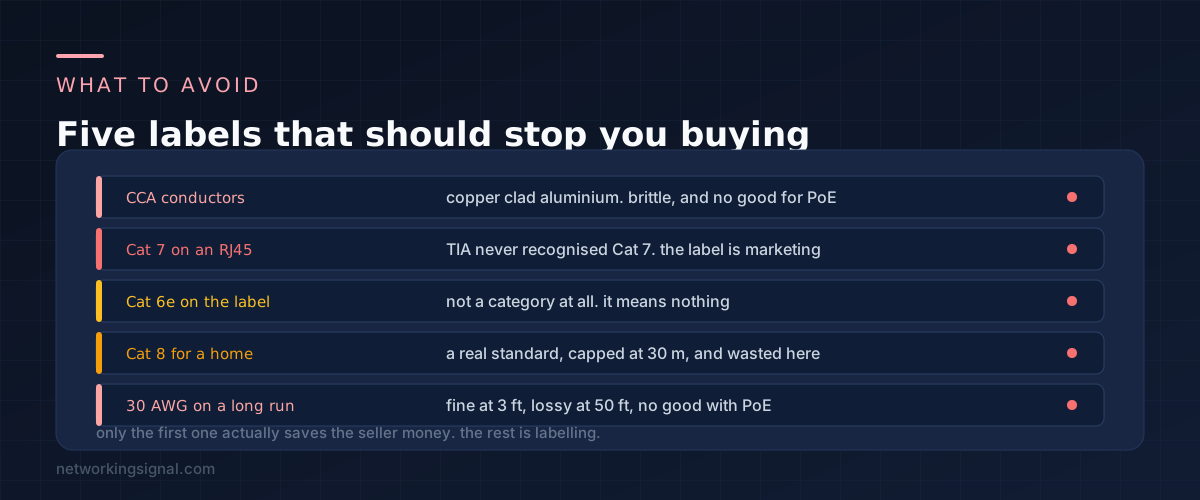
Copper clad aluminium. An aluminium core with a thin copper skin, sold as copper because the surface is. It has about 60% of copper’s conductivity, so it loses more signal over the same distance, and it is brittle enough to snap at the plug after a few months of being moved. It also cannot safely carry PoE. If a listing describes the conductor as “CCA”, or simply refuses to say what the conductor is, assume aluminium and move on.
Cat 7 printed on an RJ45 cable. Cat 7 exists as an ISO specification, but it was designed around GG45 and TERA connectors, and TIA never recognised it. A cable with ordinary RJ45 plugs on the ends cannot be Cat 7 in any meaningful sense, so the word on the jacket is decoration. Buy a Cat 6 or Cat 6a cable from a seller who states the gauge instead.
Cat 6e. No such category exists. TIA defines Cat 6 and Cat 6a. Anything labelled 6e is a Cat 6 cable with an extra letter, and while the cable underneath may be perfectly good, the label tells you the seller is willing to invent specifications.
Cat 8 at home. This one is real. TIA-568.2-D defines Cat 8 for 25 and 40 Gbps, and it works. It is also limited to 30 m by design, requires shielded terminations to perform, and needs 25 GbE equipment at both ends to do anything at all. On a home connection it is identical to Cat 6 and costs more.
Thin cable on a long run. Covered above and worth repeating, because the cheapest 50 and 100 ft cables on the market are all 30 AWG. The cable will probably work. It will also be the reason your link sits at 100 Mbps in two years when a plug gets slightly bent, and the fault will look like anything but the cable.
If you are cabling a house rather than a desk, none of this applies and you want solid core cable in bulk instead, which we cover in our guide to the best bulk Ethernet cables.
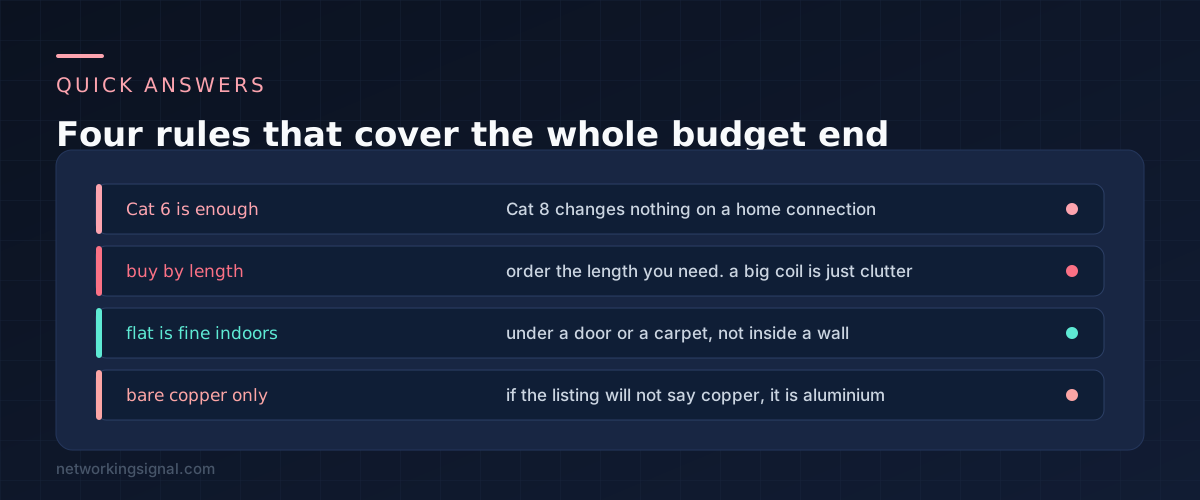
Over 3 ft, yes, and you could not measure the difference with lab equipment. Over 50 ft, no, because the expensive cable has thicker conductors and the cheap one is at its distance limit. Price tracks copper thickness and testing, and neither of those matters at short length.
Only if the current one is broken or the wrong category. A working Cat 5e cable already carries gigabit, which is faster than most home connections. If you are on a 300 Mbps plan, no cable on earth will make it quicker. Our guide to Cat 6 against Cat 6a, Cat 7 and Cat 8 covers where the categories actually differ.
Measure the route the cable will take rather than the straight line, then add about 20%. Buying much longer and coiling the slack is untidy and, with PoE in a bundle, adds heat for no reason. Buying too short is worse, so round up rather than down.
Not for the way most people use it. Flat cable is fine on a surface, under a carpet edge or through a doorway, which is exactly what it is for. It is not rated for inside a wall, and its geometry gives up some interference rejection that only matters at length. Under about 25 ft it behaves the same as round cable.
Use 24 AWG bare copper, and of the cables here that means the Cable Matters 5-pack. Thin conductors heat up carrying current, and a warm cable bundled with others in a confined space is the failure mode to avoid. Never use copper clad aluminium for PoE at any price.
Almost never. Shielding helps in industrial settings and in bundles running alongside mains cable, and it only works when both ends are properly grounded. A badly grounded shield makes things worse. Unshielded is the right default in a house.
Cable Matters 3 ft 5-pack at $9.99 is the one to buy if you want cable you will not think about again. It is the only 24 AWG option here, it is the only one honestly rated for PoE, and five short cables cover most of what a small setup needs.
If you only need one cable, Amazon Basics 3 ft at $5.15 does the job. If the run has to cross a room and be walked on, Folishine Flat 10 ft at $4.59 is the cheapest sensible answer. Whatever you pick, read the listing for the conductor: if it will not say bare copper, it is aluminium.
Disclosure: Networking Signal is a participant in the Amazon Services LLC Associates Program. We earn a commission on qualifying purchases made through links on this page, at no additional cost to you. Prices shown were accurate at the time of writing and change frequently at this end of the market. Distance figures cited follow TIA guidance for reduced-diameter patch cords; manufacturer ratings vary.
Hand-picked articles you might also find useful.
 Cables
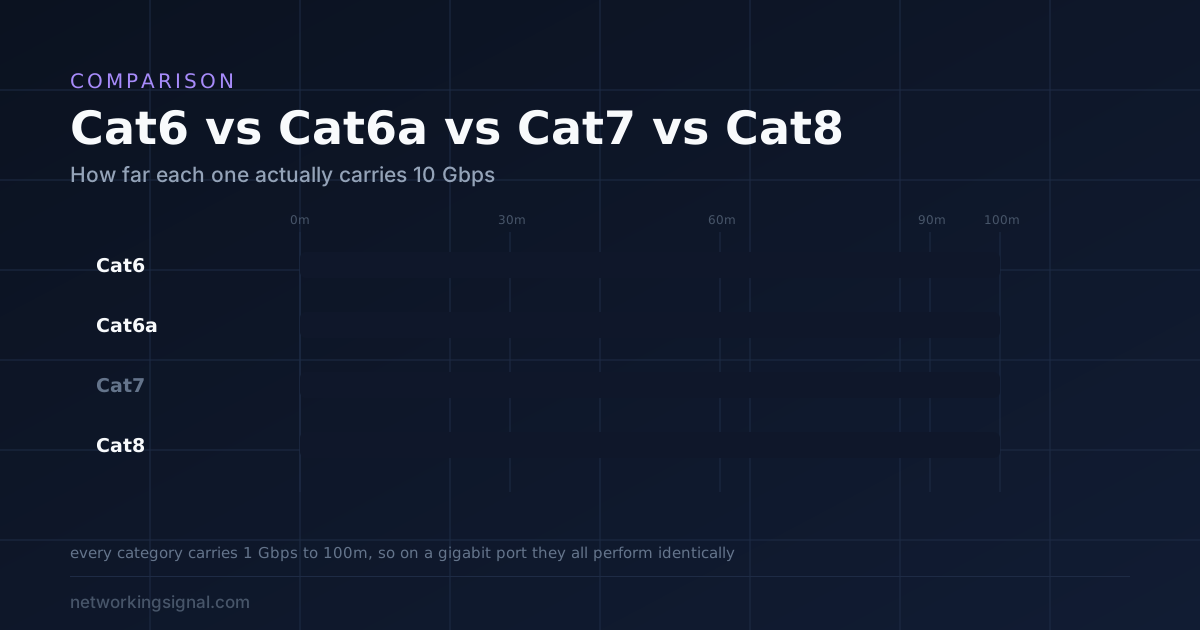
 Cat6, Cat6a, Cat7 or Cat8? Cat6 is right for almost every home and office. Cat7 is not a…
 Cables
 Fiber optic cable is a cutting-edge telecommunications medium that leverages the properties of optical fibers, typically made of…
 Cables
 When setting up a wired local area network , one of the most basic but important decisions is…