
8 Best Gaming Routers in 2026: Tested Picks for Low Ping
The best gaming routers in 2026, ranked on latency handling rather than headline speed. The ASUS RT-BE86U at…
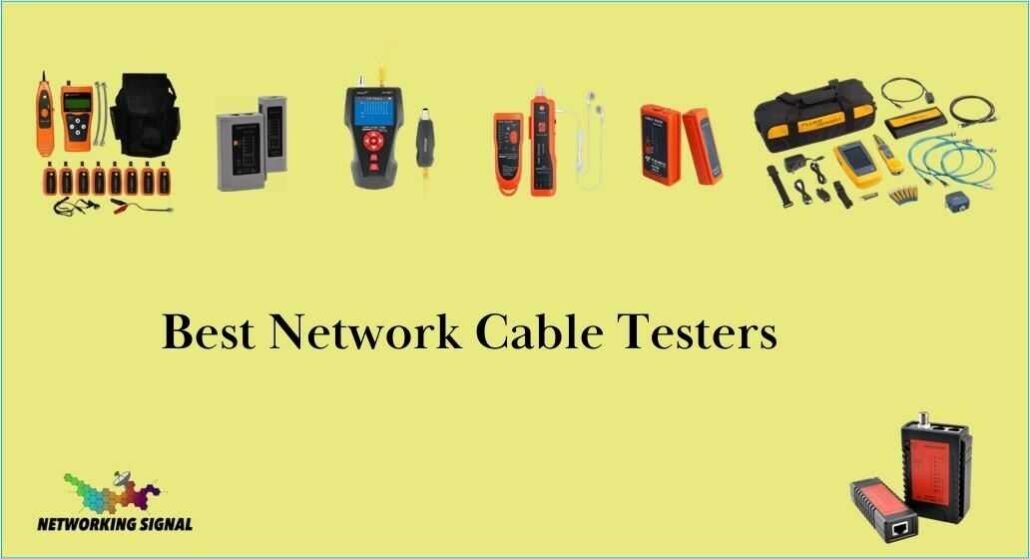
The Klein Tools VDV500-705 ($49.98) is the tester to buy for most people. It does pin to pin wire mapping and tone tracing, comes with alligator clips for unterminated wire, and Klein tools tend to still work in ten years.
On a budget, the KAIWEETS kit at $19.99 does the same job, has a three year warranty, and is the only tester here that ships with the two 9V batteries it needs. Every other unit on this page arrives dead until you buy a battery.
What none of these do is certify a cable. They confirm the eight conductors are connected in the right order and find opens, shorts and reversals. They cannot measure crosstalk, attenuation or return loss, which is what a certification tester does and why those start around $2,000. For home and small office work, wire mapping catches almost every fault people actually create.
| Product | Tester | Type | Tone range | Batteries | Price | |
|---|---|---|---|---|---|---|
 | Klein VDV500-705Best overall | Map plus tone | Analog | Standard | Not included | $49.98 |
 | KAIWEETS Tester KitBest value | Map plus tone | Analog | 300 m | Two included | $19.99 |
 | Klein VDV500-820 ProBest professional | Tone plus continuity | 5 cadences | 1,000 ft | Not included | $99.98 |
 | Cable Tracer 18 LEDBudget pick | Map plus tone | Digital signal | Standard | Not included | $17.98 |
 | iMBAPrice WH806RSimplest to use | Map plus tone | Analog | Standard | Not included | $18.99 |
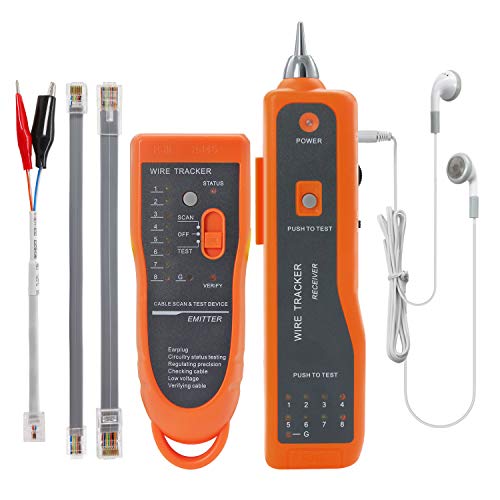 | BOOGIIO Wire TrackerBest for noisy sites | Map plus tone | Analog | Standard | Not included | $19.57 |
These tools get lumped together, but they answer different questions.
A wire map tester answers “is this cable wired correctly”. You put the main unit on one end and the remote on the other, and LEDs light in sequence one to eight. If they light in order, the cable is good. If one stays dark you have an open, if two light together you have a short, if the order jumps you have a crossed pair. This catches essentially every mistake made during termination.
A tone generator and probe answers “which cable is this”. You clip the toner onto one end and it injects an audible signal. You then sweep the probe along a bundle of cables and listen for the loudest tone. This is what you need standing at a patch panel with twelve unlabelled cables, or trying to find where a run emerges in a loft.
A certification tester answers “will this cable actually carry gigabit reliably”. It measures crosstalk, insertion loss, return loss and propagation delay against the TIA standard, and prints a pass or fail report. These are Fluke class instruments and start around $2,000. You do not need one to wire a house.
Every tester on this page does the first two. That combination is the right tool for home installations, small offices and troubleshooting, and it is why these kits bundle both functions.
The gap worth knowing about: a cable can pass a wire map test and still perform badly. If you untwisted the pairs too far at the termination, crosstalk rises and throughput drops, but continuity is perfect and the LEDs light in order. That is the one class of fault these tools cannot see, and the reason to keep your untwisted length short when terminating.
This deserves its own section because getting it wrong destroys the tool and can be genuinely dangerous.
Tone generators are designed for low voltage, non energised wiring, generally under 60V. Klein states this explicitly on both its units. Clip a toner onto a live mains circuit and you will destroy the tester, and depending on the fault path you may hurt yourself.
The confusion arises because several of these tools advertise tracing “electrical and speaker wires” with the alligator clip adapter. That is true, and the manufacturers are consistent about the condition: the wire must be powered off first. BOOGIIO and KAIWEETS both state it plainly in their listings.
Power over Ethernet is a separate case. PoE runs at 44 to 57V, which is under the 60V threshold, and several testers here explicitly support checking wire order on a live PoE line. The orange Cable Tracer states PoE support below 60V directly. If you are working on cabling that feeds cameras or access points, check for that support rather than assuming it, and where you can, switch the PoE port off first anyway.
One more practical rule: tone tracing works best when the wire is separated from others and properly grounded. Klein notes this in its instructions, and it explains why tracing sometimes seems to pick up three cables at once. The signal couples capacitively into neighbouring conductors in a tight bundle. Separating the target cable a few inches from its neighbours near the probe makes identification much cleaner.
Klein makes tools for electricians who use them every day, and that shows in the parts of this kit that cheaper testers get wrong.
The alligator clips are the practical difference. Most budget testers assume every cable has an RJ45 plug on it. During an installation that is exactly what is not true: you are working with bare cable pulled through a wall, unterminated at one or both ends, trying to work out which run is which before you commit to punching it down. Alligator clips let you tone an unterminated conductor directly.
The toner and probe together perform a pin to pin wire map, so this is not just a tracer. You get both functions that matter in one kit, with an RJ45 to RJ45 test cable included.
The probe tip carries a work light. That sounds like a gimmick until you are in a loft or under a floor with a torch in your teeth. Cable tracing happens in dark places by definition, because if you could see the cable you would not need to trace it.
It handles RJ45, RJ11 and RJ12 alongside speaker, coax and video cable, so it covers the low voltage work that surrounds a network installation.
The batteries are not included, which is near universal here and still irritating at $50.
Buy this if you are installing cable, not just testing finished leads, and want a tool that lasts.
Twenty dollars for a complete tone and probe kit with wire mapping is good value on its own. Two details make it the best value here.
First, the batteries are included. Both of them. Every other tester on this page arrives as a dead box until you find a 9V battery, and if you ordered it on a Friday for a weekend job that is genuinely annoying. KAIWEETS is the only manufacturer here that packs them.
Second, a three year warranty, which is triple what most sellers in this category offer and considerably more than the one year on the budget alternatives.
The functional set is complete: pin to pin mapping with LED sequence display, detection of opens, shorts, miswiring and reversals, testing over runs up to 300 metres, and telephone line testing that identifies idle, ringing and busy states plus TIP and RING identification.
The receiver has a volume control knob and an LED flashlight. Adjustable volume matters more than it sounds: with the gain too high, every cable in a bundle sounds equally loud and you cannot pick the target. Turning it down until only the closest cable registers is the actual technique for tracing in a dense bundle.
The kit includes the transmitter, receiver with BNC interface, RJ11 alligator clip adapter and RJ45 cable.
Buy this if you want a complete working kit out of the box without a separate battery run.
This is the tool for commercial work, and the three features that justify doubling the price all address problems you only meet at scale.
Five distinct tone cadences. On a large site you often need to trace several cables at once, or hand one end to a colleague. Different cadences let you put a distinct tone on each cable and identify them individually, instead of running back and forth re toning one at a time. On a big job this changes how long the work takes.
Signal transmission over 1,000 feet. Beyond the 100 metre Ethernet limit, which matters when tracing runs that pass through risers, between floors, or across a building where the cable path is far longer than the electrical distance.
Angled Bed of Nails clips. The ABN clip has a row of sharp points that bite through insulation and grip firmly, rather than the simple alligator jaw on cheaper units. On stiff solid conductor cable in an awkward position, a clip that stays put while you walk away is worth real money.
The Probe Pro adds a 3.5 mm headphone jack. In a plant room, a data centre or a building site, ambient noise swamps a small speaker. Headphones are not a luxury there. They are not included.
The toner also tests continuity and polarity with labelled LEDs, so it covers basic verification alongside tracing.
For a home installation this is more tool than the job requires. For someone doing this professionally, it is the one that pays for itself.
Buy this if you trace cable for a living, on sites where several runs need identifying at once.
The cheapest tester here has two capabilities the more expensive units lack, which makes it more interesting than its price suggests.
It uses a digital signal rather than an analog tone for tracing. The practical benefit is finding shielded cable, which analog toners struggle with because the shield absorbs the signal. This unit includes a dedicated G indicator light for shield testing, so it verifies the shield as well as the eight conductors. If you have run shielded cable, most testers simply ignore the screen.
It also explicitly supports PoE below 60V for checking wire sequence on a live line. That is genuinely useful when a camera has stopped responding and you want to check the cabling without pulling the PoE port down and rebooting everything on that switch.
The 18 line sequence indicator lights give more granular fault display than the eight or nine LEDs on simpler units, showing opens, shorts, missing wires and reversals distinctly rather than making you interpret a partial sequence.
An earphone is included, which the Klein VDV500-820 does not include at five times the price.
The warranty is one year against KAIWEETS’s three, and batteries are not included. But for under $18 with shield testing and PoE support, the specification is hard to fault.
Buy this if you work with shielded cable or live PoE runs and want the lowest price.
The WH806R is the least complicated tool here, and for someone who will use a tester a few times a year that is a genuine advantage.
The feature that makes tracing work is adjustable sensitivity. Beginners assume more sensitivity is better and turn it up, which makes every cable in a bundle register. The correct technique is the opposite: start high to find the general area, then reduce sensitivity until only the target cable still sounds. A tool with a clear sensitivity control teaches you that quickly.
It covers cable tracing, tone generation, continuity testing and fault detection, across RJ45, RJ11, Cat5, Cat5e, Cat6, UTP and STP.
Tone tracing follows cable through walls, ceilings, wiring closets, patch panels and cabinets without damaging insulation, and the wire map function diagnoses opens, shorts, crossed pairs and miswires.
A probe and earphone are included.
What you do not get is anything unusual: no digital signal, no shield test light, no PoE rating, no long range mode. It does the two core jobs competently and stops there. If your work is home network troubleshooting and occasional patch cable checking, that is the right amount of tool.
Buy this for occasional home troubleshooting where a simple, clear tool beats a featured one.
BOOGIIO packs the accessories that make field work practical, and includes a storage box, which sounds trivial and is not.
A tone and probe kit is several loose pieces: transmitter, receiver, two adapter cables, earphones. Kept loose in a toolbag they separate, and the adapter you need is always the one that is missing. A moulded box keeps the set together, and it is the reason this kit is still complete a year later when the others have lost a lead.
The combination of earphones and a volume rotary knob is the right one for noisy environments. Earphones exclude ambient noise, and the knob lets you reduce gain until only the target cable registers. Together they are what makes tracing possible next to plant machinery or on a building site.
It also does something the others do not: battery polarity measurement from 10V to 110V. That is useful in mixed low voltage work, checking DC supplies for cameras, door entry systems and alarm panels alongside the network cabling.
Standard wire mapping covers opens, shorts, miswires and reversals, plus telephone line status and TIP or RING identification.
Two cautions from the listing worth repeating: the receiver has an RJ45 port but no RJ11 port, so telephone work goes through the transmitter, and it requires a 9V alkaline or rechargeable battery installed with correct polarity, because reversing it leaves the unit apparently dead.
Buy this if you work in loud environments or across mixed low voltage systems.
Start with sensitivity high, then reduce it. Sweep the probe over the bundle at high gain to find roughly where the signal is. Then turn the gain down and sweep again. Repeat until only one cable still sounds. Trying to identify a cable at maximum sensitivity is the most common reason people give up on tone tracing.
Separate the target from the bundle where you can. Tone couples into neighbouring conductors through capacitance, so tightly bundled cables all carry a faint version of the signal. Pulling a few inches of slack away from the bundle near the probe gives a far clearer result.
Ground the far end if tracing is weak. Klein specifically recommends proper grounding for accurate detection. Clipping the toner’s second lead to a ground point completes a circuit and strengthens the signal considerably compared with leaving it floating.
Check the battery first when something behaves oddly. Nearly every listing here mentions it, because a weak 9V battery produces a faint tone that is easy to mistake for a wiring fault. If the sound is unexpectedly quiet, replace the battery before diagnosing the cable.
Test as you install, not afterwards. Finding a miswired jack while the ladder is still up and the tools are out takes two minutes. Finding it after the wall plate is screwed on and the loft hatch is closed takes an afternoon. Our guides to crimping Ethernet cable and wiring a patch panel cover the terminations these tools verify.
A tester confirms the eight conductors are connected in the right order and finds opens, shorts and reversals. A certifier measures crosstalk, insertion loss, return loss and propagation delay against the TIA standard and issues a pass or fail report. Certifiers start around $2,000. For home and small office work a tester catches almost every fault people create.
It can tell you a break exists and which conductor is affected, and a tone tracer can help you follow the cable to roughly where the signal stops. It cannot give you an exact distance to the fault. That requires a TDR function, found on higher end testers. For most faults, knowing which run is broken is enough to justify replacing it.
A wire map tester is enough if your cables are labelled and you only need to verify terminations. You need a tone generator the moment you are faced with unlabelled cables at a patch panel, or need to find where a run emerges. Most kits include both, so the decision rarely arises.
Only with a tester rated for it. PoE runs at 44 to 57V, under the 60V limit these tools specify, and some units explicitly support checking wire order on a live PoE line. Check the rating rather than assuming, and where practical switch the PoE port off first. Never connect a tone generator to mains wiring at any voltage.
The signal couples capacitively into neighbouring conductors in a tight bundle. Reduce the probe sensitivity until only the loudest cable registers, and physically separate the target cable a few inches from the bundle near the probe. Grounding the far end of the cable also sharpens the signal considerably.
Almost none of them. Every tester on this page except the KAIWEETS requires a 9V battery that is not supplied, which is stated in each listing and still catches people out. Order batteries with the tester, and use alkaline or rechargeable rather than carbon zinc, since a weak battery produces a faint tone that mimics a wiring fault.
For most people the KAIWEETS kit at $19.99 is the sensible buy. It maps wires, traces cables to 300 metres, carries a three year warranty, and is the only tester here that arrives ready to use with both batteries in the box.
Step up to the Klein VDV500-705 at $49.98 if you are installing cable rather than testing finished leads, because the alligator clips let you tone unterminated conductors and the probe work light matters in the dark places tracing actually happens. And if you work with shielded cable or live PoE runs, the 18 LED Cable Tracer at $17.98 does both of those things that testers three times its price do not.
Disclosure: Networking Signal is a participant in the Amazon Services LLC Associates Program. We earn a commission on qualifying purchases made through links on this page, at no additional cost to you. Prices shown were accurate at the time of writing and may change. Tone generators are for low voltage, non energised wiring only. Never connect one to mains circuits.
Choose the tester by the fault you need to solve. For a newly crimped patch cable or wall run, a wire-map tester is the essential function: it identifies opens, shorts, reversed conductors and split pairs. For an unlabelled bundle or a cable hidden in a wall, add a tone generator and probe. Neither replaces a certification tester when a contractor, client or warranty requires a documented Cat5e/Cat6/Cat6A link test.
A basic cable tester cannot measure real Ethernet throughput. It detects wiring faults; use a certification tester or an end-to-end network test when you need performance evidence.
Use a cable tester to check whether a known cable is wired correctly. Use a tracer to identify which unknown cable in a bundle belongs to a room, jack or patch-panel port. Many practical kits include both.
Next steps: learn how to crimp an Ethernet cable, compare RJ45 crimpers, or review our guide to network and fiber cable testing.
Hand-picked articles you might also find useful.
 Networking Gears
 The best gaming routers in 2026, ranked on latency handling rather than headline speed. The ASUS RT-BE86U at…
 Cables
 The best fiber optic cleaning kits in 2026. The D YEDEMC kit at $60 covers both cleaning types,…
 Networking Gears
 Compare the best stackable switches for SMB networks, including 10GbE, PoE, stack size and when cloud-managed switches are…